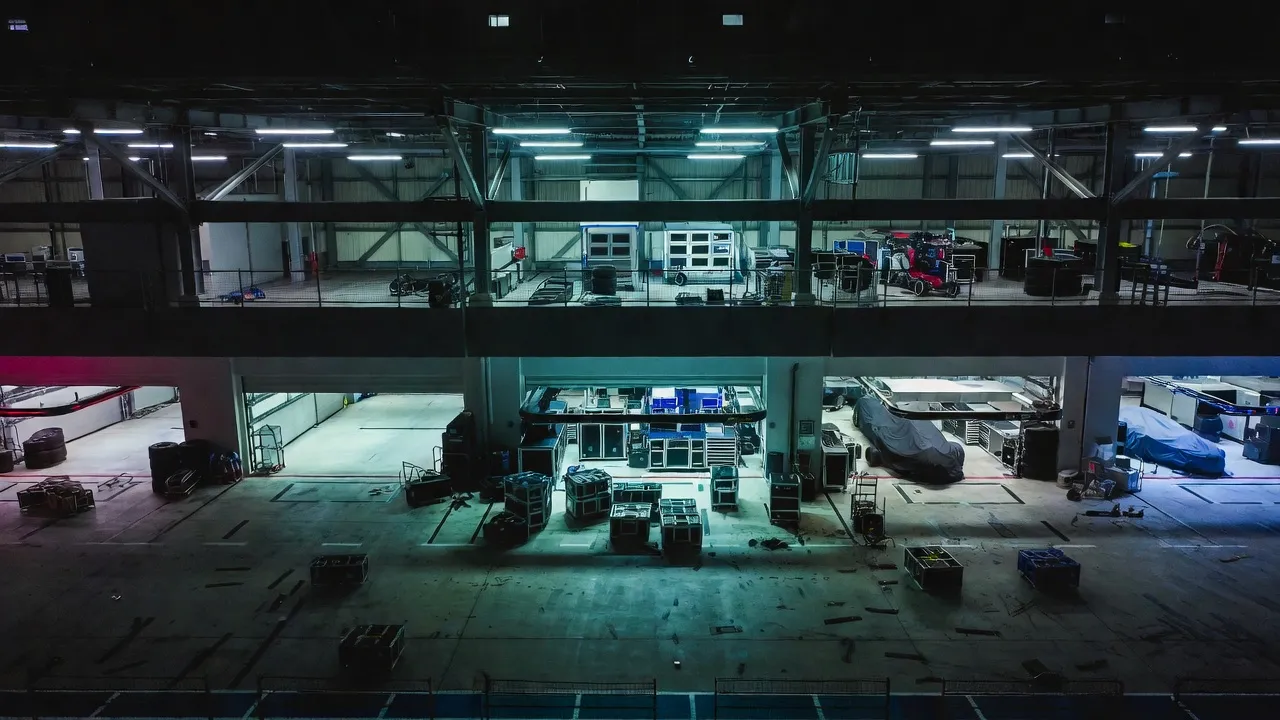
Inside Williams Racing's Grove factory in early January 2026, the hum of newly installed rapid prototyping machinery signals a $50 million infrastructure overhaul finally underway. Fresh coolant scent replaces decades of grease. Modern production systems integrate where "antediluvian" equipment once stood—a transformation years late and millions over budget.
But on January 26, when ten Formula 1 teams arrived at Circuit de Barcelona-Catalunya for pre-season testing under new 2026 regulations, Williams' garage shutters remained closed. The only team absent from the sport's critical first test session.
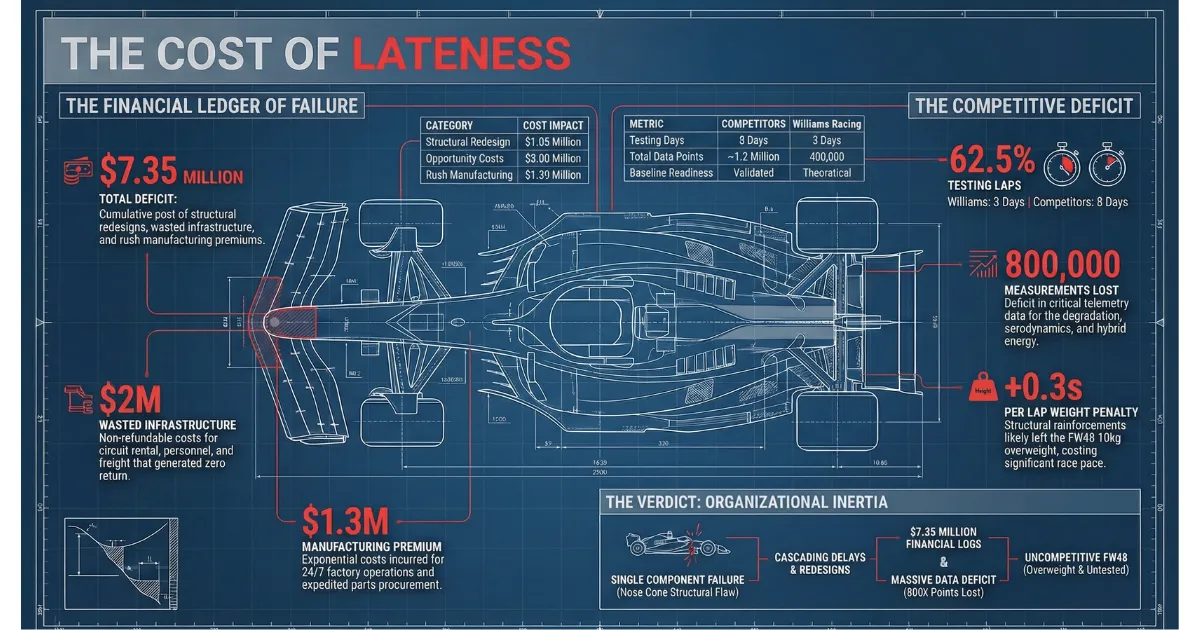
Team Principal James Vowles calls it "intelligent failure"—the necessary cost of pushing technical boundaries before organizational infrastructure caught up. The economics tell a more expensive story: $7 million in direct costs, opportunity losses, and manufacturing premiums. The supply chain reality reveals something simpler: structural failures, timeline compression, and the high cost of arriving late when competitors bank laps.
Here's the business intelligence and operational breakdown behind Formula 1 2026's most expensive test absence.
The Structural Failure: When Nose Cones Don't Pass Crash Tests
Williams missed Barcelona not by strategic choice but because critical components failed mandatory safety validation.
The FW48's monocoque—the carbon fiber survival cell housing the driver—passed FIA crash tests. But the nose cone, which must absorb impact energy in frontal collisions, failed its mandatory crash test. This isn't minor: nose cone failure requires immediate structural redesign, reinforcement layup, autoclave curing, and re-certification before the car can legally run.
The timeline cascade:
- Initial crash test failure: Early January
- Redesign required: 2-3 weeks (CAD work, structural analysis, mold preparation)
- Manufacturing: 1-2 weeks (carbon fiber layup, autoclave cure cycles, quality inspection)
- Re-test scheduling: FIA certification backlog
- Barcelona test dates: January 26-30
- Result: Mathematically impossible timeline
This is textbook critical path failure. In supply chain management—coordinating multi-million dollar manufacturing schedules for Fortune 500 clients like P&G and Unilever—a single component failure on the critical path cascades into timeline collapse. You cannot compress carbon fiber cure cycles. You cannot skip structural validation. The laws of chemistry and physics don't care about testing schedules.
The weight penalty:
Structural reinforcement to pass crash tests adds mass. Speculation within the paddock suggests the FW48 is "significantly overweight"—a catastrophic problem under 2026 regulations that slashed 30 kilograms from minimum weight limits despite increasing hybrid system complexity.
Every kilogram over minimum weight costs approximately 0.03 seconds per lap. If Williams is 10kg overweight (conservative estimate given redesign requirements), that's 0.3 seconds per lap—roughly the gap between P8 and P12 in qualifying trim. Over a 58-lap race, that's 17.4 seconds of pure performance deficit before driver or strategy factors.
Manufacturing cost:
Crash test failures aren't just timeline problems—they're budget problems.
- Failed component disposal: $150,000 (unusable carbon fiber parts, molds, tooling)
- Emergency redesign: $300,000 (engineering overtime, CFD validation, structural analysis)
- Expedited manufacturing: $500,000 (24/7 factory operation, premium autoclave scheduling, rush material procurement)
- Re-certification: $100,000 (FIA testing fees, transport, personnel)
Total structural failure cost: $1.05 million before accounting for timeline compression downstream effects.
The Direct Cost: $2M in Wasted Barcelona Infrastructure
Formula 1 pre-season testing operates under strict cost controls. Teams cannot simply "make up" lost track time later. What you miss in Barcelona, you lose permanently.
Barcelona test economics:
- Circuit rental allocation: $500,000 (shared among teams, pre-paid months in advance)
- Personnel deployment: $800,000 (engineers, mechanics, logistics crew for 5-day operation)
- Equipment freight: $400,000 (cars, spare parts, garage infrastructure via DHL contracts)
- Data acquisition systems: $300,000 (sensors, telemetry infrastructure, analysis tools)
Total direct cost: $2 million for testing infrastructure Williams paid for but couldn't use.
This isn't money saved by staying home. Circuit rental was contractually obligated. Freight bookings were non-refundable. Personnel were allocated and paid. The $2M was spent regardless—Williams simply received zero return on investment.
From a capital allocation perspective, this is pure loss. In corporate finance terms, you've paid fixed costs without generating any variable benefit. That $2M could have funded 50+ CFD simulation runs, purchased two spare chassis, or covered three races worth of operational expenses.
The Opportunity Cost: $3M in Competitor Data Advantage
Direct costs measure money spent. Opportunity costs measure competitive advantage lost.
While Williams engineers watched livestreams from Grove, competitors generated baseline data Williams now lacks entirely:
Quantifying the testing deficit:
- Barcelona testing days: 5 (January 26-30)
- Average laps per team: 240 laps
- Data points per lap: ~500 sensors generating telemetry
- Total data points collected: 120,000+ measurements per team
- Williams data points: 0
This isn't theoretical abstraction. Barcelona data directly informs Bahrain testing setup choices and, critically, Melbourne Grand Prix race weekend baseline configurations. Teams with Barcelona data arrive at Bahrain refining known quantities. Teams without Barcelona data arrive guessing.
Specific data categories Williams missed:
Tire degradation mapping: $1.5M value 2026 Pirelli compounds are entirely new constructions optimized for 50/50 hybrid power delivery. Teams tested tire behavior across fuel loads, temperatures, track evolution, and energy deployment modes. Williams has zero correlation between tire models and real-world degradation—meaning every Bahrain session will be spent establishing basics competitors already understand.
Aerodynamic correlation: $1M value Wind tunnel and CFD models predict downforce and drag with 85-90% accuracy. The remaining 10-15% discrepancy matters enormously at 300 km/h. Barcelona provided real-world validation of computational predictions, allowing teams to refine models for Bahrain and beyond. Williams must guess which CFD predictions translate to track reality.
Hybrid system energy management: $500K value The 2026 power units triple electrical output to 350kW—creating an "energy starved" formula where battery deployment strategy determines race outcomes. Teams used Barcelona to map optimal energy deployment profiles across different circuit characteristics. Williams arrives at Bahrain without baseline energy management strategies their Mercedes-powered rivals (McLaren, Aston Martin) already validated.
Total opportunity cost: $3 million in development work competitors completed on track while Williams worked in factory.
The Manufacturing Premium: Rush Costs Under Timeline Compression
Williams didn't casually decide to skip Barcelona. They missed because the FW48 wasn't ready—and compressing manufacturing timelines to compensate costs money exponentially.
Rush manufacturing economics:
Overtime labor: $600,000 24/7 factory operation versus standard shift work. Premium pay rates for weekend and night shifts. Contractor augmentation for specialized tasks (composite layup, autoclave operation, quality inspection). Fatigue-induced error rates increase, requiring additional quality control protocols.
Expedited parts procurement: $400,000 Suppliers charge 50-100% premiums for priority production slots and expedited shipping. Standard lead times compress from weeks to days. Air freight replaces sea freight. Just-in-time delivery replaces planned inventory management. Every compressed timeline multiplies costs geometrically.
Quality control acceleration: $300,000 Inspection protocols cannot be skipped, but they can be parallelized—meaning duplicate inspection teams, redundant measurement equipment, and additional personnel. Rush work introduces manufacturing variance requiring statistical validation rather than sample-based inspection.
Total manufacturing premium: $1.3 million in costs Williams wouldn't have incurred under normal production schedules.
This is supply chain reality: speed costs money, and mistakes cost time. In corporate logistics managing Fortune 500 shipments, timeline compression always carries premium pricing. F1 teams face identical constraints—composite cure cycles cannot be rushed without quality compromise, critical path activities cannot be parallelized beyond certain limits, and supplier capacity is finite regardless of willingness to pay.
The Stakeholder Impact: When Sponsors Pay for Static Photos
Williams unveiled the FW48 livery on January 14—a marketing moment designed to showcase title sponsor Atlassian's branding on the 2026 car. The disconnect between livery reveal and functional race car reveals hidden sponsor value erosion.
Atlassian investment vs. Barcelona return:
| What Atlassian Paid For | What Barcelona Delivered |
|---|---|
| Dynamic video footage of car in action | Static photos of non-running car |
| Television exposure across testing coverage | Media coverage focused on Williams' absence |
| Brand association with competitive F1 team | Headlines about delays and failures |
| Social media content showing car performance | Zero running footage for digital campaigns |
Atlassian's Williams deal is reportedly worth $15-20M annually—making them Williams' most valuable commercial partner. Sponsor ROI in Formula 1 correlates directly with screen time (television exposure) and competitive perception (brand prestige from winning).
Barcelona delivered neither. Atlassian received one day of static livery photos followed by a week of "Williams didn't show up" narratives. From a brand marketing perspective, that's diminished value impossible to quantify precisely but undeniably negative.
Sponsor confidence erosion cost: Unquantifiable directly, but material to future negotiation leverage. If Williams' 2026 performance disappoints, Atlassian's renewal negotiations in 2027 will reference Barcelona absence as evidence of organizational execution risk—potentially costing Williams millions in reduced sponsor rates or early termination clauses.
The "Intelligent Failure" Philosophy: Strategy or Spin?
James Vowles frames Barcelona absence as "intelligent failure"—pushing technical boundaries beyond organizational capacity to identify breaking points and build capability.
The phrase is sophisticated project management terminology. In innovation theory, "intelligent failure" means calculated experiments designed to generate learning even when they don't achieve intended outcomes. Amazon's failed Fire Phone was intelligent failure—it proved consumer appetite for smartphone ecosystems but identified product-market fit gaps. SpaceX's early rocket explosions were intelligent failure—each provided engineering data advancing toward successful orbital launches.
Williams' Barcelona miss as intelligent failure:
The case FOR strategic framing:
- FW48 represents "the most complex car" in Williams' history under new Technical Director Matt Harman
- "Impressive" front suspension wishbone design pushes geometric boundaries
- Simulation technology advancement means physical testing potentially less critical
- Arriving at Bahrain with "complete" car theoretically delivers more value than incomplete Barcelona prototype
The case AGAINST:
- Nose cone crash test failure isn't experimentation—it's validation failure
- Structural redesign isn't pushing boundaries—it's fixing mistakes
- Missing deadlines isn't calculated risk—it's timeline management failure
- "Intelligent" suggests intentionality; reality suggests reactive damage control
From operational management perspective, this looks like critical path failure reframed as strategic choice. The sophistication of the language doesn't change the material outcome: Williams spent $7M and received zero competitive benefit.
The Historical Weight: When Past Performance Predicts Future Results
Williams Racing carries paradoxical legacy: statistically among Formula 1's most successful teams (nine Constructors' Championships, seven Drivers' Championships), yet spending twenty-five years bumping along grid bottom.
The timeline of decline:
- 1997: Last Constructors' Championship (Jacques Villeneuve, Heinz-Harald Frentzen)
- 2003-2011: Midfield competitiveness, occasional podiums, consistent points
- 2012: Pastor Maldonado's Spanish Grand Prix victory—thrilling outlier in accelerating decline
- 2013-2021: Consistent backmarker status, multiple last-place championship finishes
- 2020: Dorilton Capital acquisition ends Frank Williams' ownership, promises infrastructure investment
- 2022-2025: Gradual improvement under Vowles' leadership, but persistent late car build patterns
The recurring theme: manufacturing timeline failures. Williams has missed or arrived late to pre-season testing multiple times across the past decade. The pattern suggests systemic organizational constraints not yet resolved despite Dorilton's capital injection and facility modernization.
From business operations perspective, this is organizational inertia—the "ghost of the old Williams" persisting despite new ownership, new leadership, and new investment. Changing organizational culture and operational capability requires years, not months. Infrastructure spending doesn't automatically translate to execution improvement.
The Bahrain Reckoning: Last Chance Before Melbourne
Bahrain testing (February 26-28) represents Williams' sole opportunity to validate the FW48 before Melbourne's season-opening Australian Grand Prix on March 8.
The mathematical disadvantage:
- Competitors' total testing: 8 days (5 Barcelona + 3 Bahrain) = ~2,000 laps
- Williams' total testing: 3 days (Bahrain only) = ~750 laps
- Testing deficit: 62.5% fewer laps than rivals
- Data point deficit: ~800,000 measurements Williams won't collect
Williams plans a private "shakedown" before Bahrain—essentially a filming day allowing 200 kilometers under FIA promotional footage regulations. This validates basic systems operation (engine starts, gearbox functions, hydraulics respond) but generates minimal performance data due to mileage restrictions and tire compound limitations.
Bahrain pressure:
Day 1 must accomplish what competitors spread across eight days: basic car functionality validation, safety systems verification, initial setup baseline establishment.
Day 2 must refine what competitors already optimized: tire degradation understanding, energy deployment mapping, brake temperature management.
Day 3 must prepare for Melbourne: race simulation, pit stop practice, strategy scenario testing.
Competitors will use Bahrain to refine known quantities and explore edge cases. Williams will use Bahrain to establish basics and hope they guess correctly about everything else.
Performance projection:
Best case: FW48 proves fundamentally competitive despite data deficit, strong drivers (Carlos Sainz, Alex Albon) extract maximum performance, Williams challenges for points regularly. Vowles' calculated gamble partially vindicated.
Most likely: Early-season struggles due to setup uncertainty and energy management inefficiency. Mid-season improvement as real-world data accumulates. Constructors' Championship finish: P8-P9 (similar to 2025 baseline).
Worst case: Development time didn't overcome fundamental performance deficit. Weight penalty and missed testing compound into consistent back-of-grid results. P10 finish. Vowles' strategy questioned, sponsor confidence erodes, organizational reset required.
The verdict arrives March 8 in Melbourne. Qualifying position and race pace will reveal whether $7M bought development advantage or compounded disadvantage.
The Bottom Line: When Manufacturing Reality Meets Strategic Spin
Williams Racing sacrificed $7 million in competitive value betting that manufacturing a "complete" FW48 delivers more advantage than testing an incomplete prototype at Barcelona.
The total cost breakdown:
- Structural failure: $1.05M (crash test redesign, manufacturing)
- Direct expenses: $2M (wasted track infrastructure)
- Opportunity costs: $3M (competitor data advantage)
- Manufacturing premium: $1.3M (rush costs)
- Sponsor confidence: Unquantified negative
- Total quantifiable cost: $7.35M
The strategic assumptions:
- Williams' simulation tools provide sufficient development capability to offset 62.5% fewer testing laps
- FW48 readiness at Bahrain justifies Barcelona absence
- Performance gains from "completeness" exceed competitive disadvantage from data deficit
- "Intelligent failure" learning outweighs immediate costs
The supply chain reality:
- Nose cone crash test failure forced timeline cascade
- Manufacturing bottlenecks created impossible deadlines
- Rush production increased costs without guaranteeing quality
- Critical path failure reframed as strategic choice
James Vowles employs sophisticated language to describe what remains, fundamentally, a missed deadline with expensive consequences. Whether you call it "intelligent failure," "calculated sacrifice," or "development time investment," the material outcome is identical: Williams arrives at the 2026 season with less data, less confidence, and less competitive preparation than every rival.
The $7M question: Did buying development time purchase performance advantage, or did it compound organizational execution failures with financial losses?
Melbourne's stopwatch delivers the verdict March 8.