In the high-stakes derivatives market of Formula 1, stability is usually a bullish signal. However, the unveiling of the McLaren MCL40 in Sakhir presents a complex paradox. Beneath the reassuring continuity of the papaya-and-anthracite livery lies a precarious strategic gamble: defending a World Championship title as a customer team amid a comprehensive regulatory reset.
While the marketing narrative from Woking focuses on brand equity and the "honor" of Lando Norris carrying the number '1', the underlying data from the Barcelona shakedown suggests a looming liquidity crisis—not in cash, but in data. The 2026 era is not merely an aerodynamic evolution; it is a powertrain revolution. In this landscape, McLaren's status as an "independent challenger" is no longer a romantic underdog story. It is a supply chain vulnerability.
The Operational Cost of the "Mercedes Rathole"
The most critical takeaway from the pre-season activities isn't the aesthetic continuity; it is the structural deficit inherent in the customer-supplier relationship. Team Principal Andrea Stella's admission of McLaren’s independent status highlights a tactical tether that could strangle development velocity.
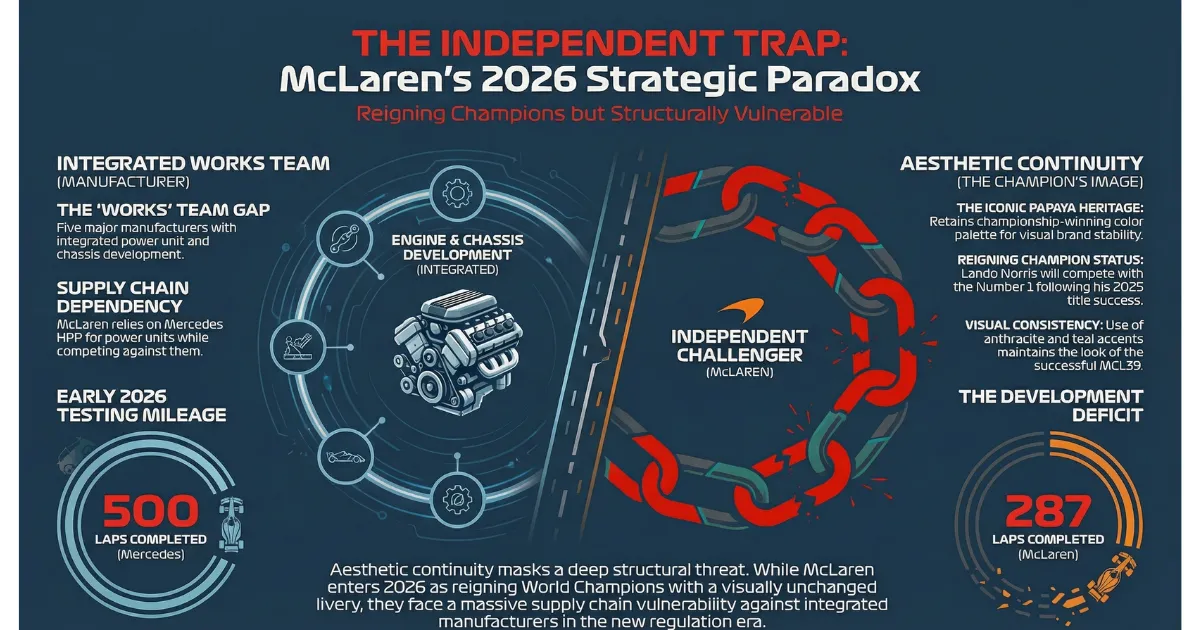
In the 2026 regulations, the Power Unit (PU) and chassis must be developed in total synergy. Teams at companies like Mercedes-AMG, Ferrari, and the nascent Audi project design their cooling architectures and energy recovery systems to complement their aerodynamic philosophies. McLaren, conversely, faces the "Mercedes rathole." They must accept a PU package optimized for the Mercedes W17 chassis and shoehorn it into the MCL40.
Comparative Analysis: Works vs. Independent Integration
The economic disparity between owning your IP and leasing it becomes stark when analyzing the integration workflows:
| Feature | Works Team (Mercedes, Ferrari, Red Bull) | Independent Challenger (McLaren) |
|---|---|---|
| PU Source | In-house R&D and manufacturing | External supply lease (Mercedes HPP) |
| Integration | Total chassis-engine synergy from Day 1 | Integration of a pre-defined package |
| Cooling | Custom-fit for factory aero map | Must adapt to manufacturer's architecture |
| Data Flow | Immediate, 100% transparency | Dependent on supplier mileage and relay |
| Strategic Autonomy | Control over development curve | Subject to supplier’s upgrade timeline |
The Data Deficit: A Supply Chain Warning
The Barcelona shakedown provided the first tangible metrics of this disadvantage. While the Mercedes factory outfit accumulated 500 laps of data to verify their cooling parameters and energy deployment strategies, McLaren managed only 287 laps. This 213-lap deficit is significant.
In the era of cost caps and limited wind tunnel time, real-world mileage is the most valuable currency. Mercedes enters the official Bahrain tests (Feb 11-13) with a validated baseline. McLaren enters with a question mark over its reliability. The 0.25s gap to Lewis Hamilton observed in Barcelona may be manageable on a single lap, but the lack of long-run data suggests McLaren is blind to the new PU's thermal degradation characteristics over a race distance.
Historical Economics: The "Reset" Risk
Financial history in F1 teaches us that regulatory revolutions favor vertical integration. The shift in 2014 saw the collapse of Red Bull-Renault's customer dominance in the face of Mercedes' fully integrated turbo-hybrid project. Conversely, McLaren’s own success in 1998 was built on a chassis regulation change (narrow track/grooved tires), not a fundamental engine overhaul.
The anomaly often cited is Brawn GP in 2009. However, that was a unique case of a team utilizing hundreds of millions in Honda’s pre-exit R&D investment. Today, McLaren faces five fully funded manufacturers, including the disruptive entry of Audi and the looming corporate might of GM-backed Cadillac. The "independent" business model is being squeezed by industrial giants.
The Driver Equity: Managing the #1 Asset
The psychological overhead on Lando Norris cannot be discounted. Carrying the #1 plate brings immense commercial pressure, but his sober assessment of "battery management" as the primary challenge indicates a shift in driver workload. The 2026 cars will require drivers to be energy managers first and racers second.
Oscar Piastri’s focus on "diagnostic feedback" over raw pace confirms the team's internal anxiety. They are in a data-gathering phase while their rivals are likely moving to performance optimization. If the active aero systems—specifically the front wing logic—do not provide the expected loophole to offset the engine integration compromise, the MCL40’s papaya livery will serve only as a reminder of past glory, rather than a beacon of future intent.
Conclusion: The Bahrain Solvency Test
The upcoming tests in Bahrain are not merely about scrubbing tires; they are a solvency test for McLaren's operational model. If they cannot close the mileage gap to Mercedes HPP, they will arrive in Melbourne with an asset—the MCL40—that they do not fully understand.
In the business of Formula 1, pace is vanity, but reliability is sanity. McLaren has bet on visual stability to mask a period of extreme technical volatility. It is a high-risk leverage play. If the "Mercedes rathole" proves too deep, the independent champion may find that in 2026, the price of independence is simply too high.