In the high-stakes theatre of Formula 1, the distance between corporate ambition and engineering reality is often measured in microns. Yet, as the AMR26 made its debut under the sodium glare of Saudi Arabian spotlights, the gap was measured in months. To the casual observer, the "matte satin" finish of the new Aston Martin challenger projected the confidence of a team ascending to full "works" status. To the trained eye of the paddock analyst, however, the glossy presentation in Jeddah was a sophisticated hedge against a far starker reality witnessed days earlier in Barcelona.
At Paddock Intel, we analyze the intersection of capital expenditure, operational efficiency, and technical regulation. The narrative surrounding the AMR26 is not merely one of aerodynamics; it is a case study in supply chain compression and the severe economic risks of a disjointed production cycle.
The Economics of the "Works" Transition
The AMR26 represents the most significant structural shift in Aston Martin’s modern history: the transition from a Mercedes customer team to a Honda works entity. In financial and operational terms, this is comparable to a mid-cap manufacturer suddenly bringing its entire supply chain in-house.
Under the 2026 technical regulations, the integration of chassis and power unit is the primary determinant of competitive advantage. The "glass-and-steel cathedral" at Silverstone is Lawrence Stroll’s answer to Maranello and Brackley—a centralized hub designed to house this integration. However, infrastructure requires calibration. The partnership with Honda is not a plug-and-play solution; it is a complex merger of Japanese corporate methodology and British racing pragmatism.
The Brain Trust Experiment
The organizational restructuring accompanying this car is as radical as the technical shift. Adrian Newey’s elevation to the dual role of Team Principal and Technical Leader centralizes authority in a manner rarely seen since the days of Colin Chapman. By pairing Newey with Andy Cowell—the architect of Mercedes’ hybrid dominance—Aston Martin has assembled the most expensive technical hierarchy on the grid.
The Operational Risk:
While the intellectual capital is undeniable, the operational risk lies in the friction between these massive centers of gravity. Newey’s holistic philosophy requires a responsive, fluid manufacturing base. Cowell’s engine program requires rigid adherence to milestones. The current delays suggest these two tectonic plates have not yet settled.
Supply Chain Forensics: The "Matte Green Mask"
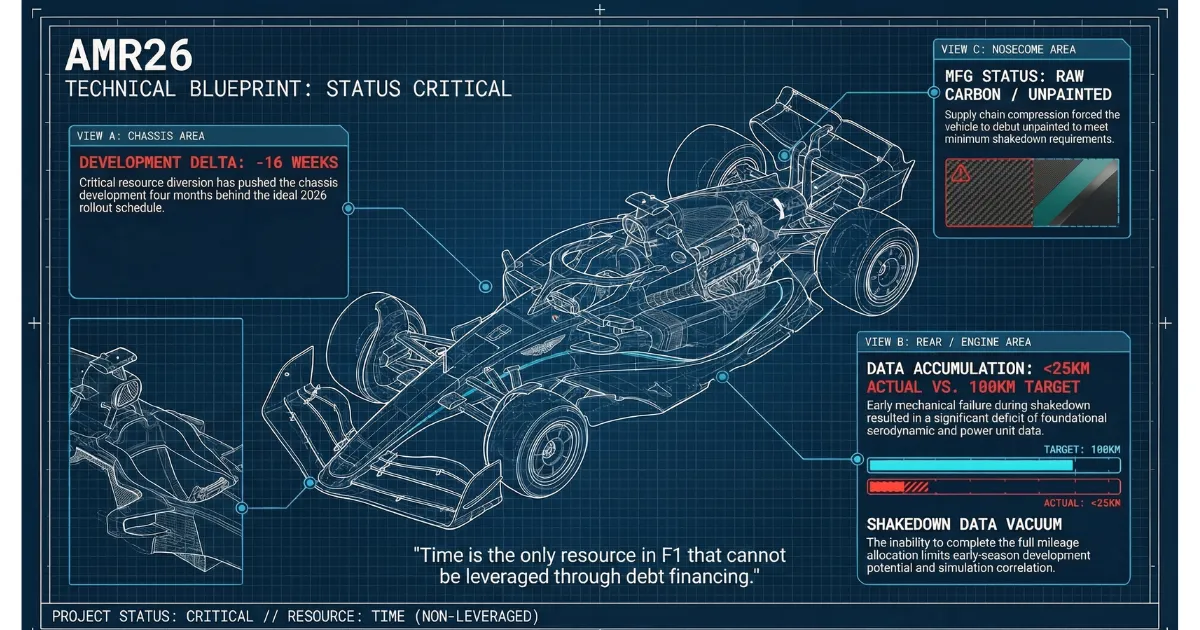
The most telling data point of the preseason came not from the timing screens but from the car's visual condition in Catalonia. The admission that the AMR26 ran in raw, unpainted carbon fibre "due to a lack of time" is a critical indicator of upstream supply chain failure.
In F1 manufacturing, the paint shop is the final station before dispatch. Skipping this stage to hit a shakedown window implies that the composite production schedule was compressed to the breaking point. Our intelligence suggests the project is trailing internal milestones by approximately 16 weeks—a "Code Red" scenario in project management terms.
The Cost of Lost Data
Time is the only resource in Formula 1 that cannot be leveraged through debt financing. The deficit has manifested in immediate mechanical fragility:
- Lance Stroll’s 5-Lap Limit: A component failure (or precaution) limiting the owner’s son to five laps is statistically disastrous for a shakedown.
- The Homologation Bottleneck: The car is currently in a state of "public homologation," using valuable track time to verify basic systems rather than gathering performance data.
Impact on Development Budget:
| Operational Metric | Target (Ideal) | Reality (AMR26) | Economic Implication |
|---|---|---|---|
| Shakedown Mileage | 100km (System Checks) | <25km (Interrupted) | Critical data vacuum entering Bahrain. |
| Assembly Status | Final Spec | Prototype/Raw | Increased manufacturing rush fees (air freight, overtime). |
| Development Delta | On Schedule | -16 Weeks | Resources diverted from upgrades to fixes. |
| Correlation Data | Verified | Unknown | Risk of wind tunnel hours being wasted on bad baselines. |
Strategic Stakeholder Analysis
The pressure on the AMR26 is compounded by the divergent objectives of its primary stakeholders. Unlike a traditional team where the goal is singular (profit or points), Aston Martin is a convergence of massive personal wealth, state-sponsored visibility, and legacy automotive branding.
The Alignment Matrix
We have broken down the conflicting pressures currently weighing on the Silverstone technical office:
| Stakeholder | Core Asset | Strategic Objective | Risk Factor |
|---|---|---|---|
| Lawrence Stroll | Capital/Infrastructure | Validation of investment thesis. | High: Personal reputation tied to "courageous" decisions. |
| Adrian Newey | Intellectual Property | Holistic integration of Honda PU. | Med: His legacy is secure, but his management capability is untested. |
| Fernando Alonso | Human Performance | Immediate title contention. | Critical: Time horizon does not allow for a "transition year." |
| Aramco | Commercial Liquidity | Global brand visibility (Saudi). | Low: Long-term energy transition partnership. |
The Newey Paradox: Innovation vs. Execution
Adrian Newey’s commentary in Saudi Arabia referenced the 2022 regulation changes, noting that Red Bull found the "correct solution" while others floundered. He is attempting to replicate this coup. However, the context is radically different. In 2022, Red Bull Racing was a well-oiled operational machine. Aston Martin, by contrast, is a team still learning to live in its new mansion.
The decision to move the "center of the F1 world" to Silverstone is a macroeconomic gamble. Newey is betting that the long-term potential of a custom chassis-engine integration outweighs the short-term chaos of a rushed production cycle. But the laws of physics are unforgiving. A car that is four months behind schedule is effectively developing in the past.
Outlook: The Bahrain Valuation
As the paddock shifts to Bahrain, the AMR26 faces a binary outcome. The test will not be about lap times; it will be an audit of the team's recovery capability.
- The Bull Case: The mechanical gremlins are superficial assembly errors caused by the rush, and the underlying aerodynamic platform is sound. Alonso’s 61-lap stint on the final day in Barcelona hints at this possibility.
- The Bear Case: The 16-week deficit has baked inherent flaws into the cooling or suspension packaging that cannot be resolved without a B-spec chassis—essentially writing off the first half of the season.
Conclusion
The "matte green mask" was a triumph of marketing, but in the ruthless economy of Formula 1, aesthetics yield zero ROI. Lawrence Stroll has purchased the best ingredients money can buy, but the kitchen is currently chaotic. If the AMR26 cannot shed its carbon skin and perform reliably in Bahrain, the team will find that even the deepest pockets cannot buy back lost time.