The 2026 Japanese Grand Prix arrives at a circuit that has hosted F1 since 1987 — but never quite like this. Honda, the company that built Suzuka as a test track in 1962, is simultaneously the race promoter through Honda Mobilityland, the power unit supplier for Aston Martin, and the commercial force behind the most passionately attended race on the calendar. No other Grand Prix on the 2026 schedule has this level of vertical integration between the circuit owner, the engine supplier, and the commercial promoter.
And it is happening during cherry blossom season, with a yen sitting at historic lows against the dollar and euro, in the last race before a 33-day gap with no F1 anywhere on the planet.
Here is the full breakdown — from the cheapest GA ticket to the hosting fee structure, the Honda commercial architecture nobody is explaining, and what 266,000 fans mean for the Nagoya economy on race weekend.
Ticket Pricing · 2026
THE SUZUKA PARADOX
Japan sells the third cheapest tickets on the 2026 F1 calendar — but the circuit sits one hour from the nearest large city, requires navigating Japanese-only rail systems, and sells out its most popular grandstands within 48 to 72 hours of going on sale. It is affordable and logistically demanding simultaneously.
| Category | Location | Price (3 Days) | Notes |
|---|---|---|---|
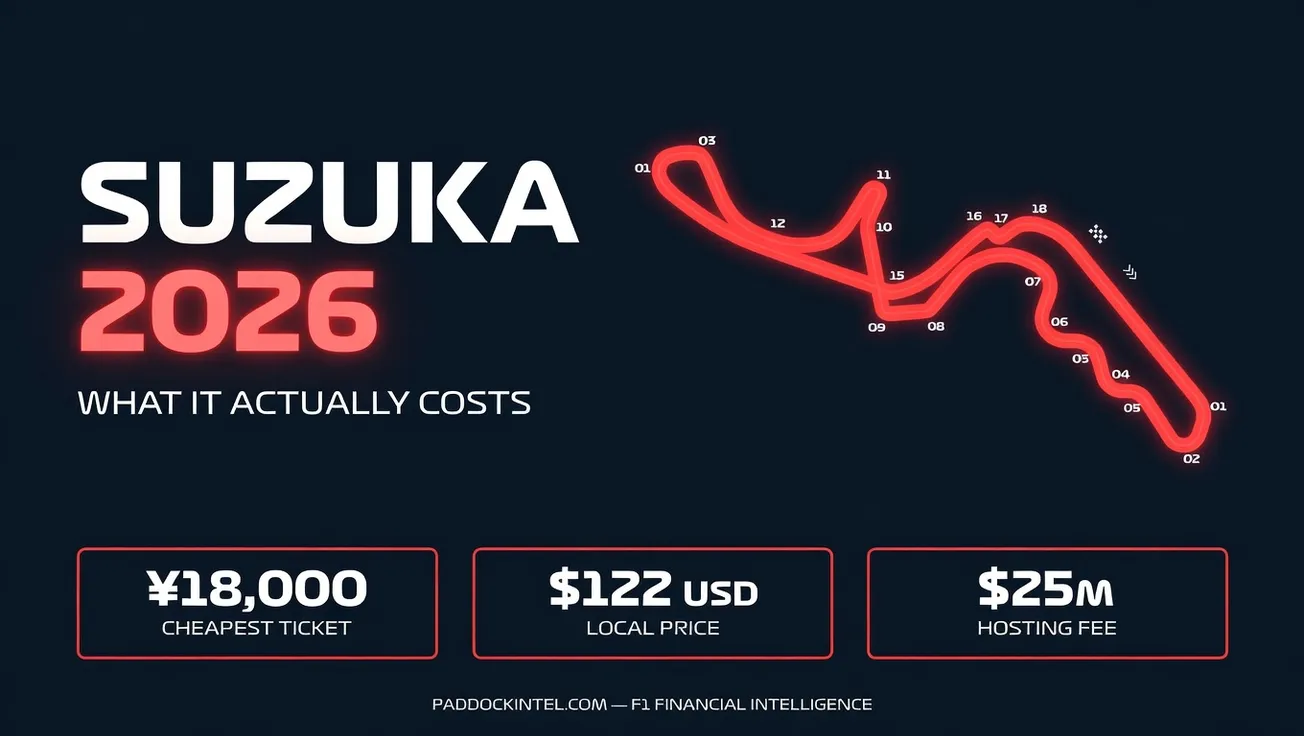
| General Admission | West Open Area — J, L, M, N, O sections | ¥18,000 ~$122 USD | Third cheapest ticket on 2026 calendar. Spoon Curve and 130R views. Fans can bring foldable chairs. |
| Grandstand C | Back straight sector | ¥22,000 ~$149 USD | Entry-level reserved seating. Popular with budget international fans. |
| Grandstand B1/B2 | Turn 1 area | ¥45,000–65,000 ~$300–435 USD | Best value covered seating. Top overtaking zone under new 2026 regs. |
| Grandstand V2 — Main Straight | Start/finish line upper tier | ¥105,000+ ~$709 USD | Best overall experience. Panoramic pit lane views. Driver interviews Saturday. Sells out in 48–72 hours. |
| F1 Experiences Champions Club | Premium hospitality | $4,619 USD | 2-day suite access, paddock tour, driver appearance. Official F1 Experiences package. |
| F1 Paddock Club | Above team garages | From $5,500 USD | Full weekend. Gourmet dining, open bar, pit lane walk. Among the most affordable Paddock Club entries on the 2026 calendar. |
FULL WEEKEND COST · SUZUKA 2026
LOCAL BUDGET FAN ~$272 USD ¥18,000 GA ticket + capsule hotel Nagoya 3 nights ($90) + trains Nagoya–Suzuka ($30) + food. Yen weakness makes this the best value GP on the calendar for dollar and euro holders.
INTERNATIONAL BUDGET ~$612 USD Grandstand C ticket + business hotel Nagoya 3 nights ($200) + trains + food and convenience store meals. Flights not included.
MID-RANGE INTERNATIONAL ~$1,800 USD Grandstand V2 ticket + Nagoya Marriott Associa or equivalent 3 nights ($750) + Shinkansen from Tokyo + dining. Flights not included.
PREMIUM / PADDOCK CLUB ~$8,000–12,000 USD Paddock Club from $5,500 + Nagoya 5-star hotel ($333/night x 3) + transfers. Per person. Corporate standard F1 spend.
The Yen Advantage · 2026
This is the number that changes the entire Suzuka economic equation for international visitors: the Japanese yen is sitting at approximately ¥150 per US dollar — near historic lows. For dollar, euro, and pound holders, every Japanese price on this page is effectively discounted by 30–40% compared to five years ago.
A Grandstand V2 ticket at ¥105,000 costs a dollar holder $700. The same ticket at 2019 exchange rates would have cost $960. The Nagoya Marriott Associa, a genuine 5-star property, runs ¥30,000–50,000 per night — $200–$333 USD. That is less than a mid-range hotel in Melbourne or Miami on GP weekend.
The yen weakness is not accidental context. It is the single biggest financial argument for attending Suzuka in 2026 over any other race on the calendar. Japan is offering a premium experience at a structurally discounted price — and 266,000 fans showing up in 2025 suggests the market already knows it.
The Hosting Fee· 2026
HOSTING FEE STRUCTURE · JAPAN GP CONTRACT THROUGH 2029
ESTIMATED ANNUAL FEE ~$25M Honda Mobilityland pays Liberty Media approximately $25M annually for the right to host the Japanese GP at Suzuka. This is below the F1 calendar average of ~$40M — reflecting Suzuka's historic status and Honda's commercial relationship with the sport.
CIRCUIT BUILD COST $150M+ est. Original construction in 1962 as Honda test track. Subsequent upgrades and modernisation across six decades. 2024 resurfacing from Turn 1 to Turn 8 entry ahead of the spring calendar move.
CONTRACT EXTENSION 2029 Renewed in February 2024 by Liberty Media and Honda Mobilityland president Tsuyoshi Saito. Five-year extension confirmed at F1.com. Domenicali: "Suzuka is part of the fabric of the sport."
ATTENDANCE TRAJECTORY 266,000 in 2025 From 200,000 in 2022 to 222,000 in 2023 to 229,000 in 2024 to 266,000 in 2025 — the largest Suzuka weekend since 2006. Consistent annual growth confirms Liberty Media's renewal was commercially straightforward.
The Honda Architecture · 2026
THE RACE NOBODY ELSE HAS
This is the angle that separates Suzuka from every other race on the 2026 calendar.
Honda built Suzuka. Honda owns Suzuka through Honda Mobilityland. Honda Mobilityland pays Liberty Media the hosting fee to put F1 on the circuit Honda owns. Honda's racing division HRC develops the power unit that Aston Martin runs in the 2026 championship. And Honda ran a Tokyo Fan Festival in 2024 and 2025 — a consumer activation that brings F1 to Japan's capital 400km from the circuit — to expand the Japanese fanbase that fills the Honda-owned circuit.
This is vertical integration that no other GP host on the calendar can match. Melbourne's promoter is a government body. Las Vegas is managed directly by Liberty Media. Monaco is run by the Automobile Club de Monaco. Suzuka is Honda's house — and Honda is simultaneously building the engine that one of the competing teams will race on Honda's track.
For Liberty Media, this is the ideal promoter relationship: a corporation with deep F1 investment, a multi-decade circuit commitment, growing domestic attendance, and commercial infrastructure that activates the sport far beyond the circuit gates. Honda does not just host the race. Honda markets F1 in Japan year-round.
The $25M hosting fee is the smallest line in Honda's total F1 investment. It is also the one that keeps Suzuka on the calendar through 2029.
Cherry Blossom Economics · 2026
THE TIMING IS NOT ACCIDENTAL
The Japanese Grand Prix moved to late March/early April in 2024 — a deliberate Liberty Media calendar decision that aligned the race with Japan's cherry blossom season for the first time. The commercial logic is precise.
March and April are Japan's peak inbound tourism months. In 2024, visitor arrivals exceeded 3 million per month during cherry blossom season. Total inbound tourism spending in Japan reached $52.29 billion in 2024 — a record high. The yen's weakness, which makes Suzuka tickets cheap for international fans, is the same force driving Japan's overall tourism boom.
The international F1 fan attending Suzuka in 2026 is not just attending a race. They are arriving in the world's most sought-after spring destination at its seasonal peak. Hotels in Nagoya price accordingly. The Nagoya Marriott Associa charges ¥50,000+ on GP weekend — double its standard rate. Kintetsu Rail, which operates the primary train route from Nagoya to Shiroko Station for Suzuka, runs additional services on the race weekend and captures direct revenue from every fan making the journey.
The cherry blossom premium on accommodation is real and unregulated. Book Nagoya hotels 6 months out, or pay spot rates that can triple standard rates on race weekend.
Nagoya · 2026
THE CITY THAT RUNS THE WEEKEND
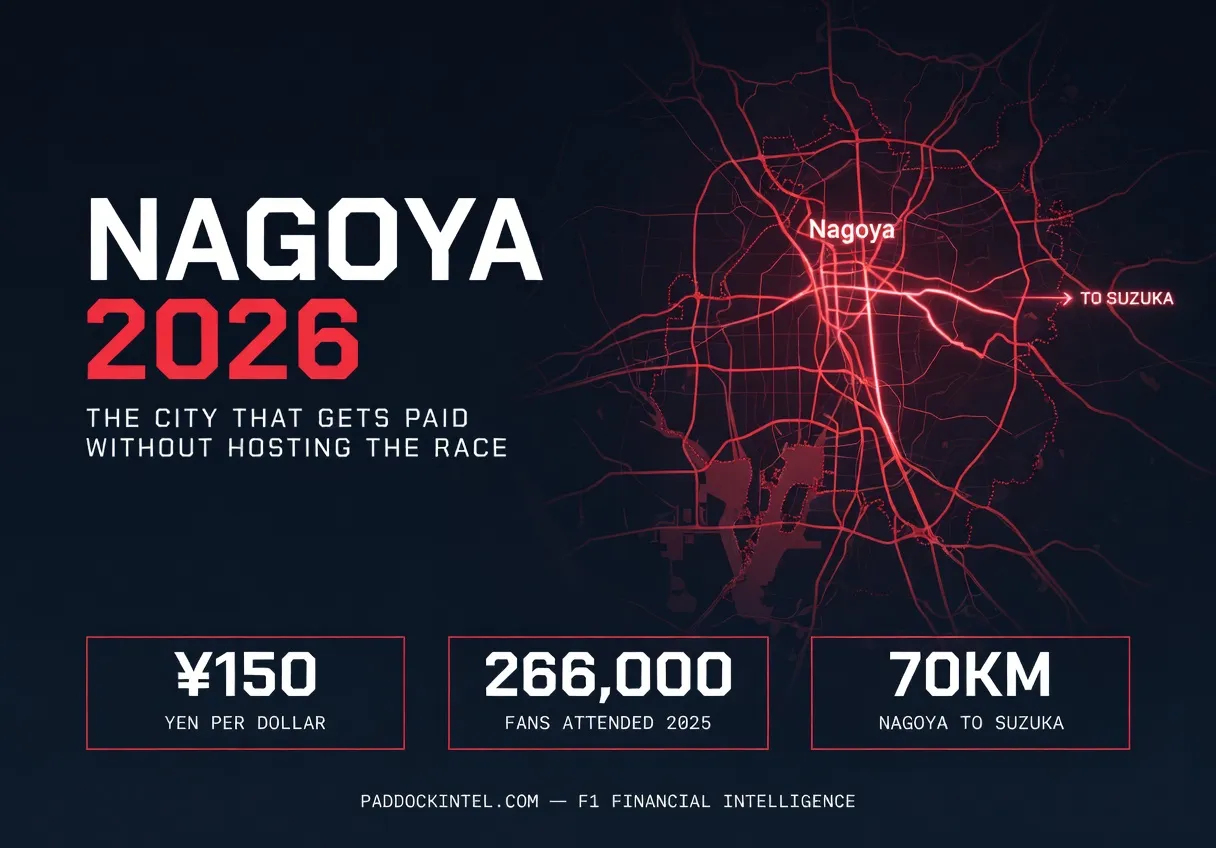
Suzuka Circuit is in Mie Prefecture, 70km from Nagoya. But Nagoya — Japan's fourth most populated city at 2.3 million — is where the GP weekend actually lives for most international attendees.
The economics of Nagoya on race weekend follow a predictable pattern that any Super Bowl host city would recognise. Hotels within walking distance of Nagoya Station, which connects to the Kintetsu line for Suzuka, are priced at full premium. The Meitetsu Grand Hotel, directly adjacent to the station, becomes the operational centre for fans managing the daily commute. Restaurants around the Sakae entertainment district fill with international visitors on Friday and Saturday nights. The 400-year-old Osu Shopping District, with 1,200 stores, absorbs the shopping spend of tens of thousands of F1 fans who extend their trip beyond the circuit.
Honda Mobilityland has deliberately structured an ecosystem around this: the F1 Tokyo Fan Festival — held in the Japanese capital in 2024 and 2025 — activates F1 in Tokyo, driving fans to Suzuka for the race itself. A Japanese driver in competitive machinery would significantly accelerate this dynamic. Yuki Tsunoda, now at Red Bull, gives Japan a genuine championship contender narrative for the first time since Honda's works programme.
The Suzuka amusement park — an actual theme park built inside the circuit — operates during the GP weekend, capturing family spending from Japanese domestic attendees who treat the race weekend as a full leisure destination rather than a pure motorsport event. This is unique to Suzuka among permanent F1 circuits.
Paddock Intel Verdict · 2026
Suzuka is the most structurally coherent race on the 2026 F1 calendar. Honda built the track, Honda funds the promotion, Honda supplies the power unit for a competing team, and Honda activates the Japanese market year-round to fill the circuit it owns. The $25M hosting fee is the most cost-efficient Liberty Media deal on the calendar — a below-average fee for a race that delivers above-average attendance, consistent growth, and a promoter that does Liberty Media's marketing for them.
For international fans, Suzuka in 2026 is the calendar anomaly. Third cheapest tickets. Historic yen weakness is already making Japanese pricing genuinely affordable. A city base in Nagoya that offers premium hospitality at rates that Melbourne and Miami cannot match. And cherry blossom season, which adds a cultural and visual layer to the GP weekend that no desert circuit or street race can replicate.
The 33-day gap after Suzuka is not just a championship storyline. It is the last race before five weeks of silence. If Mercedes continues its dominance and Verstappen's exit clause clock keeps ticking, March 29 at Suzuka could be the most consequential race of the first half of the 2026 season.
That makes the Japanese GP — economically, commercially, and competitively — worth considerably more than its $25M hosting fee suggests.
Frequently Asked Questions · 2026
How much do Japanese Grand Prix 2026 tickets cost? Official ticket prices from Honda Mobilityland range from ¥18,000 (~$122 USD) for 3-day General Admission to ¥105,000+ (~$709 USD) for Grandstand V2 on the main straight. F1 Paddock Club packages start from approximately $5,500 USD per person for the full weekend. Japan ranks third on the 2026 F1 calendar by ticket price, according to GPDestinations' ranking. The yen, at approximately ¥150 per dollar in 2026, makes all official prices significantly more affordable for dollar- and euro-holders than in previous seasons.
Where do most fans stay for the Japanese Grand Prix? Most international fans base themselves in Nagoya, approximately 70km from the Suzuka Circuit, accessible by Kintetsu train in 60–90 minutes. Hotels in Suzuka itself are almost entirely reserved by F1 teams and media. Nagoya offers 5-star options, including the Nagoya Marriott Associa (~¥30,000–50,000 per night on GP weekend), and budget options, including capsule hotels near Nagoya Station, from ¥3,000–5,000 per night. Book at least 6 months in advance — Nagoya accommodation prices surge significantly during race weekend, often doubling or tripling standard rates.
How much does Japan pay to host the F1 Grand Prix?
Honda Mobilityland pays an estimated $25M annually to Liberty Media for the right to host the Japanese Grand Prix at Suzuka, according to EssentiallySports. This is below the F1 calendar average hosting fee of approximately $40M, reflecting Suzuka's historic status and Honda's deep commercial relationship with Formula 1. The current contract runs through 2029, renewed in February 2024. Unlike Melbourne, where the Victorian government subsidises the promoter, Suzuka's fee is paid directly by Honda Mobilityland, a Honda Group subsidiary.
What is the cherry blossom connection to the Japanese Grand Prix?
The Japanese Grand Prix moved to late March/early April in 2024, deliberately aligning with Japan's cherry blossom season for the first time. Late March temperatures around Suzuka range from 7°C to 15°C with a 35% chance of rain. Cherry blossom season drives Japan's peak inbound tourism months — visitor arrivals exceeded 3 million per month in March and April 2024. International F1 fans frequently extend their Japan trip to Tokyo, Kyoto, or Osaka to combine the race with the country's most celebrated seasonal event. This calendar positioning was a Liberty Media strategic decision to maximise the cultural appeal of the Japanese GP for international audiences.
Why does Honda have such a unique role at Suzuka?
Honda built Suzuka Circuit in 1962 as a test track. Today, Honda Mobilityland — a Honda Group subsidiary — owns and operates the circuit and serves as the official promoter of the Japanese Grand Prix, paying Liberty Media the hosting fee. Simultaneously, Honda's racing division HRC supplies the power unit for Aston Martin in the 2026 F1 championship. No other race on the 2026 calendar has this level of integration between circuit owner, race promoter, and active power unit supplier. Honda also runs the F1 Tokyo Fan Festival — a consumer activation in Japan's capital — to grow the domestic fanbase that attends the Honda-owned circuit.
Is the 2026 Japanese Grand Prix sold out?
Popular grandstands including V2 and Turn 1 sections sold out within 48–72 hours of going on sale, consistent with 2024 and 2025 patterns. General Admission sections have historically remained available closer to the event. F1 Experiences and Paddock Club packages may still have limited availability through official resellers. The 2025 Japanese GP drew 266,000 fans — the largest Suzuka weekend attendance since 2006 — and 2026 demand is expected to be at least equal. Secondary market tickets are available at premium prices through international resellers.
What is the Suzuka amusement park?
Suzuka Circuit contains a fully operational amusement park — a theme park built within the circuit grounds — that operates during the Grand Prix weekend. This is unique among permanent F1 circuits and reflects Suzuka's origins as a Honda leisure destination rather than a purpose-built race facility. Japanese domestic attendees frequently treat the GP weekend as a full family leisure experience, combining circuit access with the amusement park, creating a revenue stream for Honda Mobilityland that international circuits do not have.
SOURCES · SUZUKA 2026 ECONOMIC ANALYSIS
- GPDestinations — 2026 Japanese Grand Prix Budget Planner & Official Ticket Prices
- GPDestinations — 266,000 Attend 2025 Japanese Grand Prix Weekend
- GPDestinations — Where to Stay for the Japanese Grand Prix
- EssentiallySports — How Much Does Japan Pay to Keep Suzuka on the Calendar
- Formula1.com — Formula 1 to Race in Japan Until 2029
- TripToJapan — F1 Japanese Grand Prix 2026: Dates, Tickets, Seating & Tips
- KKday — F1 Japan 2026 Last-Call Guide
- GPDestinations — What to See and Do in Japan
- Tourist Japan — Japan Travel Trends & Statistics 2024
- Honda News — 2025 F1 Pre-Season Briefing Overview