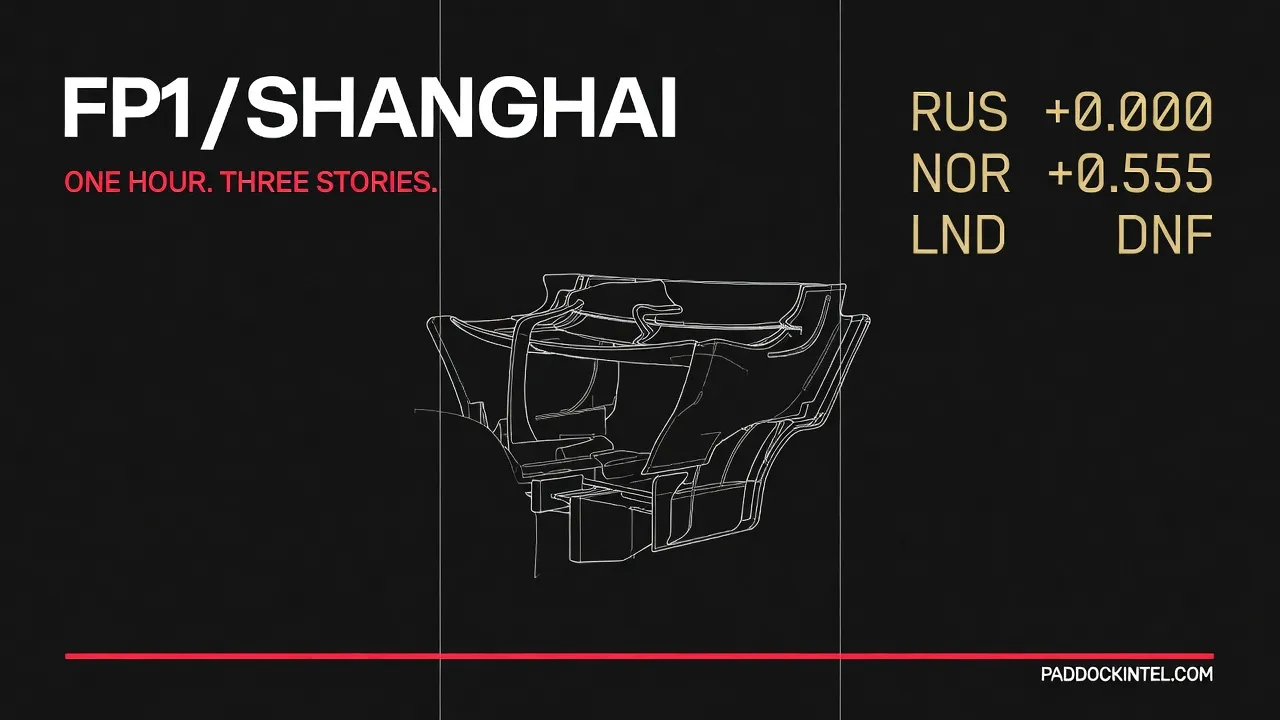
One hour. No FP2, no FP3. On a Sprint weekend, the sole practice session is everything — tyre data, qualifying simulations, car setup. Three teams left that hour with less than they needed.
Mercedes: The Warning Shot
Russell set 1:32.741. Antonelli 0.120s behind. The pair were over half a second clear of McLaren's Norris in P3 — on a circuit with the longest straight on the calendar at 1.1km, where top speed is the primary currency.
This was not a Friday accident. Mercedes arrived in Shanghai knowing this layout favours them and executed accordingly. Two races in, two sessions led. The constructors' points gap is starting to look structural.
Ferrari: The Wing That Arrived Too Early
Ferrari brought the Macarena wing to Shanghai — a rear wing that rotates 180 degrees into a fully inverted position on straights instead of simply flattening. Designed to cut drag. Perfect on paper for Shanghai's main straight.
They ran it on both SF-26s throughout FP1. They pulled it before Sprint Qualifying.
Hamilton confirmed it: premature. It was scheduled for race four or five. The detail nobody is writing about — it was transported to Shanghai in the personal luggage of team personnel, not standard freight. That is not comfort logistics. That is maximum development priority under time pressure. Ferrari is spending on urgency what it would normally spend on process.
Racing Bulls: The Reliability Tax
Lindblad stopped at lap 6. Smoke in the cockpit. Second consecutive race weekend with a major incident — in Melbourne it was Hadjar retiring the Red Bull in flames.
On a Sprint weekend with no FP2 or FP3, six laps of practice is near-zero information heading into Sprint Qualifying, the Sprint, and the race. The cost is not just the mechanical part. It is the track time that cannot be recovered. For a rookie in his second F1 race weekend at a circuit he does not know, the forced learning curve is the most expensive damage of all.
Verstappen: P8, +1.800s
The reigning champion was 1.8 seconds off the benchmark. A single session gap means nothing conclusive — programmes differ. What it does say: Red Bull did not arrive in Shanghai with answers. In Melbourne, they lacked race pace. Here they arrived without qualifying pace. The trend matters more than the number.
PaddockIntel Verdict
The Sprint weekend format doubles the penalty for error. Without additional practice sessions, every mechanical failure, every lap lost, every rushed development decision carries a direct cost on preparation for the competitive sessions that follow.
Mercedes understood that. They arrived prepared, executed with margin, and preserved information for qualifying. Ferrari bet on showing a card before it was ready. Racing Bulls paid in data they cannot get back.
FP1 in Shanghai did not determine the outcome of the weekend, but it determined who arrives better armed for the rest of it.
What is Ferrari's Macarena wing? Ferrari's Macarena wing rotates the top rear flap 180 degrees into a fully inverted position on straights — instead of simply flattening like a conventional DRS. Named by Ferrari TP Fred Vasseur after the 1990s dance. Designed to cut drag and boost top speed, particularly effective on long-straight circuits like Shanghai.
Why did Ferrari remove the Macarena wing after FP1? Hamilton confirmed it was premature — originally scheduled for race four or five. Ferrari only had two units, transported to Shanghai in personal luggage rather than standard freight. After running both SF-26s in FP1, the team removed it to continue development before racing it competitively. It will return.
Why did Lindblad stop in FP1 Shanghai 2026? Lindblad pulled off at Turn 14 after six laps with smoke in the cockpit indicating mechanical failure. Racing Bulls confirmed his session was over. Second major reliability incident in two weekends following Hadjar's retirement in Melbourne. On a Sprint weekend with no FP2 or FP3, that track time cannot be recovered.
How dominant was Mercedes in FP1 at the 2026 Chinese Grand Prix? Russell set P1 at 1:32.741, Antonelli 0.120s behind. The Mercedes pair were over half a second ahead of McLaren's Norris in P3. Verstappen was 1.8 seconds off the benchmark. Two races in, two sessions led.
Why is there only one practice session at the Chinese Grand Prix? China follows the Sprint weekend format. FP2 and FP3 are replaced by Sprint Qualifying and the Sprint race. Teams get one hour of practice on Friday before Sprint Qualifying begins later that same day — making every lap significantly more valuable than on a standard race weekend.