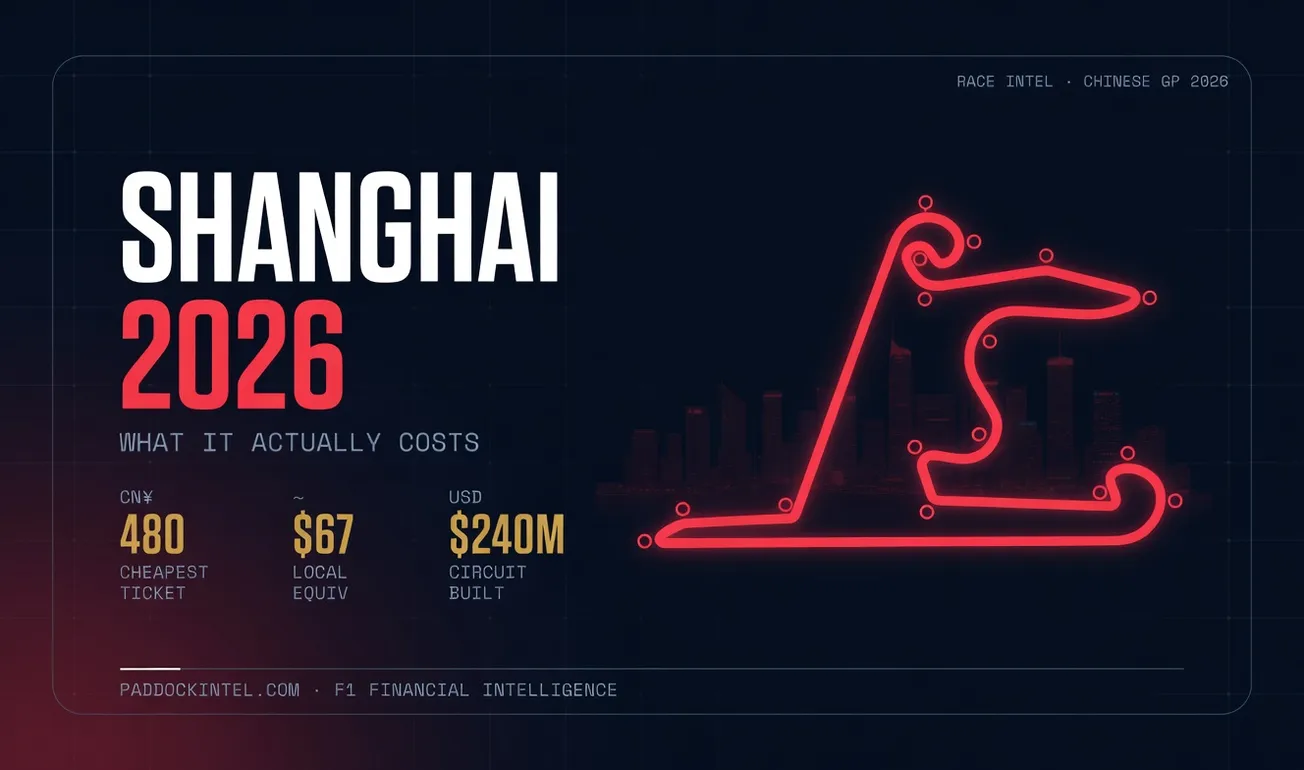
CN¥ 480
Cheapest Local Ticket
3-day GA via Chinese promoter. ~$67 USD. The lowest-priced ticket on the entire 2026 F1 calendar.
200K
Circuit Capacity
Shanghai International Circuit. Sold out for 2026. One of the largest F1 venues on the calendar.
$240M
Circuit Build Cost
Construction cost in 2004. The most expensive F1 circuit facility ever built at the time of opening.
The 2026 Chinese Grand Prix sold out before most international fans could reach the ticket page. Local demand consumed the allocation within hours. The resale market opened immediately, at multiples of the official price.
That is the demand side. Nobody is talking about the supply side: what it actually costs to put 200,000 people through the gates of a $240 million circuit in Shanghai's Jiading district — and who absorbs the financial architecture that makes this weekend possible.
Here is the full breakdown — from the cheapest general admission pass to the hosting fee that nearly ended the Chinese Grand Prix forever, the Sprint economics nobody explains properly, and why BYD's announcement this morning was not accidental timing.
TICKET PRICING · 2026
THE SHANGHAI PARADOX
China sells the cheapest tickets on the entire 2026 F1 calendar — averaging $220 USD for grandstand seats, lower than Bahrain, Japan, or Sao Paulo. But almost no international fan can access them. Local Chinese buyers exhaust the allocation first, through apps and payment systems unavailable outside China. International ticket agents charge 3–5x the promoter price for the same seats. The cheapest market is effectively the most inaccessible.
| Category |
Location |
Price (3 Days) |
Notes |
| General Admission SOLD OUT |
Zones C, F, J, L — trackside standing |
CN¥ 480
~$67 USD |
Cheapest ticket on the 2026 F1 calendar. Local promoter only — not available internationally. |
| Grandstand E LOCAL PRICE |
Back straight sector |
~$226 USD |
Cheapest available grandstand seat. 2nd most affordable on the calendar after Japan. |
| Grandstand H / K |
Turn 14 hairpin — top overtaking zone |
~$244–273 USD |
Best value reserved seating. Family tickets available. Covered grandstands. |
| Grandstand A — Main Straight SOLD OUT |
Start/finish line, 29,000 seats |
$300–500+ USD |
Largest grandstand on the circuit. Podium view. Sold out locally; international agents charging premiums. |
| Grandstand A Platinum |
Upper tier main straight |
From €15,047 |
Via Formula1.com official store. Hospitality + premium access included at this tier. |
| F1 Paddock Club |
Paddock level — team access |
From €15,047 |
F1 global hospitality product. Driver appearances, gourmet dining, paddock access. Top-tier corporate spend. |
FULL WEEKEND COST · SHANGHAI 2026
LOCAL BUDGET FAN
~$224 USD
CN¥ 480 GA ticket + hostel 3 nights + food and metro. Local prices only. Flights not included. Accessible only via Chinese payment apps.
INTERNATIONAL BUDGET
~$578 USD
CN¥ 1,580 total estimated. Grandstand ticket + 3-star hotel 3 nights + food and transport. Flights not included.
MID-RANGE INTERNATIONAL
~$1,800 USD
International grandstand ticket (agent price) + 4-star central Shanghai hotel + dining and experiences. Flights not included.
CORPORATE / PADDOCK CLUB
$20,000+
Paddock Club (from €15,047) + luxury hotel + transfers + client entertainment. Per person. Standard corporate F1 spend.
THE HOSTING FEE · WHAT CHINA ACTUALLY PAYS
The ticket price is what fans pay. The hosting fee is what China pays. And the history of that fee nearly ended the Chinese Grand Prix permanently.
ESTIMATED ANNUAL FEE
~$40M+
Average F1 hosting fee is ~$40M/year. China's fee was historically among the highest on the calendar — the key factor that nearly ended the race in 2011.
CIRCUIT CONSTRUCTION
$240M
Built in 18 months in 2004 on former marshland in Jiading district. Was the most expensive F1 facility ever built until Abu Dhabi opened in 2009.
2011 CRISIS
Near Exit
Organisers refused to pay the required fee after years of losses. F1 bosses reduced the rate to keep the race. New deal ran to 2017.
CURRENT CONTRACT
To 2030
Extended in 2024 by Liberty Media. Chinese GP confirmed on calendar through 2030. China's growing F1 audience made the renewal straightforward.
THE LIBERTY MEDIA EQUATION
Unlike Melbourne (where the Victorian government subsidises the promoter), Shanghai's economics run through the local promoter paying Liberty Media directly. Liberty keeps all global broadcast rights and trackside sponsorship revenue. The promoter's only meaningful income is ticket revenue — which in China is deliberately kept low to maximise local attendance. This is the structural tension at the heart of the Chinese Grand Prix: maximum local access, minimum promoter margin, maximum Liberty Media revenue.
SPRINT RACE ECONOMICS · FIRST OF SIX IN 2026
Shanghai hosts the first Sprint weekend of the 2026 season. Six Sprint rounds are scheduled for 2026: China, Miami, Canada, Britain, Netherlands, Singapore. Each Sprint weekend changes the financial stakes of the race for every team on the grid.
8
Max Sprint Points
Sprint winner earns 8 pts. Top 8 finishers score. 8-7-6-5-4-3-2-1. No fastest lap bonus in Sprint. Pure position-based scoring.
19
Sprint Laps
Approximately 100km. ~30 minutes of racing. Saturday 11:00 local (03:00 GMT). No mandatory pit stops. High-intensity, no strategy variation.
48
Season Sprint Points Available
Across 6 Sprint rounds. For teams in close constructors' battles, 48 extra points can represent $80M+ in annual prize money swing.
$8.5M
Per Constructors Position
Estimated prize money value of one position in the constructors' standings. Sprint points directly protect or threaten that position.
2×
Sponsor Exposure
Sprint weekends deliver two competitive broadcast windows per weekend instead of one. Sponsor impressions roughly double without proportional cost increase.
$1.27B
2026 Prize Pool
Estimated total 2026 constructor prize fund. Sprint points feed directly into the final standings that determine each team's annual payout.
THE BYD VARIABLE · MARCH 10, 2026
BREAKING — BLOOMBERG EXCLUSIVE TODAY
BYD Is Exploring an F1 Entry. The Timing Is Not Accidental.
Bloomberg reported this morning that BYD Co. is examining options to enter competitive motorsport including Formula One, citing people familiar with the matter. BYD declined to comment. No decision has been made. The story broke on the morning of the 2026 Chinese Grand Prix week.
The financial logic is straightforward. BYD's ~$118B trailing revenue dwarfs an F1 program's estimated $200–500M annual cost. For a company whose biggest strategic challenge is building premium brand perception in Europe and North America, F1 offers reach no advertising campaign can match.
The 2026 power unit regulations are the critical enabler. With 50% of power output now electrical — the MGU-K delivering 350kW — F1's technical platform is the closest it has ever been to BYD's core battery and motor expertise. The R&D overlap is no longer symbolic.
FIA President Mohammed Ben Sulayem has explicitly called for a Chinese manufacturer on the F1 grid, describing it as "the next logical step" following Cadillac's arrival. Bloomberg notes BYD would prefer acquisition over building from scratch — and Alpine's Otro Capital stake remains on the market.
~$118B
BYD Trailing Revenue
$450M
Cadillac Anti-Dilution Fee
China sells the cheapest tickets on the F1 calendar. China also pays one of the highest hosting fees. The local fan experience is deliberately subsidised to fill 200,000 seats — while Liberty Media extracts broadcast and sponsorship revenue on the global side of the ledger. It is the most efficient audience-building arrangement in the sport.
The Sprint format makes Shanghai more financially consequential than a standard race weekend. 48 additional championship points across the season translate directly into prize money — at roughly $8.5M per constructors' position. Teams that underperform in Sprints don't just lose points. They lose operating budget for the following year.
And today, BYD announced it is watching all of this very carefully. A $118B company with battery manufacturing at its core, eyeing a sport that just made 50% of its power unit electrical, breaking the news during China's home race weekend. The timing is deliberate. The question is not whether a Chinese manufacturer enters F1. The question is when — and which team they acquire to get there.
FREQUENTLY ASKED QUESTIONS · SHANGHAI 2026
How much do Chinese Grand Prix 2026 tickets cost?
Official ticket prices from the local Chinese promoter range from CN¥ 480 (~$67 USD) for 3-day General Admission to over CN¥ 3,000+ for premium grandstand sections. The cheapest grandstand seat (Grandstand E) costs approximately $226 USD at promoter prices. However, all official tickets sold out rapidly to local Chinese buyers. International fans must use overseas ticket agents, where prices are significantly higher — grandstand tickets typically $300–600 USD and Paddock Club from €15,047 via Formula1.com. China offers the cheapest average ticket price of any race on the 2026 F1 calendar, but is among the hardest to access for international attendees.
Why are F1 tickets cheaper in China than anywhere else?
Shanghai's ticket pricing reflects a deliberate strategy to maximise local Chinese attendance rather than international revenue. The promoter keeps official prices low — averaging $220 USD versus $500+ at European venues — because filling the 200,000-capacity Shanghai International Circuit with engaged local fans serves F1's long-term objective of building China's fanbase. The tradeoff: those low prices are only accessible via Chinese payment systems and apps. International fans are effectively routed to a parallel market at 3–5x the official price. It is cheap for Chinese fans by design, and expensive for everyone else by consequence.
How much does China pay to host the Formula 1 Grand Prix?
The exact figure is not publicly disclosed, but the average F1 hosting fee across the calendar is approximately $40 million per year, and China's fee has historically been among the highest. In 2011, the situation came to a breaking point: the local organisers refused to pay the required fee after years of financial losses, and the race contract was nearly cancelled. F1 bosses reduced the rate to retain China on the calendar. The current contract runs through 2030, renewed by Liberty Media in 2024. Unlike Melbourne, where the Victorian government subsidises the promoter, Shanghai's promoter pays Liberty Media directly — while Liberty keeps all global broadcast and trackside sponsorship revenue.
What is the Sprint race format and how does it affect prize money?
The Sprint is a 19-lap, ~100km race held Saturday morning before main qualifying. The top 8 finishers score championship points: 8-7-6-5-4-3-2-1. No fastest lap bonus applies in the Sprint. In 2026, there are six Sprint weekends — China, Miami, Canada, Britain, Netherlands, Singapore — offering a maximum of 48 additional points across the season. Those points feed directly into the Constructors' Championship standings, which determine each team's annual prize fund allocation. With approximately $8.5 million separating each constructors' position, Sprint weekends carry significant financial consequences beyond the on-track result. For sponsors, Sprint weekends deliver two competitive broadcast windows instead of one — effectively doubling impression volume at the same location cost.
What does BYD entering F1 mean for the Chinese Grand Prix?
Bloomberg reported on March 10, 2026 — the opening day of Chinese GP week — that BYD is examining options to enter Formula One, including building a team or acquiring an existing one. No decision has been announced. If BYD does enter F1, the Chinese Grand Prix becomes structurally more important overnight: a home manufacturer racing at the home circuit in front of 200,000 fans. For Liberty Media, a Chinese constructor would unlock sponsor and broadcast revenue from the world's largest automotive market. For BYD, F1 offers premium brand positioning in Europe and North America that its $118B revenue cannot buy through conventional advertising. The 2026 power unit regulations — with 50% electrical output — reduce the technical gap between F1 and BYD's core competency in battery and motor manufacturing. FIA President Mohammed Ben Sulayem has explicitly called for a Chinese manufacturer on the grid, describing it as the sport's next logical step.
Is the Chinese Grand Prix 2026 sold out?
Yes. The 2026 Chinese Grand Prix sold out through the official local promoter shortly after tickets went on sale in late 2025. All grandstand categories and General Admission zones are sold out at promoter prices. Official F1 Experiences packages are also listed as sold out. Secondary market tickets remain available through international resellers at premium prices — grandstand seats typically priced at $400–800 USD, with VIP and hospitality packages at multiples of official rates. The circuit capacity of 200,000 spectators is fully allocated.