— WHAT HAPPENS —
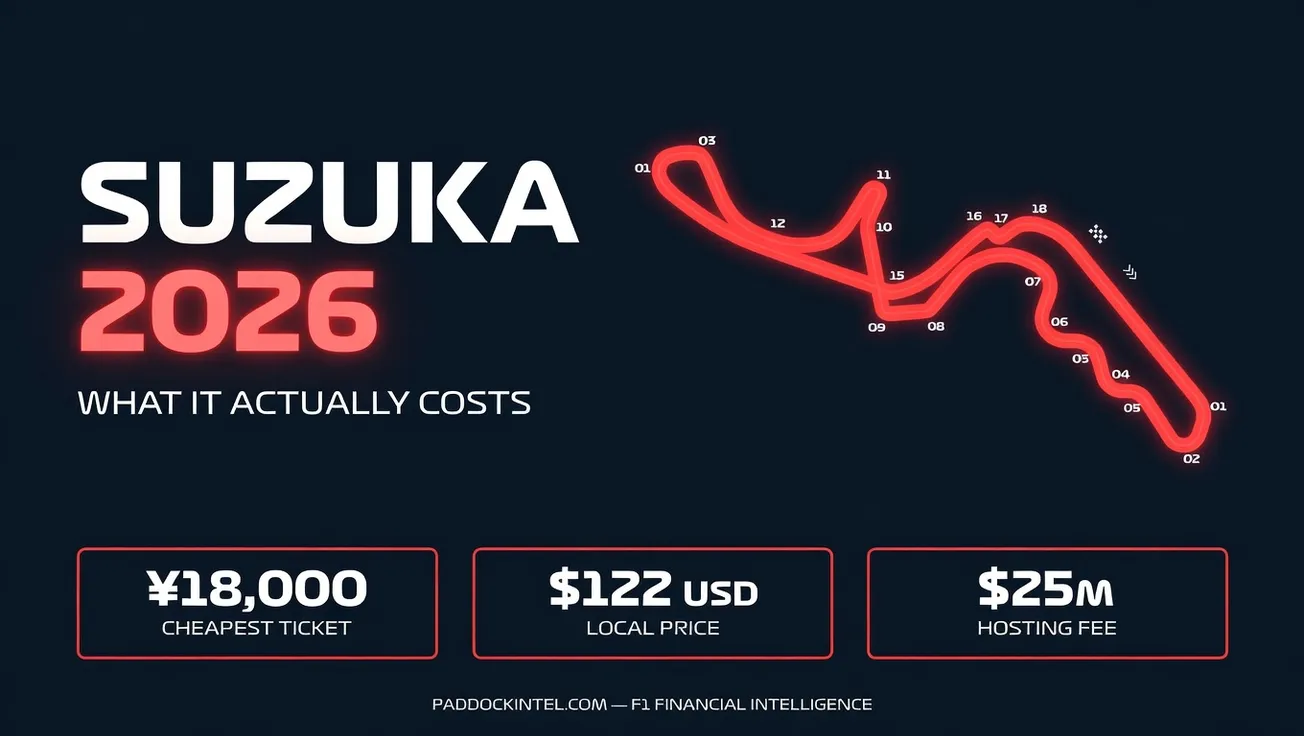
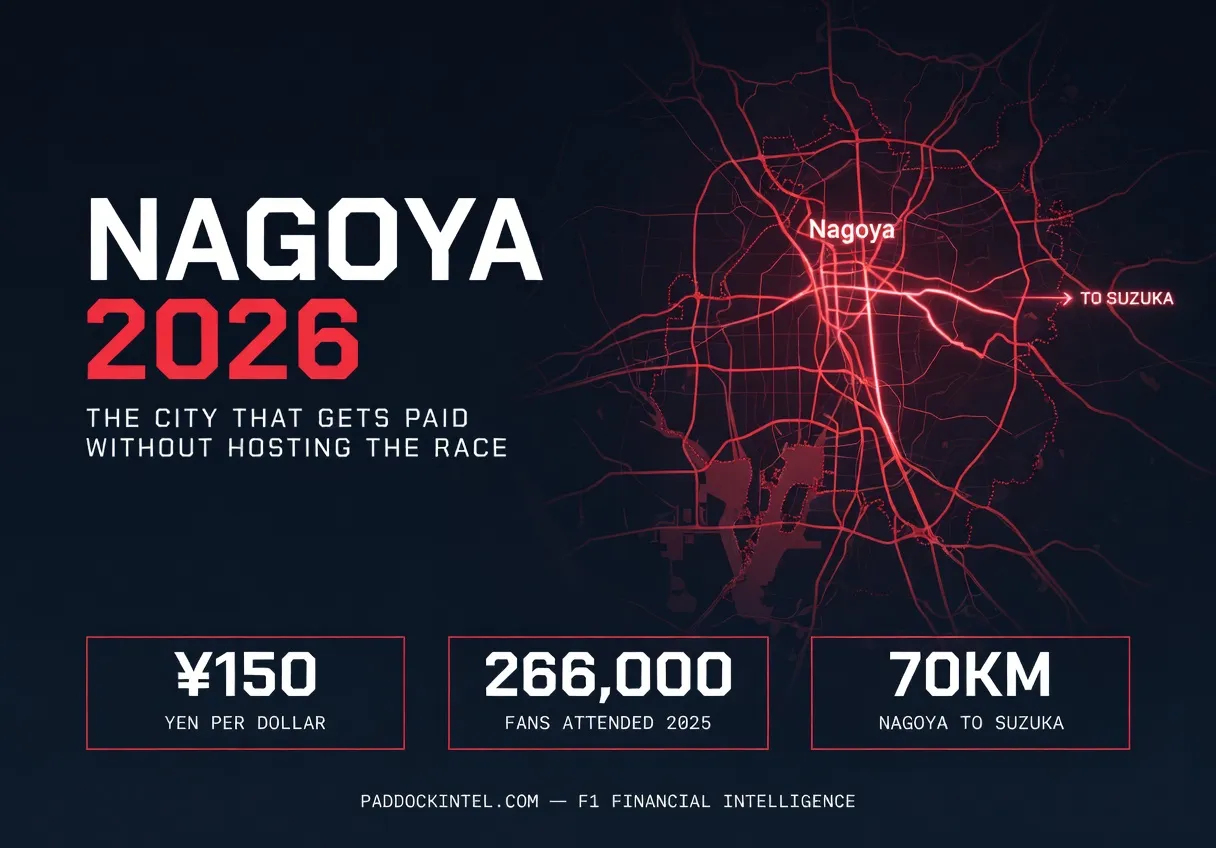
Suzuka Circuit is in Mie Prefecture. The race happens there. But the economic activation — the hotels, the restaurants, the trains, the retail surge — happens 70 kilometres away in Nagoya.
This is the invisible economy of the Japanese Grand Prix. And it follows a pattern that every F1 host city generates but almost nobody documents: the city that captures the spend without paying the hosting fee.
— THE HOTEL PREMIUM —
Nagoya on a normal March weekend is one of the most affordable major cities in Japan. The Nagoya Marriott Associa — a genuine 5-star property sitting above JR Takashimaya Department Store with panoramic views from the 52nd floor — runs ¥20,000–30,000 per night standard rate. Around $133–$200 USD at current yen rates.
On Japanese Grand Prix race weekend, that same room doubles. Sometimes triples.
This is not anecdotal. Lighthouse, a hospitality data firm, confirmed in a 2024 analysis that Suzuka's limited accommodation supply causes demand to spill directly into Nagoya — and that the Japanese GP week is among the most expensive hotel periods of the entire year for the city. The pattern is consistent: prices stay flat until race week, spike on Thursday, peak on Saturday night before race day, and revert to normal within 48 hours of the chequered flag.
The hotels within walking distance of Nagoya Station are the primary beneficiaries. The Meitetsu Grand Hotel, the Nagoya JR Gate Tower Hotel, the Hilton Nagoya, the Westin Nagoya Castle — every property with a direct Kintetsu rail connection to Shiroko station runs at full occupancy from Thursday to Sunday. Book six months out or pay spot rates that make Monaco look reasonable.
— THE KINTETSU EQUATION —
The single biggest transport winner of Japanese GP weekend is not Honda. It is Kintetsu Railway.
The Kintetsu Nagoya Line is the primary route from Nagoya to Shiroko Station — the closest train stop to Suzuka Circuit. 60–90 minutes, less than $10 USD each way. With 266,000 fans attending the 2025 race weekend, and the majority based in Nagoya, Kintetsu runs additional express services across all three days and captures direct fare revenue from every fan making the journey.
During GP weekend Kintetsu effectively becomes F1's official last-mile logistics provider for Nagoya — a commercial relationship that costs the railway nothing in sponsorship fees and generates captive revenue from a sold-out attendance base with no alternative transport option.
This is the model that makes Suzuka structurally different from Las Vegas or Miami. Those races have their economic activation built into the circuit. Suzuka distributes its economic activation across an entire city that pays no hosting fee and carries no F1 branding — but cashes in regardless.
— THE CONVENIENCE STORE ECONOMY —
This is the angle nobody covers because it does not appear in any sponsorship deck or press release.
Japan's convenience store chains — 7-Eleven Japan, Lawson, FamilyMart — are the real retail layer of the Japanese GP weekend. With over 55,000 locations nationwide and multiple stores within walking distance of every hotel around Nagoya Station, they capture the daily food, drink, and supplies spend of tens of thousands of international F1 fans who navigate Japan on convenience store economics.
A race weekend breakfast at a Japanese convenience store runs ¥500–800 (~$3–5 USD). Onigiri, hot food, canned coffee, beer. For a fan base of 266,000 across three days, the convenience store spend is not trivial — it is the base layer of the local economy that no GP hospitality analysis ever reaches.
No F1 sponsorship. No race branding. Just captive demand flowing through the existing retail infrastructure of a country that has perfected the convenience store as a civic institution.
— THE OSU SHOPPING DISTRICT —
400 years old. 1,200 stores. 10 minutes from Nagoya Station by subway.
The Osu Shopping District is Nagoya's retail centre — electronics, fashion, street food, vintage goods, gaming. Prices are structurally cheaper than Tokyo and Osaka. For the international F1 fan extending their Japan trip before or after the race, Osu is the natural spending destination that appears on no F1 merchandise map but absorbs real discretionary spend from tens of thousands of visitors arriving specifically for the GP.
The shops do not co-brand with F1. They do not need to. The fans come anyway — because they are in Nagoya, because Nagoya is where you stay for Suzuka, and because Osu is what you do on the Friday afternoon when Free Practice ends and you have three hours before dinner.
— THE NAGOYA CASTLE PREMIUM —
Cherry blossom season turns Nagoya's landmarks into paid activations — without any activation cost.
Nagoya Castle, one of Japan's most visited historic sites at ¥500 (~$3.30 USD) entry, sees visitor surges during the late March GP weekend that coincide with the castle's cherry blossom garden reaching peak bloom. The Atsuta Shrine, the SCMAGLEV and Railway Park — every major Nagoya attraction benefits from the GP weekend's timing without paying Liberty Media a single yen for the association.
This is the cherry blossom premium in its purest form. Liberty Media moved the Japanese GP to late March to capture Japan's peak tourism season. The entire city of Nagoya — its hotels, its trains, its convenience stores, its shopping districts, its historic sites — captures the economic upside of that calendar decision without appearing in any race programme or commercial agreement.
— PADDOCKINTEL VERDICT —
Nagoya does not host the Japanese Grand Prix. Nagoya hosts the Japanese Grand Prix weekend.
The distinction matters economically. Honda Mobilityland pays $25M to put 266,000 fans through the Suzuka gates. Nagoya's hotel chains, Kintetsu Railway, the Osu Shopping District, and 7-Eleven capture a meaningful share of those 266,000 fans' total spend — without a hosting fee, without F1 branding, and without appearing in any commercial analysis of the event.
The Super Bowl comparison is instructive but incomplete. Las Vegas and Miami structure their race weekend economies deliberately — the circuit and the city are commercially integrated. Suzuka and Nagoya are not. The economic activation of the Japanese GP spills into Nagoya organically, through geography and infrastructure, in a pattern that is more honest and arguably more sustainable than any deliberately engineered race city economy.
The city 70 kilometres from the circuit ends up being the city that gets paid.
SOURCES
- Lighthouse — Formula One Impact on the Hospitality Industry: Hotel Prices Race Upwards
- GPDestinations — Where to Stay for the 2026 Japanese Grand Prix
- GPDestinations — 266,000 Attend 2025 Japanese Grand Prix Weekend
- Rakuten Travel — Top Five Nagoya Hotels for the Japanese F1 Grand Prix
- Japan.GP — About Suzuka and Nagoya
- GPDestinations — 2026 Japanese Grand Prix Budget Planner