WHAT HAPPENED
| Pos | Driver | Team | Time |
|---|---|---|---|
| P1 | George Russell | Mercedes | 1:18.518 |
| P2 | Kimi Antonelli | Mercedes | +0.293 — full car rebuild between FP3 and Q1 |
| P3 | Isack Hadjar | Red Bull | +0.785 — rookie debut |
| P4 | Charles Leclerc | Ferrari | |
| P5 | Oscar Piastri | McLaren | |
| P6 | Lando Norris | McLaren | |
| P7 | Lewis Hamilton | Ferrari | |
| P8 | Liam Lawson | Racing Bulls | |
| P9 | Arvid Lindblad | Racing Bulls | |
| P10 | Gabriel Bortoleto | Audi | |
| P17 | Fernando Alonso | Aston Martin | Eliminated Q1 |
| P18 | Valtteri Bottas | Cadillac | Debut — Q1 elimination |
| P19 | Sergio Pérez | Cadillac | Debut — Q1 elimination |
| P20 | Max Verstappen | Red Bull | No time — crashed Q1 |
| P21 | Carlos Sainz | Williams | DNS |
| P22 | Lance Stroll | Aston Martin | DNS — ICE failure |
WHY IT HAPPENED
Mercedes: Years of preparation made visible in one afternoon
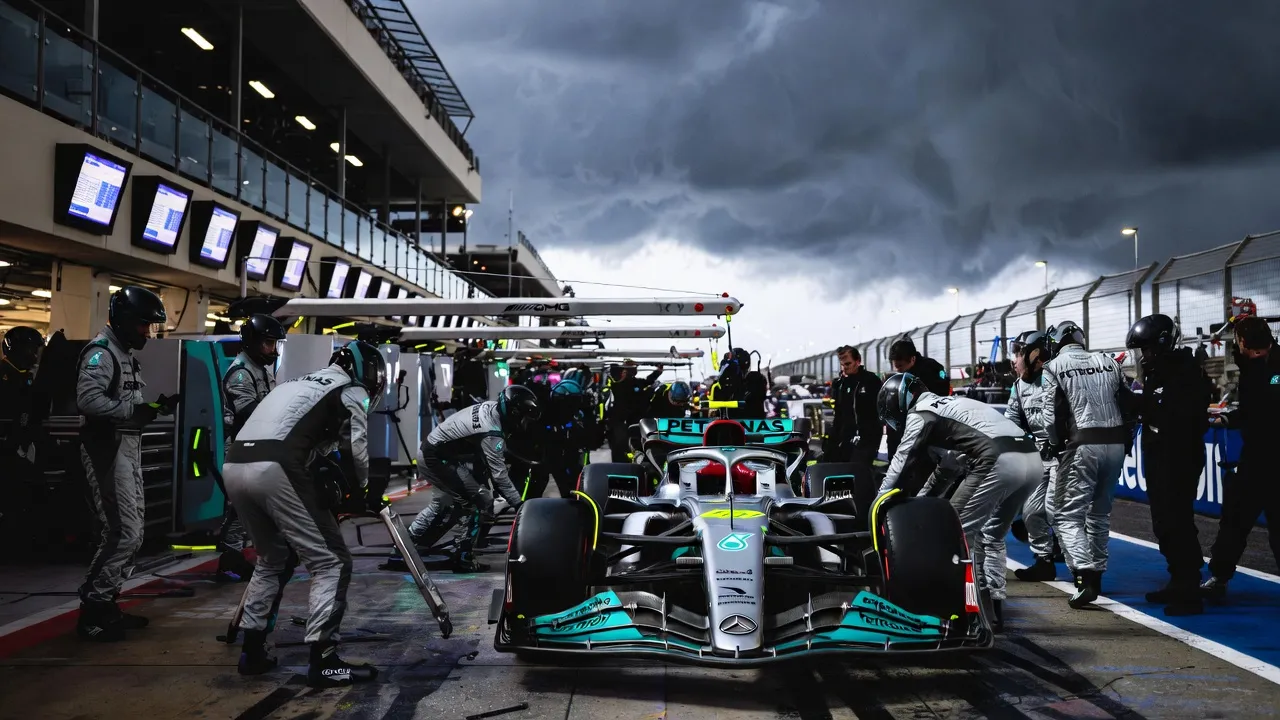
When Kimi Antonelli drove his W17 into the wall at Turn 2 with ten minutes left in FP3, the immediate reaction across the paddock was straightforward: his qualifying was over. The car hit the barrier at high speed, damaging all four corners. Mercedes had roughly two hours — reduced to two hours and ten minutes after FP3 started late due to a Formula 3 barrier incident — to perform a complete rebuild.
They did it. And then their driver qualified second.
Antonelli said it himself after the session: his mechanics were the story. The team got the car out. They couldn't even set it up properly. He just drove it onto the front row anyway.
But that rebuild didn't happen because of luck. It happened because Mercedes spent the last three years of the 2026 regulation cycle building an organization capable of executing under exactly that kind of pressure. The W17's battery management system — the core engineering challenge of the new hybrid regulations — was mapped and refined through months of preparation. When the track temperature dropped at Albert Park on Saturday afternoon, everything they had built came alive. Russell's qualifying lap was over six-tenths faster than anyone had gone all weekend.
Red Bull: Not driver error — regulation error
Max Verstappen entered Turn 1 on his first flying lap, hit the brakes, and the rear axle locked instantly. The car spun 180 degrees into the barriers. No time set. Session over.
This was not a driver's mistake. Martin Brundle called it directly on Sky Sports: the rear axle locked, and in modern F1 cars, you cannot counteract that. The technical analysis points to energy harvesting under braking — when the 2026 hybrid system recovers energy too aggressively during a downshift, the effect is identical to applying a handbrake. Red Bull's MGU-K deployment under braking failed to manage that threshold on Verstappen's first real push lap of the season.
Verstappen had already been critical of the new cars during the weekend, noting steering issues in FP3. The RB22 is not slow — Hadjar qualified P3 in the same car on debut. But the car is clearly not yet calibrated for the edge of its performance envelope.
The defending champion starts Sunday's race from 20th.
Aston Martin: No batteries, no race
The cascade that began in FP1 reached its logical conclusion in qualifying. Honda confirmed only two working batteries remained in Melbourne — one per car — with no replacement units available to ship. Lance Stroll did not leave the garage. Fernando Alonso qualified P17 on what the team described as severely limited power.
The $525M invested in the AMR26 program is sitting at Albert Park, unable to complete a qualifying lap at full capacity. This is not a performance gap. It is a supply chain failure — and one that Adrian Newey has publicly confirmed.
Cadillac: Exactly what was projected
Bottas P18, Pérez P19. Both were eliminated in Q1. The American team's debut weekend has been operationally clean — cars completed laps, no critical incidents. But the pace deficit to the midfield was consistent with what a Ferrari customer-powered new entry should produce in Year 1. In FP2, Bottas was running closer to the pace than Aston Martin's Alonso. That detail will matter when the team reviews its baseline.
ECONOMIC IMPACT
The 2026 regulation reset was sold to the paddock as a great equalizer. Melbourne's qualifying session suggests the opposite: the teams that invested earliest and most intelligently in the new architecture have already separated themselves.
Mercedes' 1-2 qualifying lockout was not a surprise if you tracked their long-run data from FP2. What was a surprise was the margin. Russell's pole lap was three-tenths clear of the field. In the budget cap era, three-tenths of a second in qualifying is not a setup advantage — it is a development advantage that takes years and hundreds of millions of dollars to build.
Red Bull's issue is different. The RB22 showed genuine pace in practice — Verstappen was P6 in FP3 before his qualifying crash, Hadjar qualified P3. The rear axle locking failure is a calibration problem, not a fundamental one. But calibration problems cost race results, and race results cost constructor points that compound over the season under the prize-money distribution model.
Aston Martin's situation costs money more directly. Every lap Alonso and Stroll cannot complete at full power is a lap of data they cannot collect. In a regulation reset year, that data deficit may cost more than the battery replacement parts themselves.
Cadillac has the luxury of low expectations. Their debut result is exactly in range. The $450M anti-dilution payment they effectively financed through their entry fee bought them a seat at the table — not a competitive car in Year 1. That was always the deal.
THE FRAMEWORK
Three stories from Melbourne qualify what the 2026 season will actually be about:
Mercedes rebuilt a car in under two hours and put it on the front row. That is an organizational capability story as much as a technical one. Teams with that level of depth under the budget cap have found ways to concentrate resources that the regulations were designed to prevent — but not prohibit.
Verstappen's crash is a reminder that the new MGU-K deployment rules under braking create a failure mode that didn't exist in the previous regulation cycle. Every team will face this boundary. The ones who map it correctly in the first three races will gain a structural advantage.
Aston Martin's battery crisis is the most financially significant story on the grid right now. If Honda cannot supply replacement units before Bahrain, the team faces two consecutive races with severely compromised machinery. At $525M invested and counting, that is an extraordinarily expensive engineering problem.
PaddockIntel Verdict
Russell starts from the pole. Antonelli starts second after a car that was scrap metal three hours ago. The mechanics at Mercedes deserve a financial bonus that probably isn't in the budget cap.
Verstappen starts 20th — not because Red Bull is slow, but because the most complicated braking system in F1 history snapped at the worst possible moment. He will be racing forward on Sunday. That will be the most interesting economic subplot of the race: what does a Verstappen charge from the back cost Red Bull in terms of mechanical risk versus the points gained?
Aston Martin and Cadillac start from the back for very different reasons. One has $525M invested and no batteries. The other has a realistic first-race target of simply finishing. Both are expected to be somewhere near the back of the grid.
Mercedes qualified 1-2. The race is tomorrow.
the Sources