While the lap times at the 2026 pre-season tests might suggest a team in transition, the financial ledger of Mercedes-AMG Petronas F1 tells a story of absolute dominance. For the first time in the history of the sport, a team has successfully achieved "Competitive Decoupling"—the ability to generate record-breaking profits and valuation surges regardless of on-track results.
As we head into the 2026 regulatory reset, Paddock Intel dissects the financial architecture that has turned a racing team into a $6 billion sports franchise.
The $300M Windfall: The Kurtz Valuation Benchmark
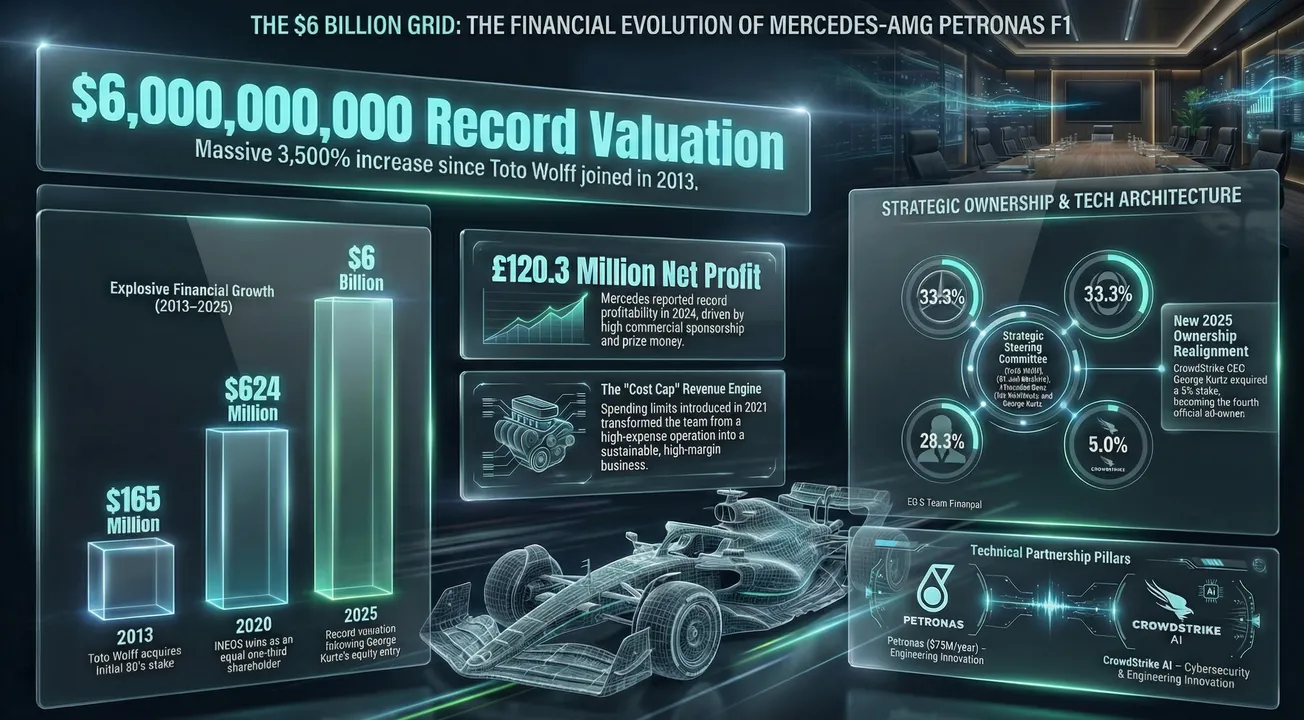
The most significant indicator of Mercedes' financial health isn't a podium; it's the recent entry of George Kurtz, CEO of CrowdStrike. By acquiring a 5% stake through Toto Wolff’s holding company, Kurtz has effectively set the team’s market valuation at a staggering $6 billion (£4.6 billion).
For context, when the tripartite ownership (Wolff, INEOS, and Mercedes-Benz AG) solidified in 2013, the team was valued at approximately $165 million. This represents a 3,500% growth in just over a decade, proving that Toto Wolff’s background in Venture Capital was the ultimate "unfair advantage" in the Paddock.
The "Petronas Lock-In" and Tech-Driven ROI
Critics pointed to Lewis Hamilton’s departure as a potential commercial cliff. However, the operational reality is different. In September 2022, Wolff secured a $75 million annual renewal with Petronas that extends well beyond 2026.
This isn't just a sponsorship; it’s a Technical R&D Partnership. By anchoring the deal to the development of 100% sustainable fuels, Mercedes has de-risked its 2026 Power Unit budget. Petronas isn't paying for stickers on a car; they are paying to co-develop the intellectual property of the next era.
Operational Efficiency: Dividends in the Cost Cap Era
Under the current Financial Regulations, Mercedes has mastered the art of the "Franchise Model." In 2024, despite finishing outside the top spot in the Constructors' Championship, the team reported:
- Turnover: £636 million
- Net Profit: £120.34 million
- Dividends: A £125 million payout to shareholders.
From an Estimating and Onboarding perspective, this is a masterclass. The team has optimized its Brackley facility within a $51 million CapEx limit (2025-2028), ensuring that every dollar spent on infrastructure is directly tied to the 2026 technical reset.
Paddock Intel Verdict
The "Wolff Dynasty" has built a fortress that is immune to a bad Sunday. By pivoting the commercial identity away from driver star power and toward Engineering Excellence and Digital Ecosystems (leveraging partners like WhatsApp and Adidas), Mercedes has ensured that its valuation remains a "Safe Haven" for institutional capital.
In the 2026 era, speed is expensive, but stability is priceless.