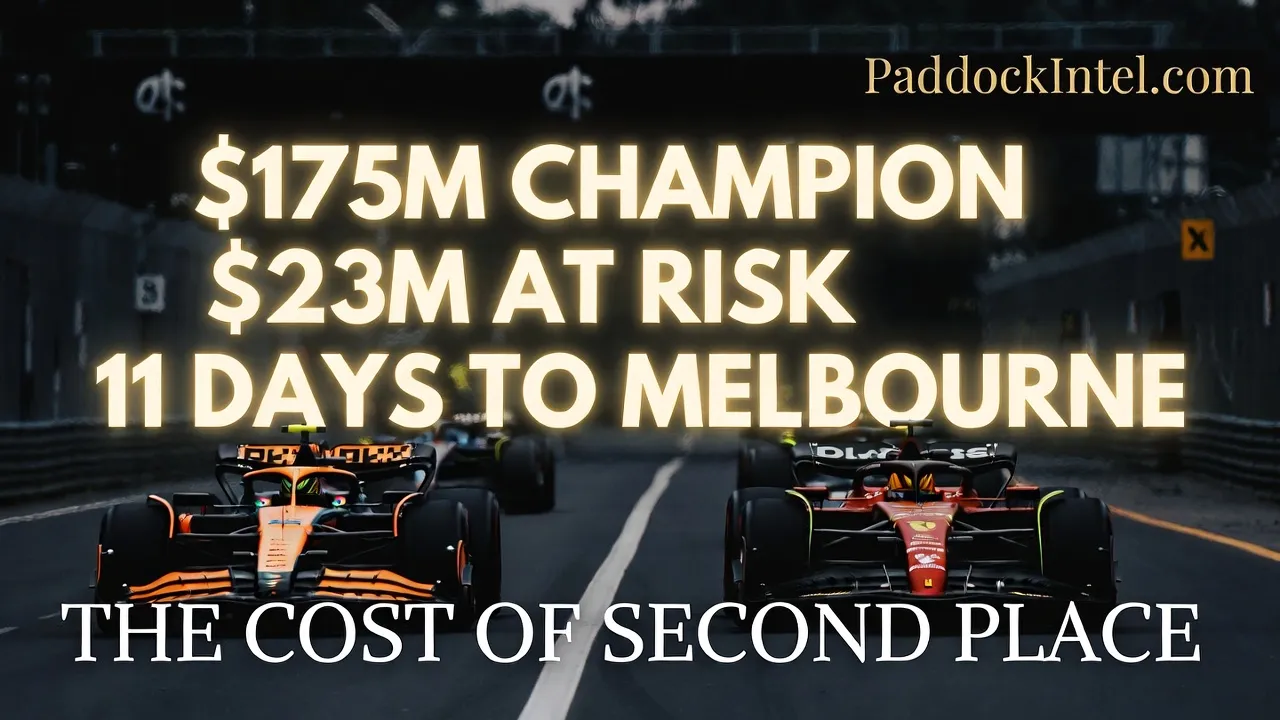
Lando Norris became the Formula 1 World Champion in 2025. McLaren won their second consecutive constructors' title and collected $175 million in prize money — the largest single-season payout in the team's history.
Eleven days before the 2026 season opener in Melbourne, their own team principal is publicly admitting they are not the fastest car on the grid.
"Ferrari and Mercedes are a step ahead," Andrea Stella told the media after Bahrain testing. Norris was more direct: the MCL40 is "a little bit off" on race pace, tyre degradation is a concern, and the concepts that made McLaren dominant in 2025 are not automatically transferable to the new regulations.
Two consecutive championships. $315 million in prize money over two seasons. And heading into 2026 as the third-fastest car.
The financial consequences are precise and significant.
WHAT HAPPENED
McLaren's Bahrain testing was not a disaster. That distinction belongs to Aston Martin. The MCL40 completed over 800 laps across both test weeks — more than any other team — and showed strong reliability throughout. By lap count alone, McLaren had a productive pre-season.
The problem is relative pace.
Charles Leclerc set the fastest time of the entire pre-season on the final day — a 1:31.992 — nearly 0.9 seconds faster than anyone else. Ferrari completed 754 laps with zero major reliability incidents. Mercedes posted 714 laps with Kimi Antonelli setting the second-fastest time of testing at 1:32.803.
McLaren's fastest time was a 1:32.871 from Norris — quick, but clearly behind Ferrari's performance run. More concerning was Norris's admission about race simulation pace: the MCL40 requires more effort to match Ferrari and Mercedes over long stints, resulting in higher tyre degradation.
On the final day, McLaren also lost track time to an apparent cooling issue — a small reliability flag on a car that otherwise ran cleanly all week.
WHY IT HAPPENED
The 2026 regulations represent the most significant technical reset in Formula 1 history. New chassis, new power units, a fundamentally different energy deployment philosophy. The concepts that gave McLaren a race-pace advantage in 2025 — their aerodynamic efficiency, tyre management window, and strategic flexibility — are not automatically transferable to an entirely new technical framework.
Ferrari has spent years developing a power unit architecture specifically optimised for 2026's electrical deployment requirements. The SF-26's pace in race simulations — not just qualifying runs — alarmed McLaren's technical team during the first Bahrain test week.
Mercedes, meanwhile, ran conservatively throughout testing. George Russell and Kimi Antonelli posted strong lap times without showing their hand. Jolyon Palmer noted that Mercedes" deliberately low-key approach "speaks volumes — a team that doesn't need to show pace in testing because they already know they have it.
McLaren's situation is not panic-worthy. Stella confirmed that they completed virtually their entire planned test programme, that the car is reliable, and that Norris and Piastri both extracted useful data. But the honest admission from the team — that Ferrari and Mercedes are ahead — sets up a prize money calculation that matters enormously for 2026 development funding.
ECONOMIC IMPACT
| TEAM | 2025 POSITION | 2025 PRIZE MONEY | 2026 TESTING |
|---|---|---|---|
| McLaren | P1 ✅ | $175M | P3 est. |
| Mercedes | P2 | $164M | P1–P2 est. |
| Red Bull | P3 | $152M | P4 est. |
| Ferrari | P4 | $141M | P1 est. |
| Gap P1 → P3 | — | -$23M/season | Development cost |
| 📊 PaddockIntel.com — Prize money data via Motorsport Week/RacingNews365. Testing position estimates based on Bahrain pre-season results. | |||
| TEAM | 2025 POSITION | 2025 PRIZE MONEY | 2026 TESTING |
|---|---|---|---|
| McLaren | P1 ✅ | $175M | P3 est. |
| Mercedes | P2 | $164M | P1–P2 est. |
| Red Bull | P3 | $152M | P4 est. |
| Ferrari | P4 | $141M | P1 est. |
| Gap P1 → P3 | — | -$23M/season | Development cost |
| 📊 PaddockIntel.com — Prize money data via Motorsport Week/RacingNews365. Testing position estimates based on Bahrain pre-season results. | |||
The prize money mathematics of dropping from first to third is not theoretical. McLaren collected $175 million as the 2025 champions. Ferrari, finishing fourth last year, collected $141 million. The gap between first and third in the constructors' championship is approximately $23 million annually — development funding that either exists or doesn't, depending on F1's $144 million cost cap.
The cost cap context makes this critical. Every dollar of prize money is development capacity. A team finishing third instead of first has $23 million less to spend on upgrades across a 24-race season. At $10 million per constructor position in prize money terms, the difference between Melbourne expectations and Bahrain testing reality could cost McLaren two championship positions — and $20 million — before the first chequered flag drops.
There is also the sponsorship dimension. McLaren's title sponsorship portfolio — Mastercard, Google, OKX, VELO — carries premium rate cards built on championship-winning status. Two consecutive titles command rates that a third-place team cannot maintain at renewal. The commercial overhang of losing the constructors' title is not felt only in 2026, but also in the 2027 and 2028 contract renewals.
PaddockIntel Verdict
McLaren's testing admission is honest, professional, and ultimately the correct strategic communication. Stella is managing expectations rather than generating alarm. The MCL40 is fast, reliable, and in the hands of a world champion driver.
But the prize money is already recalibrating. The 2026 constructor payment McLaren receives is based on their 2025 championship win — $175 million banked regardless of what happens in Melbourne. The 2027 payment, however, will reflect 2026 performance. If Ferrari and Mercedes are genuinely faster over a full season, McLaren's financial trajectory reverses for the first time since 2023.
Two titles. $315 million. A testing gap they openly admit exists.
The championship defence starts in eleven days.