— WHAT HAPPENED —
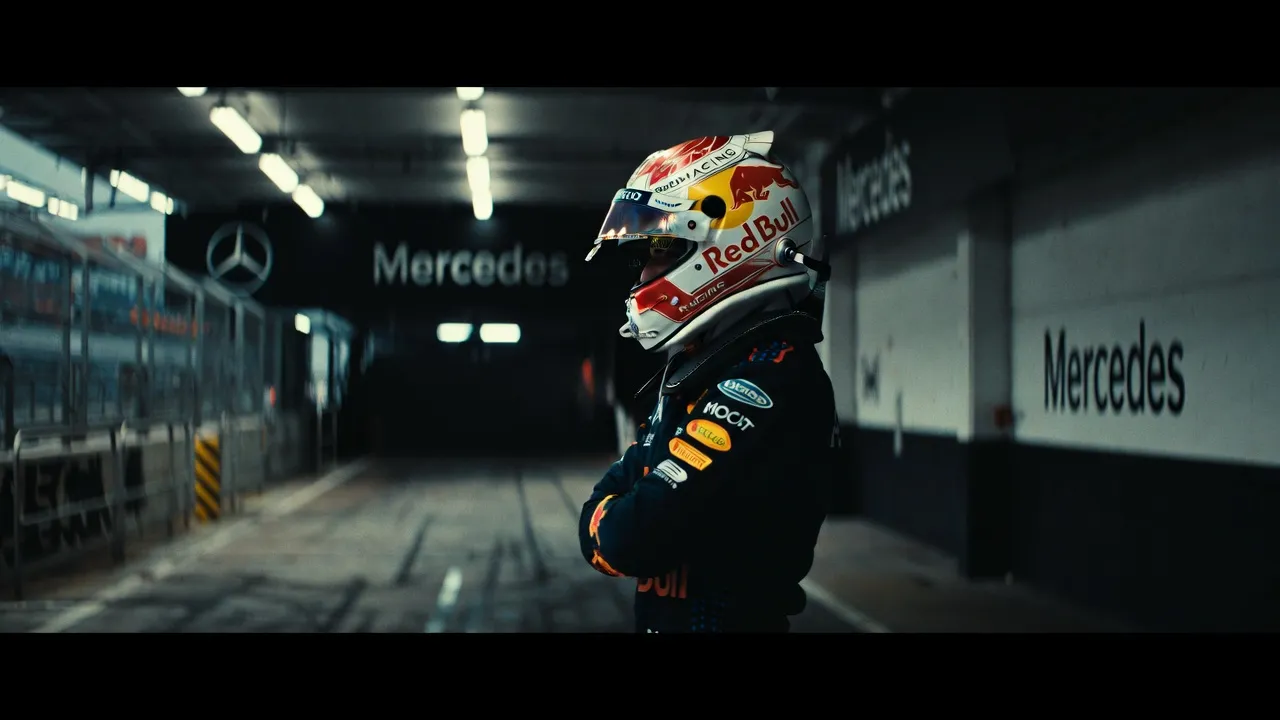
Max Verstappen called the 2026 regulations his "least favourite" era of Formula 1. He used the word "management" to define the entire season. He left a hint — deliberately vague, typically Verstappen — about Mercedes engines. And Toto Wolff, the man who spent the entire summer of 2025 trying to pry him away from Red Bull, is now watching from Brackley with a team that looks genuinely fast in pre-season testing.
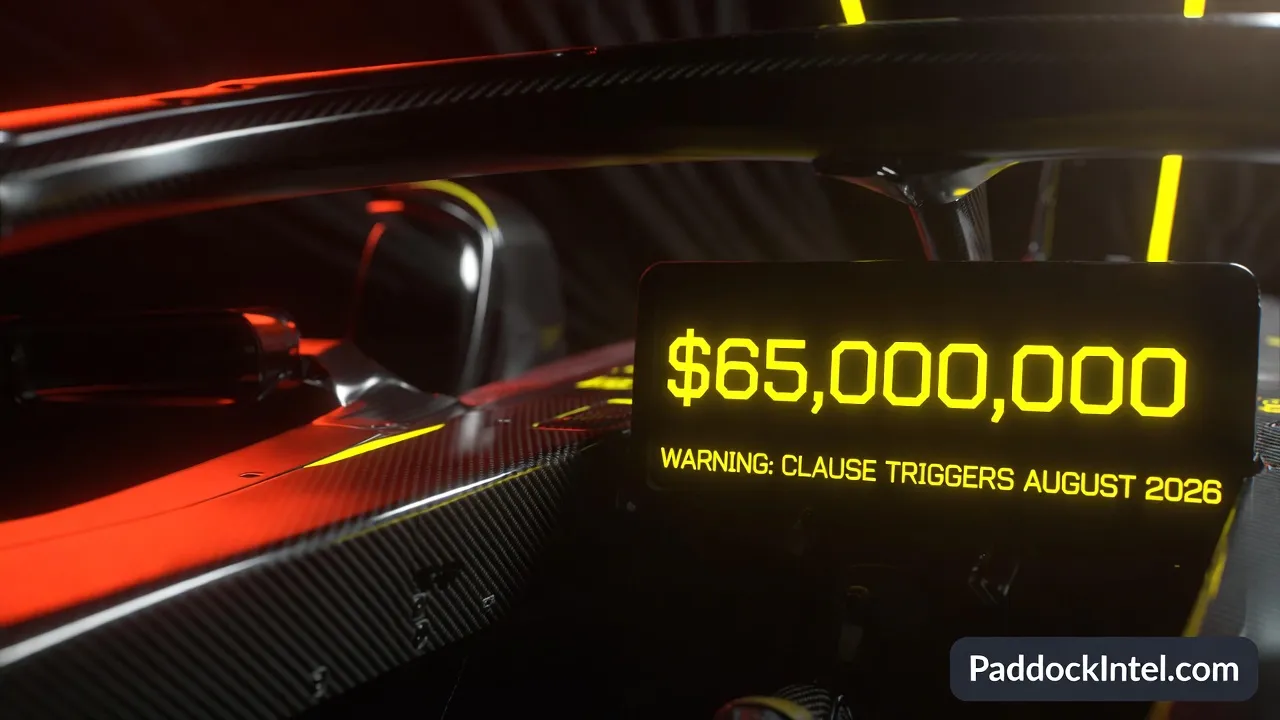
The story the paddock is telling is about a driver who isn't happy. The story PaddockIntel is telling is about a contract clause worth more than the $65 million salary attached to it.
— WHY IT HAPPENED —
Verstappen's current Red Bull deal runs until the end of 2028 — a five-year, $275 million contract signed in early 2022, according to Spotrac, averaging $55 million annually with escalating base salaries reaching $65 million in 2026. With performance bonuses, total annual earnings are estimated between $75 million and $95 million, making him the highest-paid driver on the grid by a significant margin.
But the contract has teeth in both directions.
Embedded within the deal is a performance-linked exit clause. The exact trigger has been reported differently by different outlets, but the consistent version — confirmed by Sky Sports F1, ESPN, and Motorsport.com — is this: if Verstappen finishes below a defined championship position threshold before the summer break, he is contractually free to leave. In 2025, that threshold was P3. The clause didn't activate — Verstappen held P3 going into the August break despite a difficult season. For 2026, Sky Sports F1 reported that the threshold would tighten to P2., If he's third or lower at the summer break, he can walk.
That changes everything.
Red Bull enters 2026 with its first in-house power unit, developed alongside Ford. Nobody outside the factory knows exactly where it sits relative to Mercedes, Ferrari, and the new Audi unit. Pre-season testing in Bahrain showed flashes of strong energy deployment from Red Bull, but Verstappen himself described the car as requiring a fundamentally different driving style — more sliding, more management, less of the mechanical grip that defined the dominant RB19 era.
Meanwhile, Mercedes, which Wolff openly confirmed had "conversations behind closed doors" with Verstappen's camp throughout 2025, arrives at Melbourne with what multiple sources describe as the strongest power unit on the grid. Ferrari is fast. McLaren won the 2025 title. Red Bull is an unknown.
*"My contract runs until 2028, but it will depend on the new rules in 2026, and if they are nice and fun. If they are not fun, then I don't really see myself hanging around."* — Max Verstappen, Qatar GP 2025
— ECONOMIC IMPACT —
The financial architecture of this situation has three layers, and none of them are simple.
Layer 1: What Red Bull loses if the clause activates
Verstappen is not just Red Bull's fastest driver — he is the commercial engine of the entire operation. Red Bull Racing's sponsorship value is inextricably linked to his presence. Oracle's title sponsorship, estimated at $100 million annually, was negotiated with Verstappen as the centerpiece of the team's identity. Brands like Jumbo, Castore, and the broader Red Bull portfolio of personal endorsements attached to the car depend on his continued participation.
Losing Verstappen mid-contract would not just cost Red Bull a driver; it would cost Red Bull a driver. It would trigger a renegotiation of commercial deals structured around a four-time world champion behind the wheel. The prize money impact is equally direct: Red Bull collected an estimated $145 million in 2025 prize money distributions based on their Constructors' position. A Verstappen departure to a rival team could shift $30-50 million in Constructors' prize money to whoever catches him.
Layer 2: What Mercedes would actually have to pay
Damon Hill put it simply: "astronomical." Wolff confirmed conversations happened. The market reality is that signing Verstappen away from Red Bull before 2028 would require buying out the remaining contract value — estimated at $130-180 million, depending on year of departure — plus offering a new deal competitive with his current $65 million base. Industry sources suggest a Mercedes Verstappen deal would realistically start at $80-90 million annually, making it the most expensive driver contract in F1 history.
For context: Mercedes' total annual operating budget under the 2026 cost cap framework sits around $215 million. A $90 million driver salary would represent over 40% of that figure before a single car component is purchased.
Layer 3: The 2026 exit clause as real-time leverage
The most underreported angle is this: Verstappen doesn't need to leave Red Bull for the clause to be valuable. Its existence alone forces Red Bull to prioritize his car development above everything else. Every strategic decision — tire allocation, upgrade sequencing, race strategy — is now filtered through the question of whether Verstappen will be P2 or better before the August break.
Red Bull GmbH CEO Oliver Mintzlaff addressed this directly in December 2025: "I'm not afraid of any performance clause in his contract. The most important thing is that Max sees everyone on the team giving their all for him." That statement is not reassuring. It is a public commitment, made under financial pressure, to a driver who holds a contractual exit ramp.
| # | DRIVER | BASE SALARY | RELATIVE SCALE | NOTE |
|---|---|---|---|---|
1 |
Max Verstappen
RED BULL RACING
|
$65M
Total w/ bonuses: ~$75-95M
|
EXIT CLAUSE ACTIVE | |
2 |
Lewis Hamilton
FERRARI
|
$60M
Total w/ bonuses: ~$100M
|
MULTI-YR FERRARI | |
3 |
Lando Norris
McLAREN
|
$30-35M
Reigning champion
|
CHAMP CONTRACT | |
4 |
George Russell
MERCEDES
|
$25-30M
Flexible contract structure
|
WOLFF FLEX DEAL | |
5 |
Charles Leclerc
FERRARI
|
$25-30M
Long-term Maranello deal
|
LONG TERM | |
6 |
Fernando Alonso
ASTON MARTIN
|
$20-25M
Veteran premium
|
VETERAN DEAL | |
7 |
Kimi Antonelli
MERCEDES
|
$5-8M
Sophomore season
|
RISING VALUE | |
8 |
Isack Hadjar
RED BULL RACING
|
$0.5-1M
Rookie contract
|
ROOKIE |
— PADDOCKINTEL VERDICT —
The paddock narrative around Verstappen in 2026 is being written as a story about an unhappy champion. The economic reality is more precise: a $65 million driver holds a contractual weapon that is currently pointed at the team paying his salary, and the trigger gets easier to pull with every race Red Bull finishes outside the top two. Toto Wolff doesn't need to make a call. He just needs to wait until August.
SOURCES
Spotrac — Verstappen contract details
- Sky Sports F1 — Exit clause P2 threshold 2026
- ESPN — Exit clause confirmation, Belgian GP
- Motorsport.com — Clause analysis + Wolff timeline
- Motorsport.com — Wolff "just a coincidence"
- Newsweek — Damon Hill "astronomical" salary quote