While the headlines focus on lap times, the true story of the 2026 pre-season testing opener in Bahrain lies in the operational balance sheets of the teams. Lando Norris topping the timesheets serves as a marketing validation for McLaren's championship defense, but the underlying economic indicators point to significant strategic divergences across the grid. In the high-stakes environment of Formula 1's Cost Cap era, testing is not just about speed—it is about the Return on Investment (ROI) of every kilometer driven.
The Reliability Multiple: Red Bull’s Volume Strategy
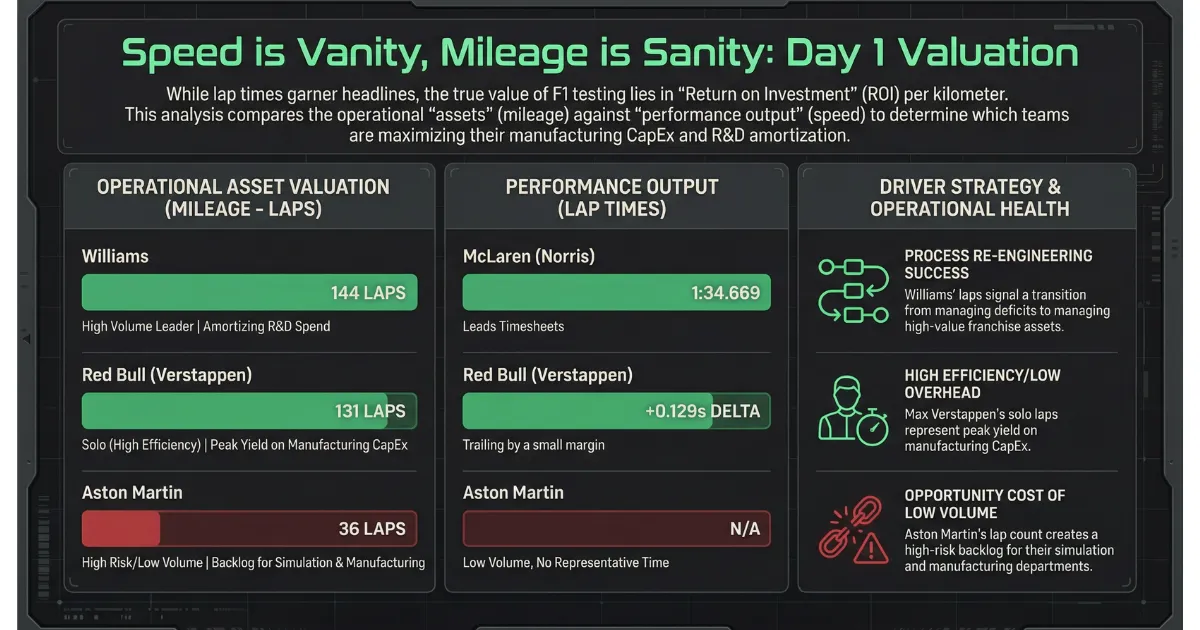
The most significant data point of Day 1 was not Norris’s 1:34.669, but Max Verstappen’s 131 laps. In the context of a newly built engine project for 2026, this volume represents a massive competitive advantage in Unit Economics.
Red Bull Racing is effectively amortizing its R&D spend faster than its competitors. By completing more than two Grand Prix distances in a single day, they are driving down the Cost per Terabyte of data gathered. In financial terms, early reliability acts as a hedge against future operational expenditure. Every failure identified in Bahrain is one that does not occur in Melbourne or Jeddah, where the logistics of shipping replacement parts would significantly impact the Cost Cap bottom line. Red Bull's ability to run uninterrupted signals that its supply chain and assembly quality control are operating at peak efficiency, maximizing yield on its manufacturing CapEx.
Williams: Operational Turnaround as an Asset Class
Perhaps the most bullish signal comes from the Williams garage. Historically plagued by logistical delays and missed shakedowns—classic indicators of operational insolvency—the Grove-based team logged a combined 144 laps, the highest of any team.
This is a clear indicator of successful process re-engineering. Under the 2026 regulations, efficiency is currency. Williams has transitioned from a team managing deficits to one managing assets. By maximizing track time, they are validating their correlation models between CFD (Computational Fluid Dynamics) and track reality earlier than rivals. This correlation efficiency reduces the need for iterative manufacturing of aero parts later in the season, freeing up budget for performance development rather than error correction. For investors monitoring the valuation of franchise assets, Williams demonstrated the highest day-over-day operational gain.
The Newey Premium vs. Sunk Cost Risks
Aston Martin’s low mileage (36 laps) presents a contrasting risk profile. With the first car designed under Adrian Newey, market expectations were high. However, limited running suggests potential integration issues or a deliberate, cautious rollout. In the Economy of Things, time on track is a perishable resource.
Every hour the car sits in the garage, the Opportunity Cost rises. While Newey’s designs often carry a "performance premium" that pays off later, the lack of data gathering on Day 1 puts pressure on the team's simulation departments. If the track data does not flow, the verification of the Digital Twin is delayed, potentially creating a backlog of manufacturing decisions that must be rushed—and therefore become more expensive—before the first race.
Entry Capital: The Cadillac and Audi Equation
The 2026 grid introduces major OEM capital via Audi and Cadillac. Their performance—118 laps for Sauber/Audi and 104 for Cadillac—reflects a standard Market Entry Strategy. They are not chasing lap-time liquidity but rather the solvency of systems checks.
For these new entrants, the primary goal is to establish a baseline for Thermal Efficiency and energy deployment management. Their lap counts suggest a robust start to their operational logistics, avoiding the embarrassing mechanical failures that often plague new entrants. This reliability is critical for maintaining confidence among corporate boards in Detroit and Ingolstadt, proving that the massive Foreign Direct Investment (FDI) into F1 is yielding functional industrial machinery.
Conclusion: The Efficiency Metric
Ultimately, "Lando Norris fastest on day one of F1 testing in Bahrain" is the headline for the fans. For the PaddockIntel analyst, the winner of Day 1 is the entity with the lowest Cost per Validated Data Point. Red Bull and Williams have emerged as the leaders in this metric, leveraging their assets to the fullest. McLaren has proven performance, but the true test of their economic efficiency will be in sustaining that speed without blowing through their development budget early in the cycle.