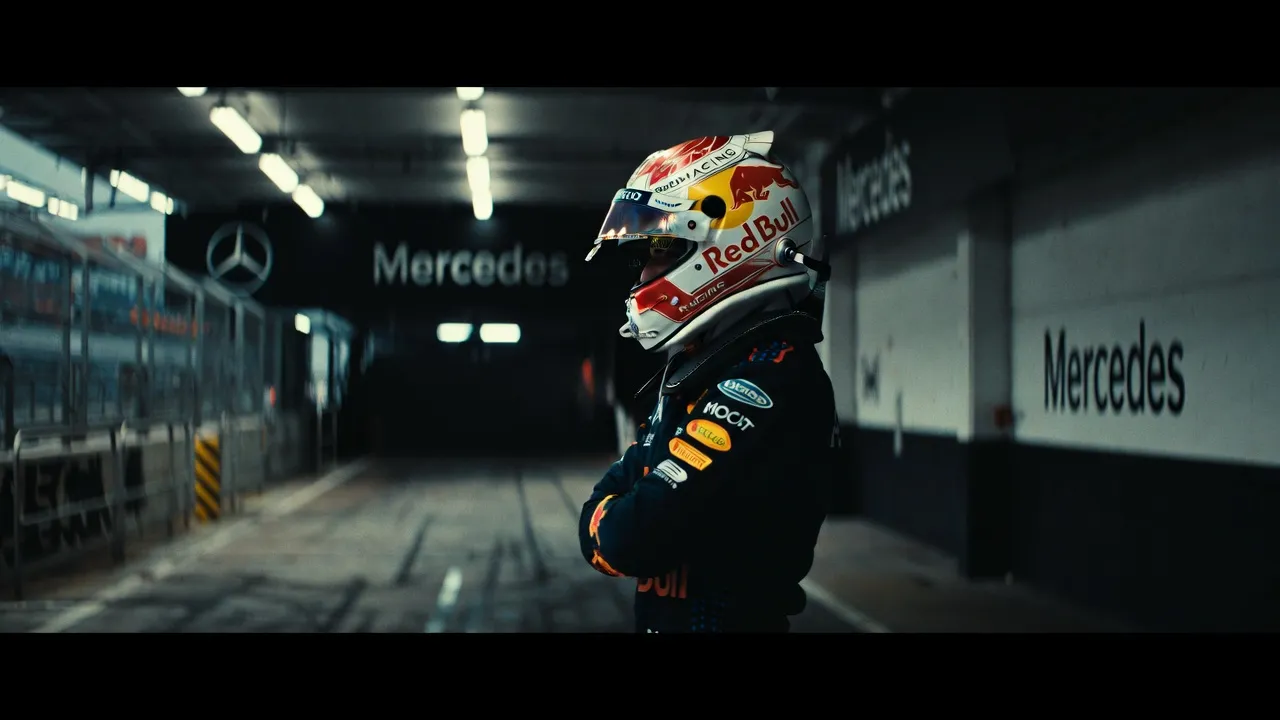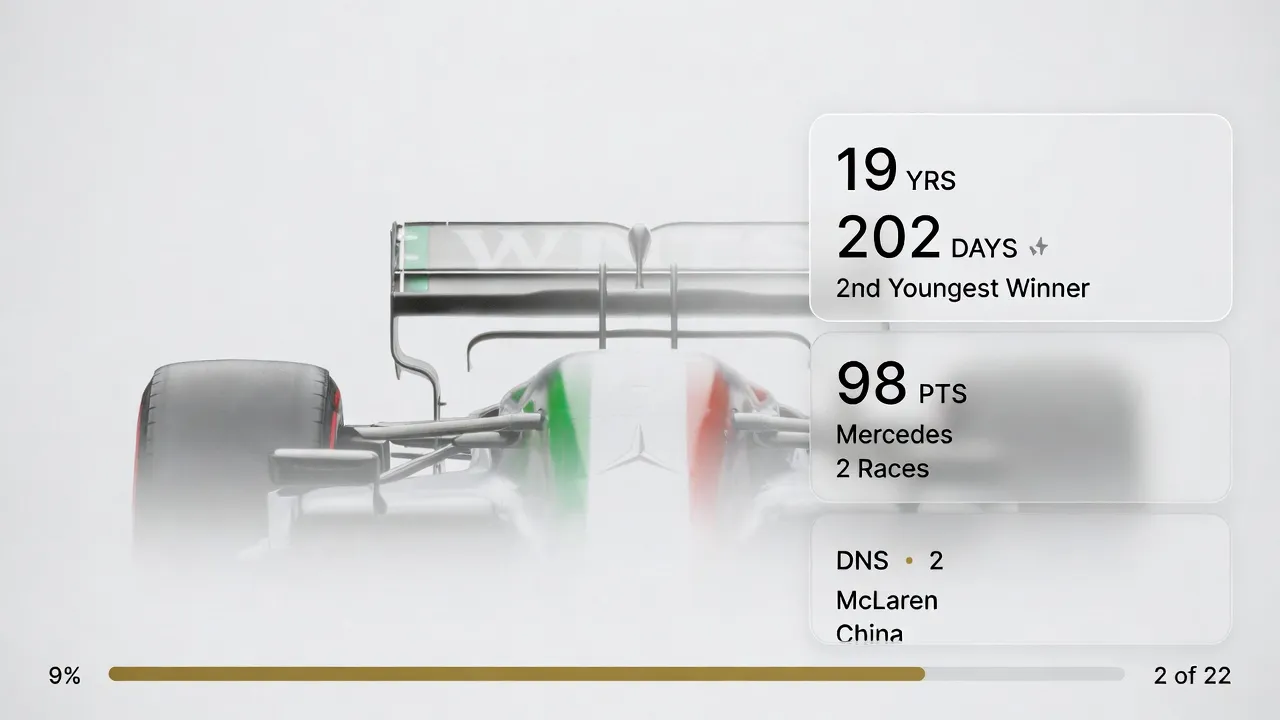
When Mercedes confirmed Kimi Antonelli as Lewis Hamilton's replacement for 2025, the headlines focused on his age — 18 years old, the third-youngest driver in F1 history. The emotional narrative wrote itself: Italian prodigy, Bologna-born, Senna's number 12, replacing a seven-time world champion.
But beneath the storyline, Mercedes was making a cold, calculated financial decision that stretches well beyond 2026. This is the economic case for Andrea Kimi Antonelli — and why it may be the most strategically sound driver investment in modern Formula 1.
WHAT HAPPENED
Kimi Antonelli entered F1 in 2025 on a rookie contract worth approximately $2 million base salary — replacing Lewis Hamilton, who had been earning an estimated $50 million per year at Mercedes. After a debut season that included three podiums, a Sprint pole in Miami, and a seventh-place finish in the Drivers' Championship, Mercedes confirmed him for 2026 alongside George Russell.
His 2026 contract reflects that upward trajectory: base salary of $5 million, with total compensation reaching an estimated $12.5 million when bonuses are included. Meanwhile, Mercedes finished second in the 2025 Constructors' Championship, earning approximately $164 million in prize money — their best result since their dominant era ended in 2021.
Heading into Bahrain pre-season testing, Antonelli topped the timing sheets on multiple sessions, and Mercedes arrived in the desert as the bookmakers' clear favorite for the 2026 title under new regulations.
WHY IT HAPPENED
Mercedes didn't sign Antonelli because Hamilton left. They signed Antonelli because the 2026 regulations gave them a rare window — and Antonelli is built for exactly this kind of moment.
The 2026 rule overhaul touches both chassis and power unit architecture, eliminating the MGU-H and introducing a significantly more powerful electrical deployment system. This reset punishes accumulated car knowledge and rewards raw development speed. In that environment, a 19-year-old with no bad habits and total immersion in the new machinery is not a liability. It's a feature.
Toto Wolff has spent years building Mercedes' junior program into one of the most structured driver development pipelines in motorsport. Antonelli joined it at age 12, was fast-tracked through F4 and Formula Regional by skipping F3 entirely, and arrived in F2 at 17. The investment began years before his F1 debut. By the time he signed for the main team, Mercedes had already spent significant resources building him specifically for this role.
The Hamilton departure also reframed the calculus. At $50 million per year, Hamilton was the highest-paid non-Verstappen entity on the grid. Replacing him with Antonelli at $2 million — even accounting for the full performance-bonus ceiling — frees up capital that flows directly into car development under the cost cap structure. Driver salaries remain exempt from the budget cap, but the organizational bandwidth consumed by managing a seven-time champion is not free. Antonelli, by contrast, is entirely aligned with Mercedes' long-term architecture.
"He's going into his second season knowing all the tracks, all the requirements — there's no doubt about his speed or his race craft." — Toto Wolff, February 2026
ECONOMIC IMPACT
The financial logic behind the Antonelli decision operates on three distinct layers: direct compensation savings, prize money leverage, and long-term brand asset value.
| DRIVER | BASE SALARY | MAX w/ BONUSES | SEASON |
|---|---|---|---|
| Lewis Hamilton | $50,000,000 | ~$55,000,000 | 2024 (final at Mercedes) |
| Kimi Antonelli | $2,000,000 | ~$4,000,000 | 2025 (rookie) |
| Kimi Antonelli | $5,000,000 | ~$12,500,000 | 2026 |
| Annual Saving vs Hamilton | $45,000,000 | ~$37,500,000 | 2026 |
| 📊 PaddockIntel.com — Driver salary data via public reports & Spotrac estimates | |||
| SEASON | CONSTRUCTORS POSITION | PRIZE MONEY (EST.) | YoY CHANGE |
|---|---|---|---|
| 2023 | 2nd | ~$145,000,000 | — |
| 2024 | 4th | ~$130,000,000 | -$15,000,000 |
| 2025 | 2nd | ~$164,000,000 | +$34,000,000 |
| 2026 (if 1st) | 1st 🏆 | ~$175,000,000+ | +$11,000,000 |
| 4th → 1st swing (2024 → 2026) | +$45,000,000 potential | ||
| 📊 PaddockIntel.com — Prize money estimates via RacingNews365, Motorsport Week & Liberty Media Q3 2025 | |||
| REVENUE STREAM | 2025 ACTUAL | 2026 PROJECTION (Title) |
|---|---|---|
| Prize Money (Constructors) | $164,000,000 | $175,000,000+ |
| Sponsorship Revenue | $130,000,000 | $140,000,000+ (est.) |
| Driver Cost (Antonelli) | -$4,000,000 | -$12,500,000 |
| Driver Cost (Russell) | -$26,000,000 | -$26,000,000 |
| Compensation saving vs Hamilton era | +$46,000,000 | +$37,500,000 |
| Total Commercial Upside (est.) | $264,000,000 | $314,000,000+ |
| 📊 PaddockIntel.com — All figures estimated. Prize money via Liberty Media & RacingNews365. Sponsorship via RN365/ChaseYourSport. |
The Compensation Arbitrage
The immediate saving is significant but often underestimated. Hamilton's $50 million annual salary was not simply a line item — it represented a structural commitment that shaped how Mercedes allocated resources across the organization. Antonelli's 2026 package at $12.5 million (including maximum bonuses) creates a gap of approximately $37.5 million annually. Even if a portion of that is redirected into development, the flexibility alone has compounding value across a multi-year regulation cycle.
The Prize Money Multiplier
Mercedes earned $164 million in 2025 prize money after finishing second in the Constructors' Championship. The difference between first and second place in the prize pool is approximately $11 million. If Antonelli contributes meaningfully to a championship-winning campaign in 2026 — the first year of new regulations where Mercedes enters as favorite — the financial return on his contract could exceed 10x in prize money differential alone.
Every Constructor's position carries weight. Moving from fourth (2024) to second (2025) added an estimated $30 million to Mercedes' prize distribution. A title in 2026, Mercedes' first since 2021, would push that figure higher still — in an environment where the total prize pool has already reached $1.6 billion and continues growing with F1's commercial expansion.
The Long-Term Brand Asset
This is the layer no competitor is modeling. If Antonelli wins a World Championship at 19 or 20 years old, Mercedes holds the contract rights to arguably the most commercially valuable driver in the sport — for the remainder of a career that could span two more decades. The sponsorship premium attached to a young, winning, Italian driver at a German works team is not theoretical. It is the exact profile that global brands in fashion, technology, and lifestyle have been seeking in F1 since Liberty Media's audience expansion began.
Mercedes' current sponsorship portfolio generates approximately $130 million annually. A championship-winning Antonelli — the face of a new era — creates the conditions for that number to move materially upward at the next renewal cycle.
PaddockIntel Verdict
The Antonelli signing is not a gamble. It is a multi-year financial position, structured around a regulation reset that Mercedes helped design and that its power unit is optimized for. The $37.5 million compensation gap versus Hamilton, combined with $164 million in 2025 prize money and a title-caliber car entering 2026, makes this one of the highest-ROI driver decisions in recent F1 history.
The risk is performance inconsistency — something Wolff himself acknowledged from 2025. But the structure of the bet insulates Mercedes against that risk: even a competitive but non-winning season still delivers prize money in the $150 million range, while preserving a driver asset whose value compounds every year he stays on the grid.
Mercedes didn't replace Hamilton with a teenager. They replaced a $50 million annual liability with a $5 million long-term investment that could define the next era of the sport.
The math checks out. Now Melbourne has to.