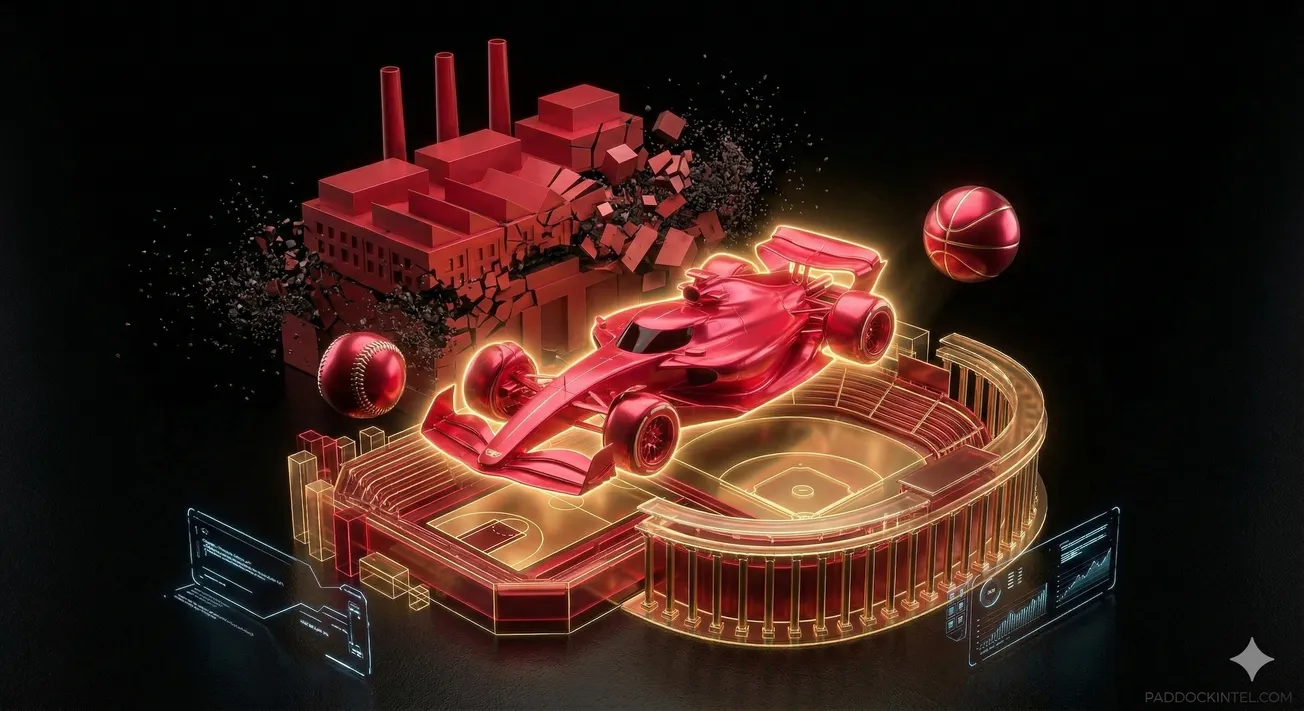
Scuderia Ferrari has reached a $6.5 billion valuation, officially decoupling the team’s worth from the parent company's industrial output. This 2026 appraisal signals a shift where F1 teams are no longer automotive marketing arms, but sovereign media franchises competing with the NBA and MLB for capital dominance.
Intelligence Index
01. The Scarcity Premium 02. F1 vs. Major League Benchmarks 03. The 2026 Prize Money Multiplier 04. The Paddock Intel VerdictThe latest institutional appraisals confirm that Ferrari has shattered the $6 billion ceiling, establishing a new "Blue Chip" tier in motorsport. This valuation is not supported by road car sales or traditional title sponsorships alone; it is driven by the 2026 regulatory framework which guarantees a fixed winners' share and a hard cost cap of $215 million. By limiting supply while demand for grid slots—evidenced by Cadillac’s $30 million monthly burn—continues to surge, Liberty Media has created a rare environment of extreme asset scarcity.
The Scarcity Premium
Unlike the automotive sector, where valuations are tied to unit margins and cyclical demand, Ferrari’s racing division is now priced as a "Veblen Good." The Concorde Agreement’s anti-dilution clauses have effectively locked the grid at 10-11 entities, making a team purchase the only entry point into a $34 billion global ecosystem. This regulatory moat ensures that even a mid-field performance carries a multi-billion dollar valuation floor, as demonstrated by the recent Cadillac Investment Strategy which prices entry-level equity at nearly $2 billion.
F1 vs. Major League Benchmarks
For the first time, the average F1 team is more valuable than the average MLB franchise. Ferrari’s $6.5 billion mark places it on par with the New York Yankees or the Golden State Warriors, yet with a significantly more efficient cost structure due to the $215 million spending limit. This "Margin Superiority" is the primary driver for institutional investors. While an MLB team’s payroll can fluctuate wildly, an F1 team’s primary operational expense is capped, leading to predictable EBITDA projections that traditional sports leagues struggle to match in a high-inflation environment.
The 2026 Prize Money Multiplier
The impending 2026 shift toward a 25% winners' prize share acts as a valuation multiplier for Tier 1 teams like Ferrari. Under the new commercial agreements, the delta between winning and finishing fourth is no longer just a sporting statistic; it is a direct equity booster. This structural tension is what forces teams to maintain technical authority, as seen in the 2026 Prize Money Analysis. For Ferrari, the path to a $10 billion valuation by 2030 relies solely on its ability to capture this winner-take-most financial model.
THE PADDOCK INTEL VERDICT
Ferrari is no longer a car company that races; it is a $6.5 billion financial fortress that uses racing as its primary engine for capital appreciation. The $215M cost cap has transformed the team from a cost center into a high-margin cash generator. As long as the regulatory moat of the Concorde Agreement holds, Ferrari's valuation is not a bubble—it is the new baseline for elite global sports assets. Conclusion: Strong Hold/Accumulate for $FWONK stakeholders.