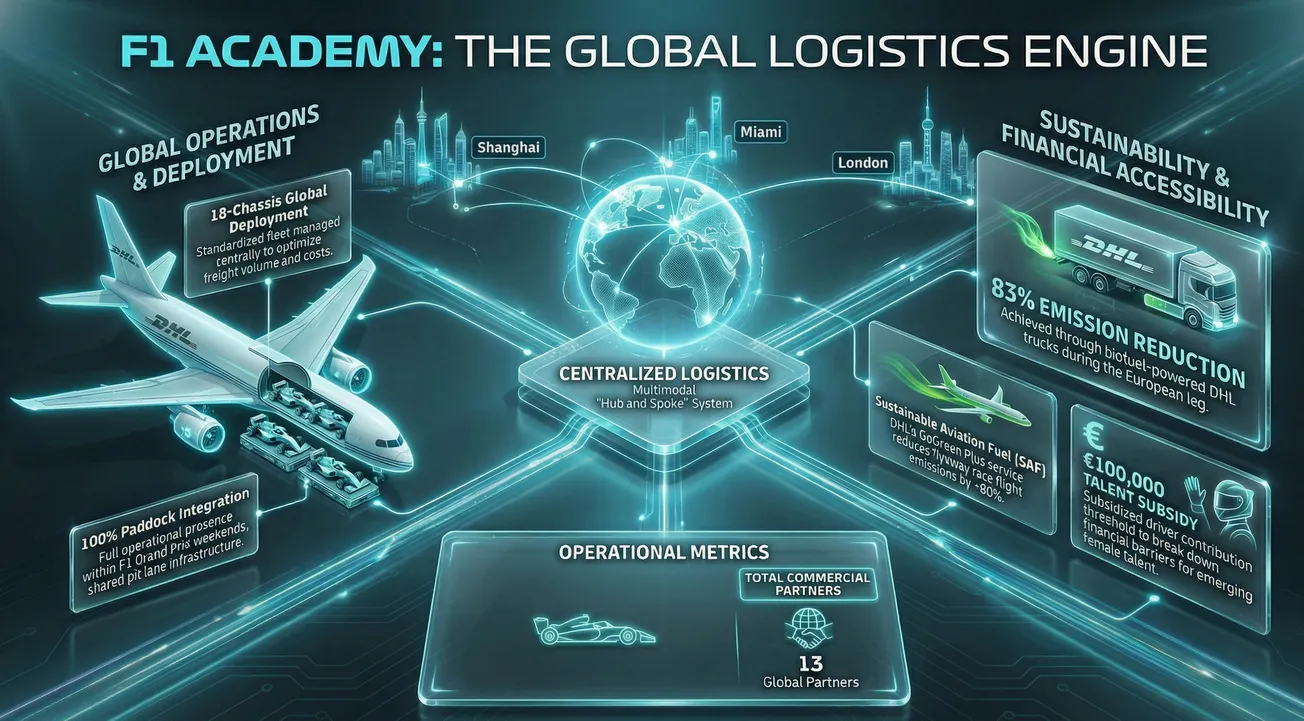
F1 Academy is entering its fourth season in 2026 with a fully stacked grid, seven race weekends on the calendar, and a roster of corporate sponsors that reads more like a Fortune 500 dinner party than a grassroots motorsport initiative. American Express, TAG Heuer, Standard Chartered, and TeamViewer are all official partners of the all-female series. Ten of Formula 1's eleven teams field a car. Cadillac, the new entrant, joins in 2027.
The narrative around F1 Academy tends to focus on representation, talent development, and the pipeline for future female F1 drivers. All of that is real. But it sits on top of something else entirely: a carefully structured sponsorship activation platform that gives corporate partners direct access to F1's fastest-growing and youngest demographic — at a fraction of what it costs to sponsor a main grid seat.
This is not a charity. It's a business model.
— WHY IT HAPPENED —
When Liberty Media acquired Formula 1's commercial rights in 2017, it inherited a sport with one critical commercial problem: its fanbase was aging, male-dominated, and geographically concentrated. Drive to Survive started solving the first two issues. F1 Academy, launched in 2023, was designed to accelerate that work.
The logic was simple. If you want to grow F1's audience among women, younger viewers, and North American markets, you need female athletes competing under F1 branding, at F1 race weekends, in front of F1 cameras. You need a product that corporate partners — especially financial services companies and luxury brands — can attach their names to without the reputational risk of motorsport's historically exclusive image.
The series arrived at the right moment. By 2025, over 300 million F1 fans globally were aged 18 to 34, according to American Express's own announcement when expanding its F1 partnership. That is the exact demographic that financial services companies, luxury watchmakers, and global banks are most aggressively competing to capture.
American Express was among the first to recognize this. It joined F1 Academy in 2024 as one of its earliest non-motorsport corporate sponsors, activating the deal not just through car liveries but through in-person cardholder events at race weekends, promotions of local female-owned businesses at each circuit, and Shop Small branding visible on-track in every market. In 2025, Amex expanded its deal from a regional Americas partnership to a full global F1 Official Partner — a significant escalation driven in part by the returns it was seeing through the Academy relationship.
TAG Heuer followed its own strategic logic. As a member of the LVMH group and, from 2025, newly reinstated Official Timekeeper of Formula 1, TAG Heuer positioned F1 Academy as its platform for the next generation of luxury watch consumers. The brand sponsored the 2026 grid entry of Megan Bruce — a 21-year-old British driver racing for Campos Racing — putting its name on a driver at the beginning of her career rather than at the peak, in a calculated bet on long-term brand loyalty.
Standard Chartered completed the picture. The global bank joined as an Official F1 Partner in a multi-year deal announced ahead of the 2026 season, with coverage explicitly extending to F1 Academy. The deal mirrors Standard Chartered's long-running front-of-shirt sponsorship with Liverpool FC — a deal reportedly worth £50 million per season — and signals how seriously the bank views F1 Academy as a vehicle for reaching clients across Asia, Africa, and the Middle East, the exact regions where the bank operates its core business.
| SPONSOR | SECTOR | ROLE IN F1 ACADEMY | STRATEGIC OBJECTIVE | STATUS |
|---|---|---|---|---|
|
TAG HEUER
LVMH GROUP · OFFICIAL PARTNER & TIMEKEEPER
|
Luxury Watches |
Official Timepiece + backs Megan Bruce / Campos Racing in 2026 |
Reach next-gen luxury consumers before brand loyalty is established |
ACTIVE 2026 |
|
AMERICAN EXPRESS
GLOBAL F1 OFFICIAL PARTNER · SINCE 2023
|
Financial Services |
Car livery branding + cardholder events at each race weekend |
Activate Millennial & Gen Z acquisition — fastest-growing Amex segment |
EXPANDED 2025 |
|
STANDARD CHARTERED
OFFICIAL F1 PARTNER · MULTI-YEAR DEAL 2026
|
Global Banking |
Official partner covering both F1 and F1 Academy |
Reach Asia, Africa & Middle East markets where StanChart operates core business |
NEW 2026 |
|
TEAMVIEWER
GLOBAL PARTNER
|
Enterprise Software |
Series-level branding across F1 Academy platform |
Associate brand with digital innovation and inclusion narratives |
ACTIVE |
|
MASTERCARD
McLAREN F1 ACADEMY LIVERY
|
Payments |
Branding on McLaren's F1 Academy entry alongside main F1 deal |
Extend existing McLaren relationship into younger demographic touchpoint |
ACTIVE |
|
SCHNEIDER ELECTRIC
McLAREN RACING PARTNER
|
Energy Technology |
Multi-team McLaren deal includes F1 Academy entry |
Showcase sustainability credentials across all McLaren race platforms |
NEW 2026 |
— ECONOMIC IMPACT —
The financial architecture of F1 Academy is built around two revenue streams that flow in opposite directions. Corporate sponsors pay into the series — through official partnerships, car liveries, and driver representation deals. F1 teams invest by operating cars and providing infrastructure. What teams get back is not prize money in the traditional sense. It is brand equity, demographic reach, and a relatively low-cost platform to keep junior sponsors engaged without consuming main grid budget.
The math favors participation heavily. Running an F1 Academy entry costs a fraction of a main grid seat — estimates for operating a full F1 team under the 2026 cost cap run upward of $215 million annually, while an F1 Academy program costs participating teams in the low single-digit millions per season. In exchange, teams receive branding real estate on 14 race weekends across seven international circuits, the ability to feature partner logos on a dedicated car, and direct alignment with F1's inclusion narrative — an increasingly important asset for sponsors doing their own ESG reporting.
For the F1 teams themselves, the calculation runs deeper than cost. McLaren, for instance, fields two cars in 2026 under the McLaren Oxagon and McLaren F1 Academy entries, both operated by Rodin Motorsport. The McLaren F1 Academy livery features branding for Mastercard, NEOM, Ecolab, DP World, Schneider Electric, and More than Equal. Each of those sponsors has a primary relationship with McLaren F1. The Academy car is not a replacement sponsorship — it is an extension of an existing commercial relationship into a new context, giving partners additional activation space without requiring additional negotiation.
Mercedes follows the same logic. Its 2026 Junior Programme — now in its 10th year — produced George Russell and Kimi Antonelli for the main F1 grid. The Academy arm extends that pipeline into F1 Academy, where 2026 driver Payton Westcott races under Mercedes backing, guided by 2025 champion Doriane Pin. The brand continuity is deliberate: Mercedes is telling sponsors, fans, and potential future drivers that its investment in talent runs deeper than one race seat.
The series has also proven effective as a market-entry tool. The Wild Card program — introduced in 2024 and now delivering 13 entries across two seasons — allows F1 Academy to place region-specific drivers at local race weekends. Shi Wei, the first Chinese driver in F1 Academy history, returns in 2026 to race in front of her home crowd in Shanghai. The commercial implication is direct: Chinese sponsors and automotive brands now have a domestically relevant athlete they can activate around, at an F1 race weekend, in the world's largest car market.
That is not grassroots development. That is a market penetration strategy wearing a racing helmet.
| RND | CIRCUIT | MARKET VALUE | SPONSOR ACTIVATION ANGLE | HIGHLIGHT |
|---|---|---|---|---|
1 |
🇨🇳
Shanghai Int'l Circuit
MAR 13–15 · CHINESE GP
|
China — World's Largest Car Market |
Wild Card Shi Wei races in front of home crowd. First Chinese F1 Academy driver. |
WILD CARD |
2 |
🇸🇦
Jeddah Corniche Circuit
APR · SAUDI ARABIAN GP
|
Middle East — Standard Chartered core territory |
High-value market for StanChart banking and luxury sponsors. Premium hospitality activation. |
BANKING MKTG |
3 |
🇨🇦
Circuit Gilles Villeneuve
MAY · CANADIAN GP
|
North America — Amex & TAG Heuer key market |
American Express cardholder events. North American audience aligns with Amex growth strategy. |
AMEX ACTIVATE |
4 |
🇬🇧
Silverstone Circuit
JUL · BRITISH GP · SERIES DEBUT
|
UK — Series debut at Silverstone |
First-ever F1 Academy race at Silverstone. 12 years since Susie Wolff raced there in FP1. Major media moment. |
HISTORIC DEBUT |
5 |
🇳🇱
Circuit Zandvoort
AUG · DUTCH GP
|
Europe — TAG Heuer & luxury brand territory |
European premium audience. Strong alignment with TAG Heuer LVMH luxury positioning. |
LUXURY DEMO |
6 |
🇺🇸
Circuit of the Americas
OCT · US GP · REINSTATED
|
USA — Fastest growing F1 market |
Haas's Kaylee Countryman (American) races on home soil. Amex Shop Small activations. |
US GROWTH |
7 |
🇺🇸
Las Vegas Strip Circuit
NOV · LAS VEGAS GP · SEASON FINALE
|
USA — Premium entertainment market |
Season finale in the highest-profile US venue. Maximum sponsor visibility and media exposure. |
SEASON FINALE |
— BOTTOM LINE —
F1 Academy is one of the most efficiently constructed sponsorship platforms in global sport. It gives corporate partners — financial services, luxury goods, technology companies — access to the youngest, fastest-growing segment of the F1 audience, at seven international race weekends, for a fraction of the cost of a primary F1 sponsorship. For F1 teams, it creates low-cost brand extension opportunities that deepen existing sponsor relationships without touching the main grid budget. The series is genuinely developing female talent in motorsport. But the reason ten of eleven F1 teams are on the grid has nothing to do with charity. It has everything to do with return on investment.