While Formula 1 is a war of individual logistics, the F1 Academy—under the leadership of Susie Wolff—has pioneered a revolutionary "Spec-Logistics" model. As we move into the 2026 era, the series isn't just developing drivers; it's a testing ground for centralized supply chain efficiency and shared financial onboarding.
Paddock Intel analyzes the operational costs and the vertical integration that makes the "Wolff Synergy" the most powerful business engine in the pit lane.
1. Centralized "Spec-Logistics": Moving 18 Chasis as One
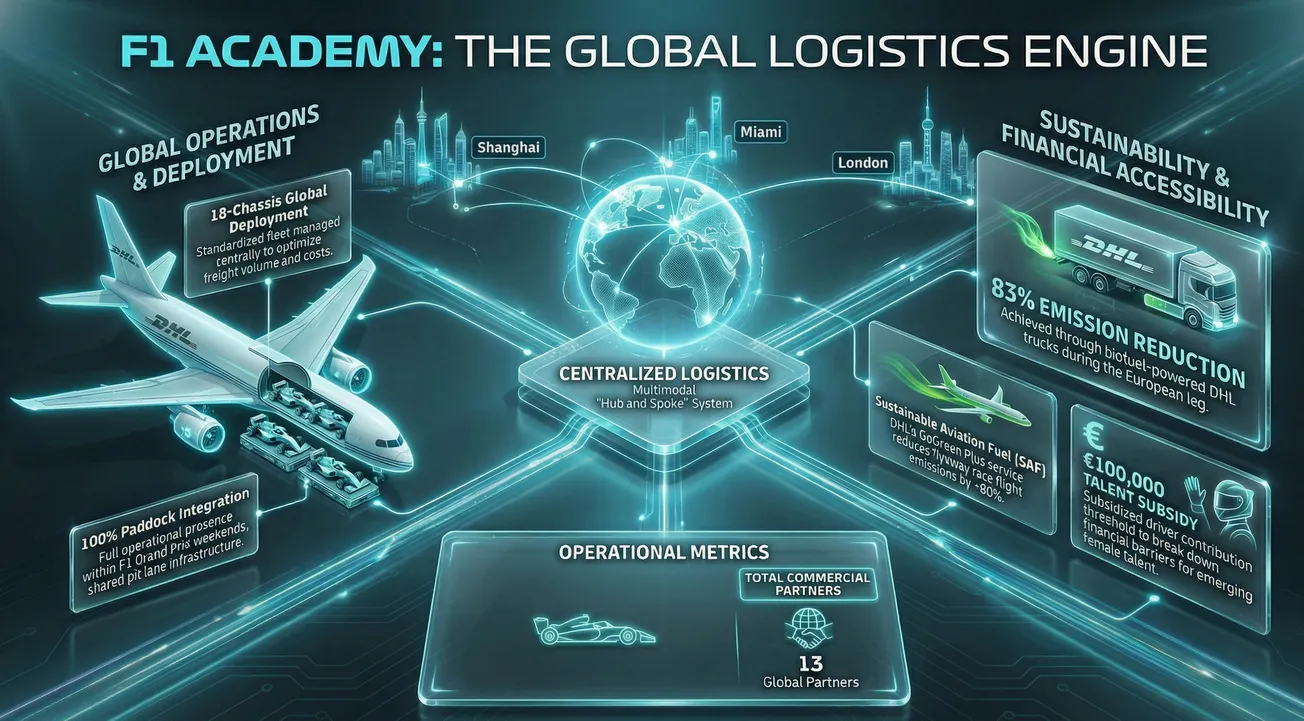
Unlike the main F1 grid, where teams manage their own freight, F1 Academy operates as a consolidated unit. This model, managed by Formula One Management (FOM) and DHL, drastically reduces the carbon footprint and operational overhead.
- Air Freight Optimization: For "flyaway" races, the 18 Tatuus F4-T421 chassis are dismantled into custom-engineered crates designed for the maximum volume efficiency of Boeing 747-8F freighters.
- The "Leapfrog" Strategy: Non-critical equipment (garage panels, hospitality) uses a multi-set maritime system. One set is en route to Miami while another is being unpacked in Shanghai, a masterclass in Estimating and cost-avoidance.
- Sustainable Hubs: During European rounds, the entire fleet runs on HVO100 biofuel, achieving an 83% reduction in emissions—a logistical benchmark for the 2026 Net Zero goal.
2. The Onboarding Math: Who Pays for the Seat?
The cost of "adopting" a driver into the Academy is a shared subsidy model designed to fix the historical financial gap for women in motorsport.
- The €100,000 Entry Fee: The driver provides approximately $116k USD, which covers less than 30% of a competitive F4 season (typically €200k-€400k).
- The Team's OpEx: F1 teams (like Mercedes, Ferrari, or Red Bull) cover the remaining deficit. Under the 2026 Cost Cap ($215M), these "diversity and junior program" costs are strategically absorbed into the expanded operational limits.
- The ROI of Aprenticeship: By "sponsoring" a livery and a driver, F1 teams get a high-visibility marketing asset without the $15M+ price tag of a full F1 sponsorship, creating an accessible Onboarding point for new B2B partners.
3. The "Wolff Synergy": Vertical Integration of Power
The synergy between Susie and Toto Wolff is a textbook case of Vertical Integration.
- Susie (Foundation): Manages the talent pipeline from karting to the F1 Academy.
- Toto (Elite): Manages the transition to the pinnacle of the sport (Mercedes Junior Team).
This structure creates a "closed-loop" economy. Partners like Puma and Tommy Hilfiger now leverage this synergy, placing their brands across both the development series and the elite team, maximizing their ROI across the entire Wolff ecosystem.
Paddock Intel Verdict
The F1 Academy is more than a racing series; it is a Logistical Sandbox. The ability to unify 10 competing F1 teams under a single operational banner (as seen during the 2024 FIA investigation standoff) proves that the Wolffs aren't just managing teams—they are managing the industrial standards of the 21st-century Paddock.