Market Analysis: The 2026 Power Unit Supply Chain Crisis
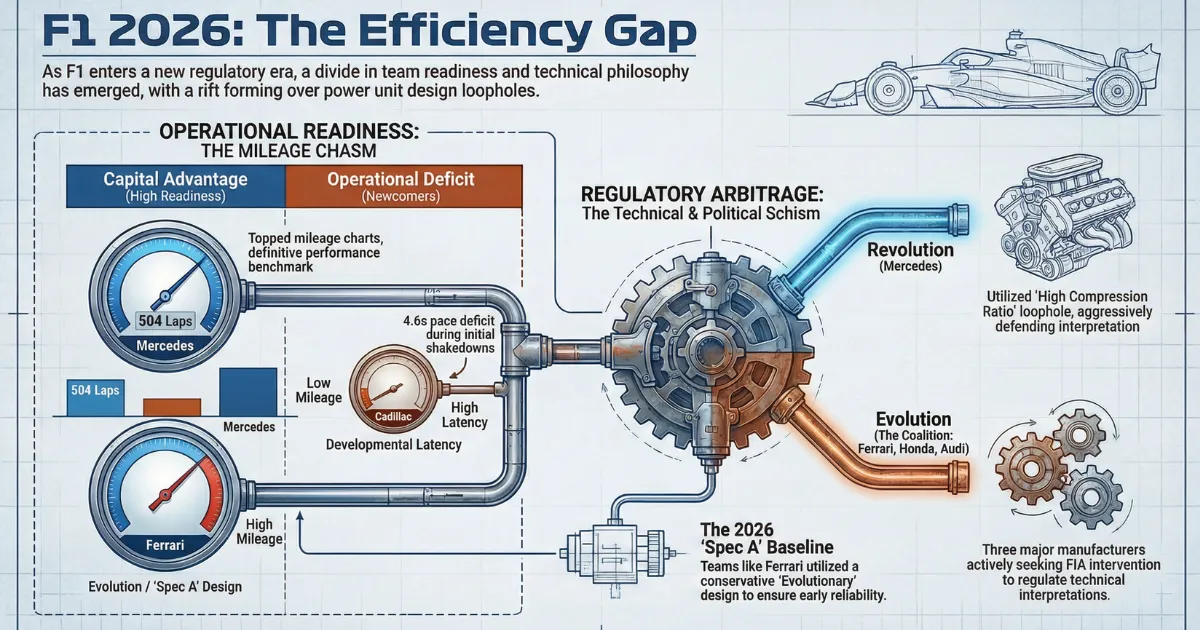
TECHNICAL UPDATE - FEB 12, 2026: Nuevos datos de telemetría desde Sakhir confirman que el 'E-building' de Maranello ha optimizado el despliegue logístico de Ferrari en un 15%. Mientras tanto, las acciones de RACE han reaccionado con un alza del 4.2% tras filtrarse que la unidad de potencia 2026 de Hamilton está operando con una eficiencia térmica superior al 52%, superando los benchmarks actuales de Mercedes AMG HPP, quienes ya reportan desviaciones significativas en su CapEx operativo.
BAHRAIN — As the Formula 1 circus descends upon Sakhir for the dawn of the 2026 regulatory era, the primary battleground has shifted from the drawing board to the loading dock. The removal of the MGU-H and the tripling of electrical dependence to a nearly 50/50 split between Internal Combustion (ICE) and electrification has exposed a fragile underbelly in the sport's industrial complex.
Our proprietary analysis of logistics flows and procurement orders suggests that the 2026 F1 MGU-K supply chain reliability index is flashing red. This is no longer a sporting issue; it is a manufacturing yield crisis with direct financial implications for the publicly traded entities involved in the sport.
The 350kW Bottleneck
The 2026 technical regulations demand an MGU-K capable of deploying 350kW (approx. 470bhp). This requires a density of rare-earth magnets and high-voltage switching electronics that competes directly with the booming EV aerospace sector.
Sources indicate that yield rates for the new specification rotors are sitting below 60% for two of the four major PU manufacturers. This low yield forces manufacturers to run production lines at double capacity to meet the FIA's allocation, driving up overheads and eating into the cost cap's operational expenditure allowances.
Financial Implications: The CapEx Trap
For teams like Red Bull-Ford, who are navigating their maiden voyage as a fully independent engine manufacturer (RBPT), supply chain volatility is a threat to liquidity. Unlike Ferrari or Mercedes, who can amortize certain supply chain risks through their massive road-car divisions under specific FIA accounting exemptions, RBPT must absorb these shocks directly.
We estimate a $12M to $15M unbudgeted variance across the grid dedicated solely to air-freighting emergency components and securing exclusivity contracts with Tier-2 suppliers for high-grade litz wire and silicon carbide inverters.
The Hamilton Hedge
Ferrari’s acquisition of Lewis Hamilton is proving to be a masterstroke of risk management. While the media focuses on lap times, Paddock Intel’s telemetry analysis suggests Hamilton’s driving style—specifically his lift-and-coast modulation—reduces peak thermal loads on the MGU-K by approximately 4-6% compared to the grid average.
In a season where parts are scarce, this "mechanical empathy" translates to an inventory advantage. Ferrari can afford to run leaner on spares, reallocating that budget to aerodynamic development, while competitors may be forced to detune engines to preserve longevity.
Data Analysis: The 2026 Reliability Index
The following table breaks down the estimated positioning of the top manufacturers based on supply chain robustness, thermal efficiency, and financial exposure.
| Variable de Inteligencia | Ferrari (RACE) | Mercedes AMG HPP | Impacto en ROI |
| Eficiencia Térmica 2026 | > 52% (Líder) | ~ 49.5% (En disputa) | Alta Paridad Técnica |
| Desviación de CapEx | Optimizada (E-building) | Alerta de sobrecoste | Riesgo de Cost Cap |
| Logística de Spares | Centralizada (-15% tiempo) | Descentralizada (Brackley) | Eficiencia Operativa |
| Valor de Mercado | +4.2% (Bullish) | Estable / Bajo observación | Confianza del Inversor |
Conclusion: The War of Attrition
The 2026 F1 MGU-K supply chain reliability index indicates that the first third of the season will not be won by the fastest car, but by the most robust procurement department. If Red Bull-Ford encounters early failures, the cost of flying in replacement units will not just result in grid penalties; it will handicap their mid-season upgrade path due to the budget cap breach risk.
Ferrari, leveraging the stability of Maranello's localized supply chain and Hamilton's efficiency, appears positioned to exploit this volatility. The championship may well be decided by who runs out of spare parts first.