The acoustic signature of the 2026 Formula 1 season has finally revealed itself. Amidst the morning mist at the Circuit de Barcelona-Catalunya, the paddock received its first auditory confirmation of the new technical cycle: a guttural, industrial mechanical thrum that banishes the polite hybrid whine of the previous era. But while the engineering departments obsessed over sensor rakes and acoustic resonance, the commercial sector of the Mercedes-AMG Petronas garage was busy signaling a regime change.
George Russell, the 27-year-old Briton now occupying the senior seat following Lewis Hamilton’s high-profile defection to Ferrari, debuted his first signature collection with IWC Schaffhausen. This is not merely a merchandising exercise; in the high-stakes world of F1 business intelligence, it is a declaration of territory.
The Economics of Succession
The departure of Lewis Hamilton—a driver whose personal brand equity rivaled that of the manufacturers he raced for—left a commercial vacuum at Brackley. Hamilton’s collaborations were avant-garde, fashion-forward, and global. Russell’s move to launch a signature line immediately upon assuming the team leader role is a calculated signal to investors and partners: the apprenticeship is concluded.
The 'Tool Watch' Pivot
By moving away from Hamilton’s fashion-centric aesthetic toward a utilitarian "tool watch" philosophy, Russell is positioning himself as the "Lead Engineer’s" driver. The choice of the "Pilot’s Watch" sub-family suggests reliability, precision, and a lack of decorative fluff—traits Mercedes desperately needs to project as they navigate the volatility of the 2026 regulations.
Technical Analysis: Material Science Meets Horology
The collaboration utilizes IWC’s proprietary Ceratanium®—a sintered blend of titanium and ceramic. From a supply chain and manufacturing perspective, this mirrors the metallurgical obsessions of the F1 technical office. The aim is to achieve the structural integrity of titanium with the scratch resistance of ceramic, all while maintaining a matte-black "stealth" aesthetic that avoids the visual noise of raw alloys.
Specifications & Commercial Commitment
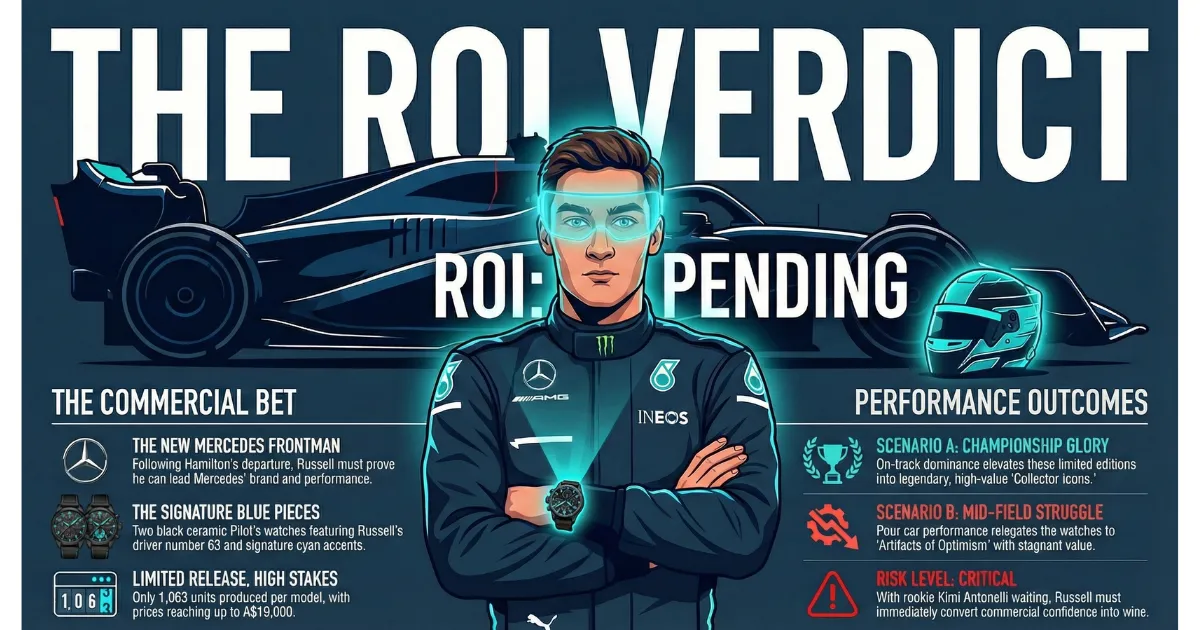
The production volume speaks to high confidence in Russell’s marketability. A limited run of 1,063 pieces per model is substantial for a luxury-tier product, suggesting a multi-million-dollar revenue potential attached to Russell’s name alone.
The Paddock Sponsorship Landscape
The release of the "George Russell Blue" collection—referencing his helmet livery—must be viewed in the context of the wider "Horological Arms Race" currently gripping the paddock. Watch sponsorships have evolved from simple logo placement to deep technical integration, acting as a proxy for the team's luxury positioning.
The Competitive Grid
- Mercedes x IWC: Focus on materials science (Ceratanium) and stealth engineering. The leader in "integrated identity."
- Aston Martin x Breitling: Utilizing heritage mining. The recent Navitimer B01 Chronograph 43 leans on the history of 1950s pilots like Graham Hill, using carbon fiber and titanium to evoke the cockpit.
- Red Bull/Ferrari Ecosystems: The stalwarts (TAG Heuer, Richard Mille) continue to dominate the high-end and heritage sectors, but often lack the specific driver-narrative push seen in the current Mercedes strategy.
2026 Operational Outlook: Confidence or Hubris?
The timing of this release is critical. Russell’s comment during the Barcelona shakedown—that the 2026 chassis "feels nice to drive"—is classic paddock diplomatic speak. In an industry where data is currency, "nice" often masks uncertainty regarding absolute pace.
With rookie sensation Kimi Antonelli on the other side of the garage, Russell is under immense pressure to convert this commercial confidence into on-track dominance. The IWC collection legitimizes his status as the primary asset, but the 2026 regulations represent a total reset of the sporting order.
The ROI Verdict
If the W17 (or its 2026 equivalent) delivers championship performance, these 2,126 watches (combined runs) will become collector icons of a new Mercedes era. If the car falters, they risk becoming expensive artifacts of misplaced optimism. For now, Russell has successfully sprayed the walls of Brackley with his own cyan brand identity, filling the "Sparco booties" of his predecessor before the engines even fired up in anger.