Chinese GP 2026: Antonelli Wins, McLaren Collapses, Mercedes Builds a Lead That Is Starting to Look Permanent
Race Economics · Chinese Grand Prix · Shanghai 2026
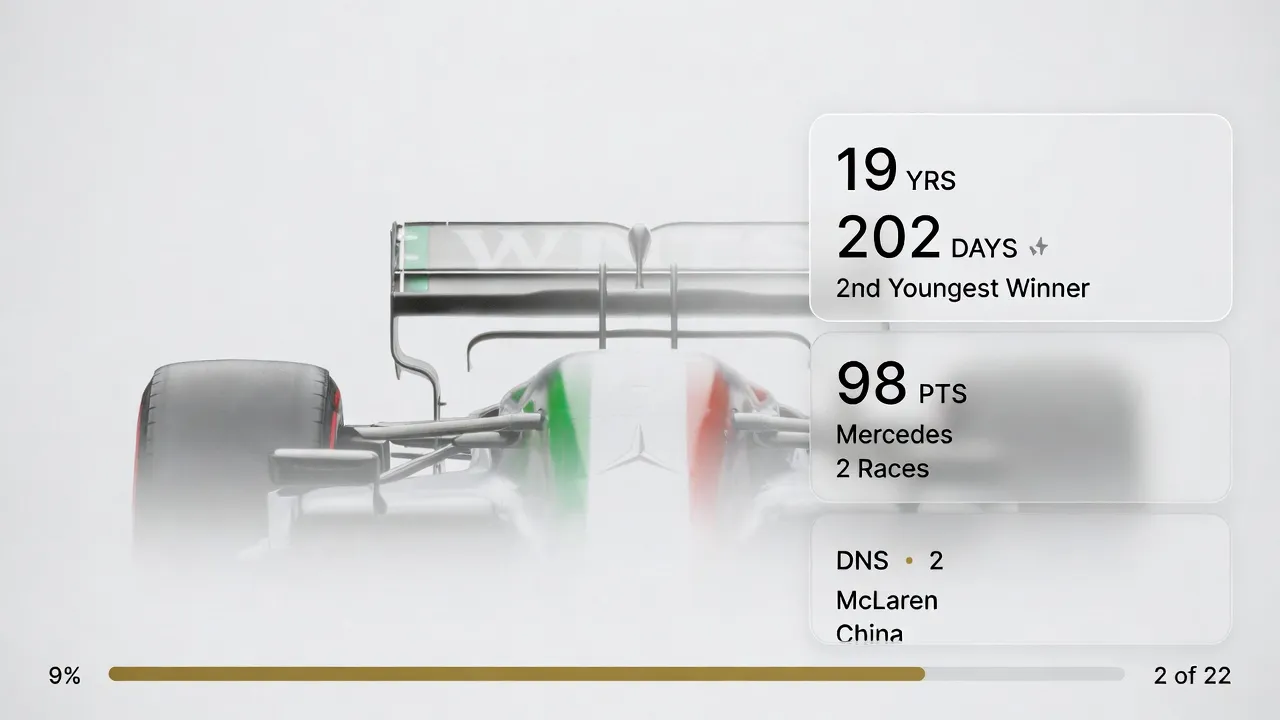
19
Antonelli Age · Years
98
Mercedes Pts · 2 Races
4
McLaren DNS · 2026
31
Gap to Ferrari · Pts
Kimi Antonelli won the Chinese Grand Prix to become the second youngest winner in Formula 1 history. That is the sporting headline. The financial headline is different: Mercedes now holds 98 constructors' points from two race weekends, McLaren failed to start with both cars, and the prize money trajectory for the 2026 season is beginning to look like a structural problem for everyone not running a Silver Arrow.
What Happened
Antonelli started from pole — the youngest Grand Prix polesitter in F1 history, a record set the day before — and converted it into victory over 56 laps at the Shanghai International Circuit. He briefly lost the lead at the start when Hamilton surged from P3 on the Ferrari's characteristic strong launch, but regained position before the end of lap two and was never headed again.
The race's decisive moment came on lap 10 when Lance Stroll's Aston Martin stopped at Turn 1 with a battery failure, triggering the Safety Car. The leaders pitted for hard tyres. After the restart, Antonelli controlled the gap while Ferrari's Hamilton and Leclerc spent five laps in a wheel-to-wheel battle for second — swapping positions multiple times across Turns 1 and 14. The fight drained Hamilton's battery. Russell took him on lap 28. Antonelli was already 7.6 seconds up the road. He won by 5.5 seconds.
"I'm speechless. I want to cry, to be honest. Thank you so much to my team, because they helped me to achieve this dream."
Kimi Antonelli — Post-race, Formula1.com, March 15 2026
Verstappen retired on lap 46 with a suspected power unit failure — Red Bull's second reliability retirement in two weekends after Hadjar's Melbourne failure. Alonso also retired. But the biggest story before a wheel had turned: both McLarens failed to start.
P
Driver
Team
Gap
Pts
1
Kimi Antonelli
Mercedes
Winner
25
2
George Russell
Mercedes
+5.515s
18
3
Lewis Hamilton
Ferrari
+25.267s
15
4
Charles Leclerc
Ferrari
+28.894s
12
5
Oliver Bearman
Haas
+57.268s
10
6
Pierre Gasly
Alpine
+59.647s
8
7
Liam Lawson
Racing Bulls
+1m 20.6s
6
8
Isack Hadjar
Red Bull
+1m 27.2s
4
9
Carlos Sainz
Williams
+1 lap
2
10
Franco Colapinto
Alpine
+1 lap
1
DNF
Max Verstappen
Red Bull
Lap 46 · PU
0
DNS
Lando Norris
McLaren
Electrical PU
0
DNS
Oscar Piastri
McLaren
Electrical PU
0
Why It Happened
Three separate stories explain Sunday's result. First: Antonelli drove a clean, controlled race from pole. The 19-year-old Italian — already the youngest Grand Prix polesitter in history after Saturday's qualifying — never overcomplicated the strategy. Pit under the Safety Car, restart in clear air, manage the gap. One mistake: a run wide at Turn 14 with three laps remaining that cost two seconds. It did not matter. His lead was already decisive.
Second: Ferrari gave away second position. Hamilton and Leclerc battled wheel-to-wheel from lap 25 with no team orders called, despite Vasseur later acknowledging the fight was "good for F1" but "unfair" to deploy team orders. The internal battle drained Hamilton's battery, handed Russell second, and cost Ferrari the constructors' points gap it needed to close. Russell described waiting for them to collide.
Third: McLaren never started. Separate electrical faults on both power units — different problems occurring simultaneously. Team principal Andrea Stella described it as "an extremely unfortunate coincidence." Mercedes HPP is now under investigation alongside McLaren to determine root cause. This is the first McLaren double DNS since the 2005 United States Grand Prix.
Pre-Race
4 DNS: Norris (electrical PU), Piastri (electrical PU — separate fault), Bortoleto (Audi hydraulics), Albon (Williams hydraulics). 18 cars start.
Lap 1
Hamilton leads from P3 — Ferrari's characteristic strong launch. Hadjar spins at Turn 13. Verstappen drops to the back with a poor start off the line.
Lap 2
Antonelli retakes the lead on the back straight. Never headed again for the remaining 54 laps.
Lap 10
Safety Car: Stroll parks at Turn 1 — Aston Martin battery failure. Leaders pit for hard tyres. Free pit window for everyone still running.
Laps 25–28
Ferrari battle: Hamilton and Leclerc swap positions multiple times with no team orders. Hamilton's battery runs dry. Russell takes Hamilton on lap 28, then Leclerc on lap 30.
Lap 46
Verstappen retires — suspected power unit failure. Red Bull's second reliability retirement in two race weekends.
Lap 53
Antonelli runs wide at Turn 14 hairpin — loses two seconds. Lead remains decisive. Holds on to the flag.
Lap 56
Antonelli wins. 5.515s clear of Russell. Second youngest F1 winner in history at 19 years, 202 days. First Italian winner since Fisichella, 2006.
Economic Impact
The prize money structure of Formula 1 rewards consistency over the full season — but the early rounds establish the trajectory. Mercedes' second consecutive 1-2 finish gives them 98 constructors' points from two race weekends. At approximately $8.5 million per constructors' position in the Concorde Agreement distribution, the gap already being constructed between Mercedes and the field is not abstract. It is financial.
Mercedes · 2 Races
98
Constructors' points from 2 consecutive 1-2 finishes. Australia + China. Approaching 100-point mark in race 2 of 22.
Ferrari · Gap
−31
Ferrari sits P2 with 67 points. Closest challenger — but 31 points down after just two events.
McLaren · Loss
−80
Defending constructors' champions on 18 points — 80 behind Mercedes after two weekends. Zero points from China.
Haas · Gain
17
Bearman P5 again. Haas P4 in constructors on 17 points — ahead of Red Bull (12). The breakout commercial story of 2026.
McLaren's situation requires particular attention. The defending constructors' champions — who entered 2026 targeting a third straight title — have scored zero points in China. Piastri has completed zero grand prix racing laps in 2026: a reconnaissance lap crash in Melbourne, and a DNS in Shanghai. Norris recorded his first career DNS. The electrical failures were traced to the Mercedes-supplied power unit — different faults, same origin supplier, same race day.
⚠
McLaren's customer supply question: Four DNS events in China involved Mercedes-powered cars — McLaren (×2) and Williams. Aston Martin suffered a double DNF with Honda power. The 2026 power unit regulations, with their extreme electrical complexity and energy management demands, are creating reliability exposure that is not evenly distributed across the grid. McLaren TP Andrea Stella has confirmed an investigation is underway with Mercedes HPP. The outcome of that investigation has commercial consequences beyond the track.
Constructors' Championship · After 2 of 22 Races
Mercedes
98 pts
Ferrari
67 pts
McLaren
18 pts
Haas
17 pts
Red Bull
12 pts
Racing Bulls
12 pts
Alpine
10 pts
The Framework
The 2026 Concorde Agreement distributes prize money based on final constructors' championship position, with a base payment plus performance-linked bonuses. The top constructors earn approximately $200M+ annually from the prize pool — with each position worth roughly $8.5M in incremental value. Two race weekends do not determine the final standings, but they do establish compounding data.
The more significant framework context is what Sunday's results mean for each team's commercial narrative. Antonelli's win has a specific commercial dimension: it is his maiden victory, recorded in his second season, at 19 years old, in Shanghai — a market that F1 is actively cultivating. It is the first Italian GP win in 20 years. Mercedes' title sponsors Petronas, PepsiCo, INEOS, and IWC Schaffhausen all activated around this weekend. A maiden win for the team's youngest-ever race winner generates earned media that no activation budget can replicate.
For Red Bull, the framework is less comfortable. Two reliability retirements from their new Red Bull Powertrains engine across two race weekends — Hadjar in Melbourne, Verstappen in Shanghai — establish a reliability narrative that damages the commercial proposition of their independent power unit project, which was built in part on the premise of reducing dependency on external suppliers. Their constructor standing after two rounds: 12 points. Mercedes: 98.
Drivers' Championship · After 2 of 22 Races
Russell
51 pts
Antonelli
47 pts
Leclerc
34 pts
Hamilton
33 pts
Bearman
17 pts
Norris
15 pts
PaddockIntel Verdict
PaddockIntel Verdict · Chinese Grand Prix 2026
Mercedes is not just winning races — they are winning the financial structure of the 2026 season. Two races, two 1-2 finishes, 98 constructors' points. The Concorde prize pool rewards the final standings, but the early trajectory matters for two reasons: it shapes sponsor renewal conversations happening right now, and it establishes the compounding points gap that every rival team is calculating against. At 31 points down after race two, Ferrari is still in the conversation. At 80 points down, McLaren is not.
Antonelli's win is the commercial story within the commercial story. The youngest Grand Prix polesitter in F1 history becomes the second youngest winner — in the same weekend, in the same car, in the same city where Mercedes has staked its title ambitions. His emotional post-race reaction — "I want to cry, to be honest" — is the kind of authentic moment that sponsor activation budgets cannot manufacture. Petronas, PepsiCo, INEOS all bought into a generational talent narrative. China delivered on that narrative in full.
The McLaren double DNS is the warning the whole paddock needed. The 2026 power unit regulations demand electrical complexity that no team has fully mastered. When two separate electrical faults hit both McLarens on the same race day — different problems, same power unit supplier — it exposes a systemic risk that is not unique to McLaren. It is a supplier risk. Mercedes HPP supplies McLaren, Williams, and Aston Martin. Four cars failed to start or finish Sunday's race on Mercedes power. The investigation underway will have consequences that extend well beyond the Chinese Grand Prix.
Frequently Asked Questions
Is Kimi Antonelli now the youngest F1 race winner in history?+
No. Antonelli is the second youngest winner in Formula 1 history. At 19 years and 202 days, he is behind only Max Verstappen, who won the 2016 Spanish Grand Prix at 18 years, 7 months and 15 days. Antonelli's win did displace Sebastian Vettel from second on the all-time list — Vettel won the 2008 Italian GP at 21 years, 2 months and 11 days. Antonelli is also the first Italian race winner since Giancarlo Fisichella at the 2006 Malaysian Grand Prix — a 20-year national drought ended in Shanghai.
Why did both McLarens fail to start the Chinese Grand Prix?+
McLaren suffered separate electrical faults on both Mercedes-supplied power units on race day. Norris's issue was identified during pre-race preparation and the car never made it out of the garage. Piastri's issue appeared on the grid just before the formation lap — his car was wheeled back to the pits. McLaren TP Andrea Stella confirmed the faults were different problems occurring simultaneously — described as "an extremely unfortunate coincidence." An investigation is underway with Mercedes HPP. This was McLaren's first double DNS since the 2005 United States Grand Prix.
What is the Formula 1 constructors' championship standings after China 2026?+
After two races: Mercedes 98 points, Ferrari 67, McLaren 18, Haas 17, Red Bull 12, Racing Bulls 12, Alpine 10. Cadillac and Aston Martin remain on zero points. Mercedes have scored consecutive 1-2 finishes in both grands prix to date, building a 31-point lead over Ferrari and an 80-point lead over defending champions McLaren.
Why did Max Verstappen retire from the Chinese Grand Prix?+
Verstappen was told to retire his Red Bull on lap 46 with a suspected power unit failure — the car appeared to lose power during the lap. It was Red Bull's second reliability retirement in two race weekends, following Hadjar's fire in Melbourne. Verstappen had also suffered a poor start, dropping to the back of the field early. He scored zero points from either the Sprint or the Grand Prix in Shanghai, leaving him eighth in the drivers' championship on 8 points after two rounds.
What is Lewis Hamilton's record with Ferrari after the Chinese Grand Prix?+
Hamilton's P3 in Shanghai was his first Grand Prix podium for Ferrari, achieved at his 26th start for the team. He had previously won the Chinese Grand Prix Sprint in 2025 in Mercedes colours. Hamilton leads the Ferrari internal battle over Leclerc with 33 points to 34 — separated by a single point — and sits fourth in the drivers' championship. The intra-Ferrari battle in China, where the pair traded positions multiple times across five laps without team orders, was the most discussed moment of the race and drew Ferrari's own TP to describe it as "good for F1" but "unfair" to use orders.
How does the Chinese GP result affect Mercedes' prize money position for 2026?+
Formula 1's Concorde Agreement distributes prize money based on final constructors' championship position, with each position worth approximately $8.5 million in incremental annual value. Two races do not determine final prize money distribution — there are 20 more rounds — but they establish the compounding gap. Mercedes at 98 points, McLaren at 18 points, Red Bull at 12 points after two events represents a structural advantage that will require sustained recovery from the chasing teams to close by season's end. The prize pool total is approximately $1.27 billion for the 2026 season.
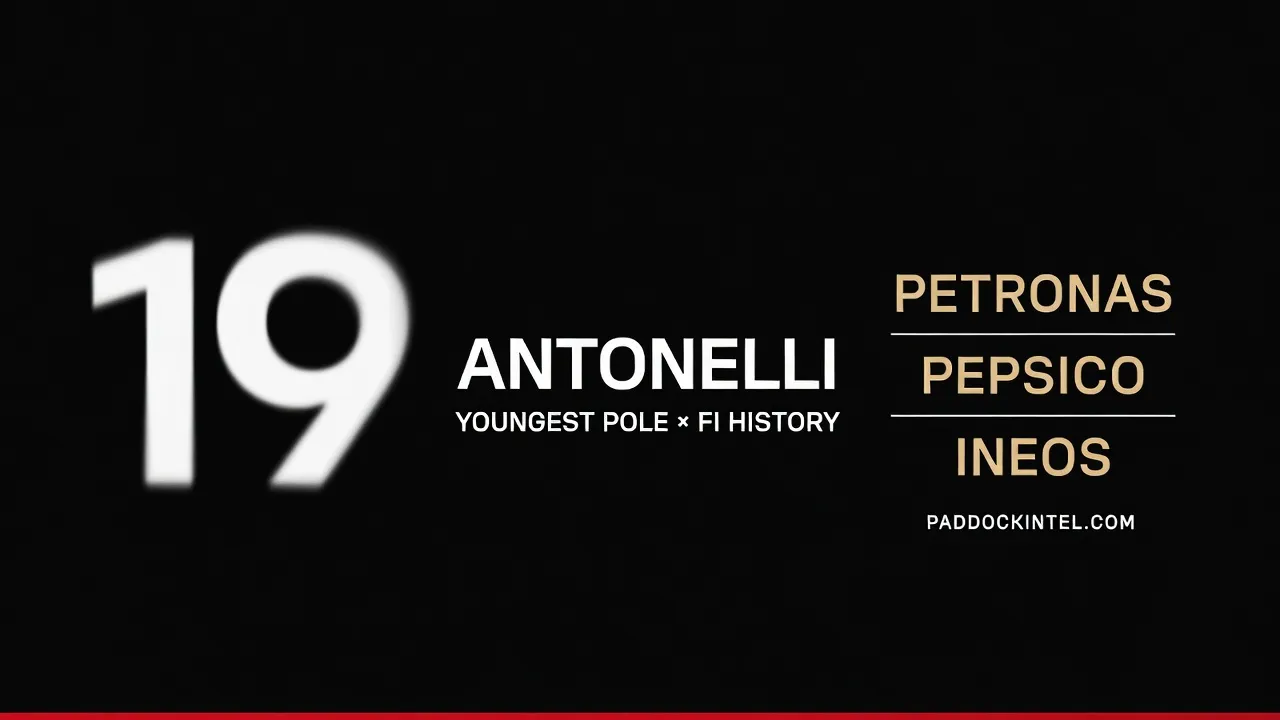
Youngest pole in F1 history isn't just a milestone. It's earned media at zero cost for Petronas, PepsiCo, and INEOS. Here's what that record is actually worth.
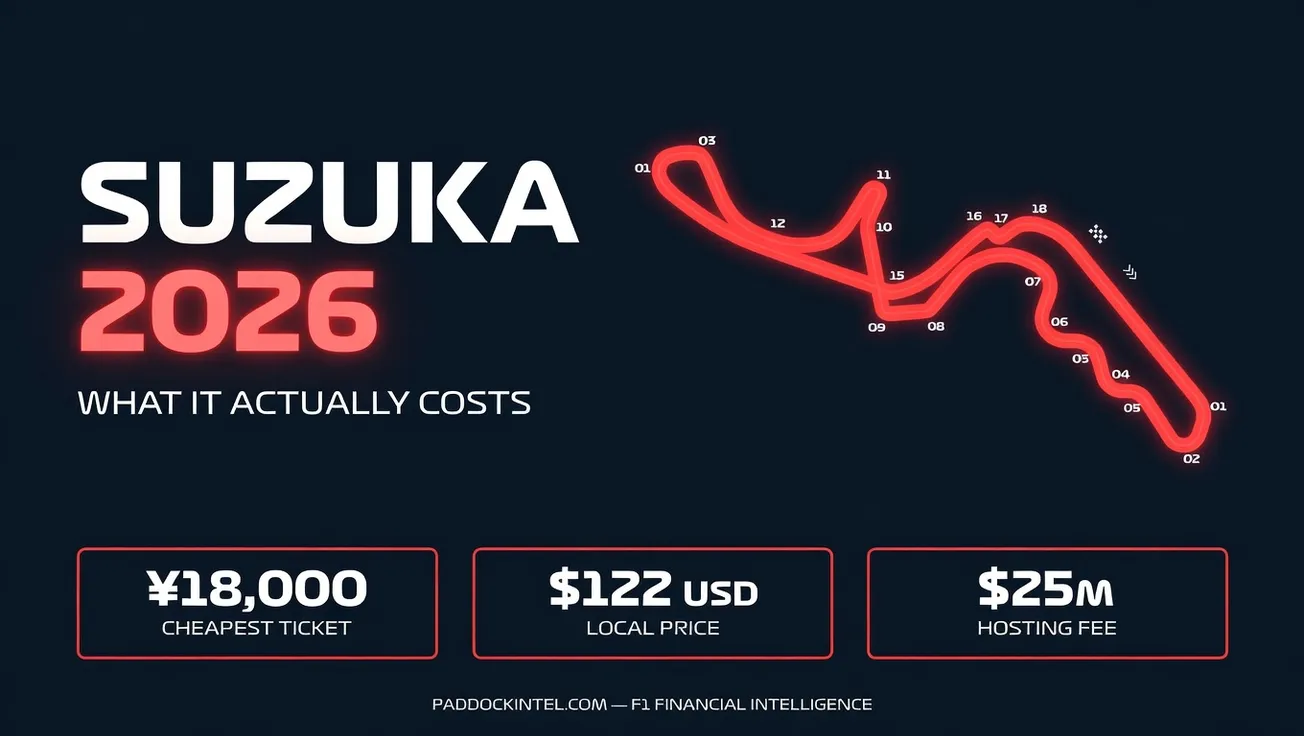
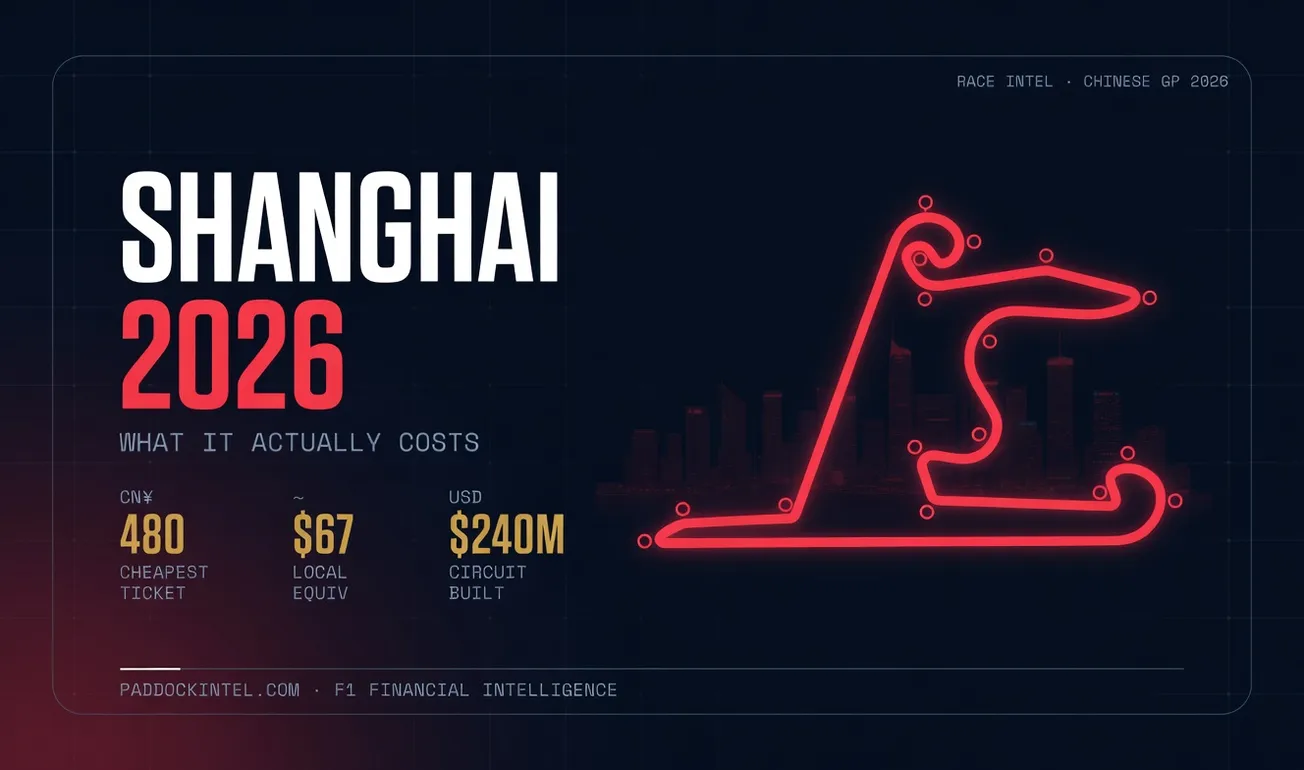
The cheapest ticket on the F1 calendar. One of the highest hosting fees. A Sprint race with $8.5M per position at stake. And BYD exploring an F1 entry — announced during Chinese GP week.
Beyond the $200M revenue headline, F1 teams face a logistics crisis no one is pricing: hundreds of tonnes of equipment stranded in a conflict zone with no clear recovery timeline.