- 01 What $1 Billion Actually Bought Full cost breakdown by category — entry fee, facilities, staff, drivers, engine →
- 02 The Revenue Side: What Cadillac Will Actually Earn Prize money vs operating costs — and the $150M sponsorship gap →
- 03 The Strategic Bet: Why GM Did This Anyway Brand value, US audience growth, and the 2029 engine play →
- 04 The Haas Comparison Nobody Wants to Make 10 years, zero wins — what history says about new F1 teams →
- 05 PaddockIntel Verdict Does the math ever work? The 2029–2032 thesis explained →
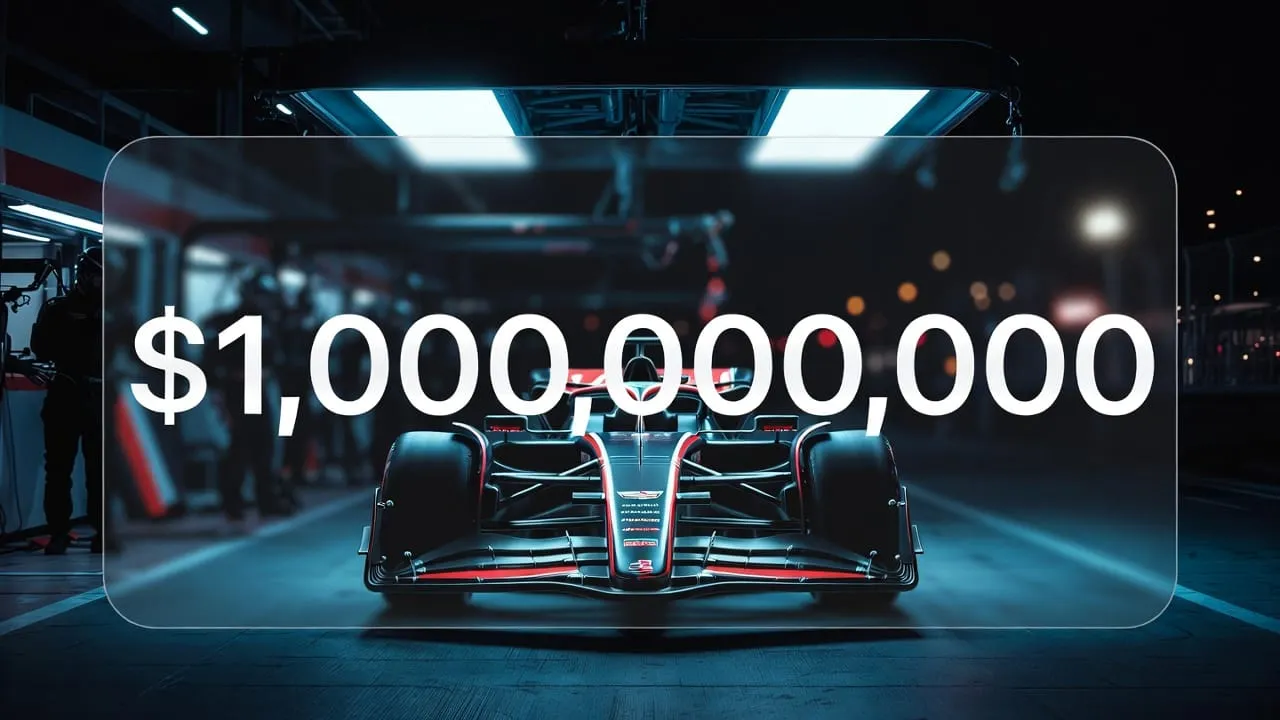
Every new F1 team pays an entry fee. Cadillac paid $450 million just to be allowed to compete — the highest in championship history, more than double what was originally demanded. That alone would have funded Haas's entire operation for three years. But according to F1 commentator Will Buxton, the entry fee isn't even the biggest line item. By the time the lights go out in Melbourne on March 16, General Motors will have spent north of $1 billion on a team that hasn't scored a single point.[1]
The question PaddockIntel is asking isn't whether Cadillac can afford it. GM's 2025 revenue was $187 billion. The question is whether the math ever works.
What $1 Billion Actually Bought
Break down the spend and a clearer picture emerges of what it costs to build an F1 team from absolute zero in the modern era.
| Category | Amount | Detail | Status |
|---|---|---|---|
|
💰 ENTRY FEE
Anti-Dilution Fee
Paid to 10 existing teams ($45M each) as compensation for permanent prize money dilution. Original Concorde Agreement set fee at $200M — renegotiated upward as team valuations exploded.[2]
|
$450M |
Highest entry fee in F1 history. More than 2× the original demand. Paid in full as condition of 2026 Concorde Agreement signing. |
CONFIRMED |
|
🏗️ FACILITIES
4 Bases — 2 Continents
Fishers, Indiana (HQ + manufacturing) · Concord, NC (204,000 sq ft GM PPU engine facility, $65–70M construction) · Warren, Michigan (GM Technical Center) · Silverstone, UK (race ops + European tech base).[3]
|
~$275M |
4-hub model is unprecedented in modern F1. Even Mercedes centralises racecar development despite multi-country operations. |
ESTIMATED |
|
👥 STAFFING
520 Hires from 143,265 Applications
595 positions advertised. Charlotte engine facility pays $100K–$125K per role — nearly 2× local market rates. Aggressive compensation mirrors Red Bull's championship-era talent strategy.[4]
|
~$150M |
~$120K fully-loaded avg cost × 520 staff × 2-year build = $125M personnel spend before car design. |
ESTIMATED |
|
🏎️ DRIVERS
Pérez + Bottas — Experience Over America
Sergio Pérez: est. $10M base + $10–15M bonuses + $4–6M personal sponsors = ~$25–30M total. Bottas: lower base, brings Mercedes-era setup data. Colton Herta signed as test driver for future pipeline.[5]
|
~$35M |
Pragmatic lineup choice. Veterans accelerate systems development. American driver pathway preserved via Herta in F2 2026. |
ESTIMATED |
|
⚙️ ENGINE PROGRAMME
GM PPU — Ferrari Bridge to 2029
Ferrari engines + gearbox for 2026–2028. GM PPU facility: $65–70M construction + $75–80M launch/scaling. Full in-house engine targeted 2029. 300–350 jobs at Charlotte facility.[6]
|
~$145M |
Engine investment feeds GM's EV performance division and positions GM alongside Ferrari and Mercedes as a full constructor by 2029. |
CONFIRMED |
The Revenue Side: What Cadillac Will Actually Earn in 2026
Here is where the model gets uncomfortable. As a team finishing at the back of the grid — realistic expectations for any debutant — Cadillac's prize money will be minimal.
The Concorde Agreement distributes prize money based on previous year constructor standings, a base payment for all teams, and performance distributions. A team with no prior history starting from zero can expect roughly $40–55 million in 2026 prize money — substantially less than the $80–100 million top teams receive.[7] Against a 2026 operating budget of $215 million (the new cost cap), that leaves a funding gap of $150–175 million that must come from sponsorship.
"They don't have a title sponsor. So that is a huge undertaking not just for Cadillac and General Motors, for TWG, Dan Towriss, that whole group behind the scenes."
— Will Buxton, Up to Speed podcast[1]
Oracle pays Red Bull an estimated $100 million per year. Petronas funds Mercedes at a similar level. Without a title partner locked in for Melbourne, Cadillac enters its first season structurally underfunded relative to its cost base. That is the single biggest financial risk in their 2026 programme — not the $450 million entry fee, but the $150 million annual sponsorship gap they need to close.
The Strategic Bet: Why GM Did This Anyway
The numbers only make sense if you accept GM's actual thesis: this isn't about prize money. It's about what F1 does to the Cadillac brand in the United States.
F1's US audience grew from 500,000 viewers per race in 2018 to over 1.5 million per race in 2025, driven by Drive to Survive and three American grands prix. Cadillac is repositioning itself as a luxury performance brand competing with BMW, Mercedes-Benz, and Porsche. F1 association — particularly with an American team — is worth hundreds of millions in brand value that doesn't appear on any prize money spreadsheet.
The Bahrain testing result adds competitive credibility to the brand story. Three-tenths off the pace in pre-season testing — within fighting distance of struggling Aston Martin — is a remarkable result for a team that built its car from zero in under two years.[8] Team Principal Graeme Lowdon was direct:
"We firmly believe we've got a platform that we can really start moving forward on. That's probably the most you could ever ask from a new team, unless it's a complete miracle."
— Graeme Lowdon, Cadillac Team Principal[8]
The Haas Comparison Nobody Wants to Make
The last new team, Haas, debuted in 2016 and scored points on day one. Ten years later, Haas has never won a race, rarely threatens the top five, and operates at the lower end of the competitive order. F1's brutal reality is that the gap between new entrant and championship contender is measured in years, not seasons.
Cadillac's total startup investment already dwarfs Haas's entire cumulative spend. The infrastructure is more ambitious, the manufacturer backing stronger, and the 2026 regulatory reset provides a theoretical leveling of the field. But as Autosport's analysis noted, Haas provided an American flag in F1 since 2016 — and much of F1's US growth came from Netflix, not the team.[7] Cadillac needs to be more than a flag. It needs to win.
PaddockIntel Verdict
Cadillac spent $1 billion before turning a competitive lap. In 2026 they will spend another $215 million running the team, earn $40–55 million in prize money, and hope sponsorship closes the gap. The pure operational math doesn't work — not yet.
What makes the investment rational is the timeline. GM isn't building a 2026 operation. It's building a 2029–2032 operation that uses 2026 as a paid education. By the time their own engine arrives, the staff will have three years of F1 systems knowledge, the facilities will be fully operational, and the Cadillac brand will have run multiple Super Bowl campaigns with a legitimate F1 team behind them.
The $1 billion before Melbourne isn't a mistake. It's the tuition fee for the most expensive engineering school on the planet. Whether GM can afford to keep paying it until graduation is the question that Melbourne won't answer.
-
1
Motorsport.com — Will Buxton: Cadillac's F1 project has already cost $1 billion before a single race motorsport.com
-
2
RacingNews365 — Cadillac pays $450M anti-dilution fee to secure F1 entry racingnews365.com
-
3
Wikipedia — Cadillac in Formula One: facilities, staffing, timeline wikipedia.org
-
4
Fluid Jobs — Inside Cadillac F1: America's $450M Gamble, staffing and facility analysis fluidjobs.com
-
5
F1 Salaries — Cadillac team valuation, driver salary estimates 2026 f1salaries.com
-
6
Formula One History — Cadillac F1 entry details, GM PPU engine facility investment formulaonehistory.com
-
7
Autosport — The Cadillac calculus F1 has made: $450M today vs billions tomorrow autosport.com
-
8
RACER — Why Cadillac has already earned the respect of its rivals racer.com