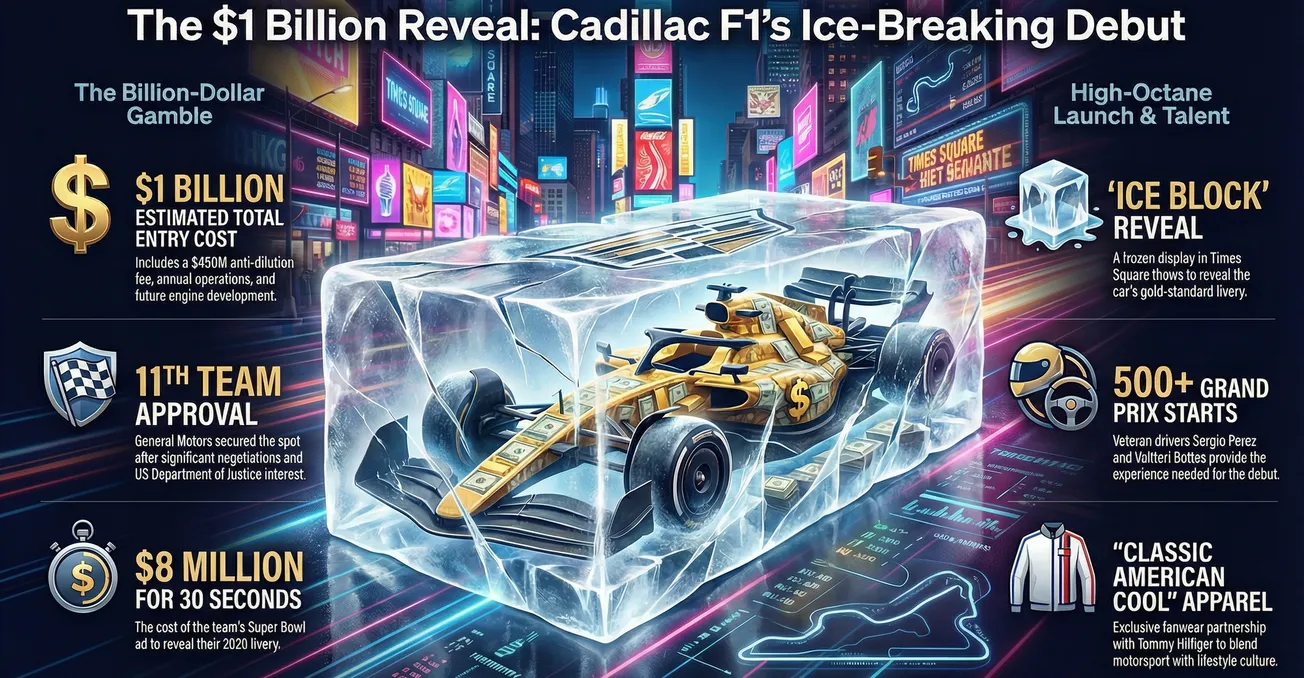
The intersection of 42nd Street and Broadway is rarely a venue for subtlety, yet Cadillac’s arrival in New York City was marked by a strategic, frozen silence. Encased within a frosted-glass display box in Times Square, the silhouette of the Cadillac F1 chassis stood as a physical stake in the ground—a tangible rebuttal to years of paddock skepticism regarding American expansion.
For the Paddock Intel audience, the frost on the glass is less interesting than the liquidity on the balance sheet. As the countdown to the Super Bowl reveal ticks away, the narrative shifts from speculative "vapourware" to hard economic reality. General Motors is no longer asking for permission; they have paid the admission price.
This is not merely a marketing exercise or a rebranding of an existing entity. This is the first true "greenfield" entry since Haas F1 Team in 2016, and the financial and operational mobilization required to achieve it offers a fascinating case study in modern motorsport economics. We analyze the capital expenditure, the geopolitical maneuvering with Liberty Media, and the risk-averse human resource strategy that defines Cadillac’s billion-dollar bet.
The Financial Architecture of the 11th Team
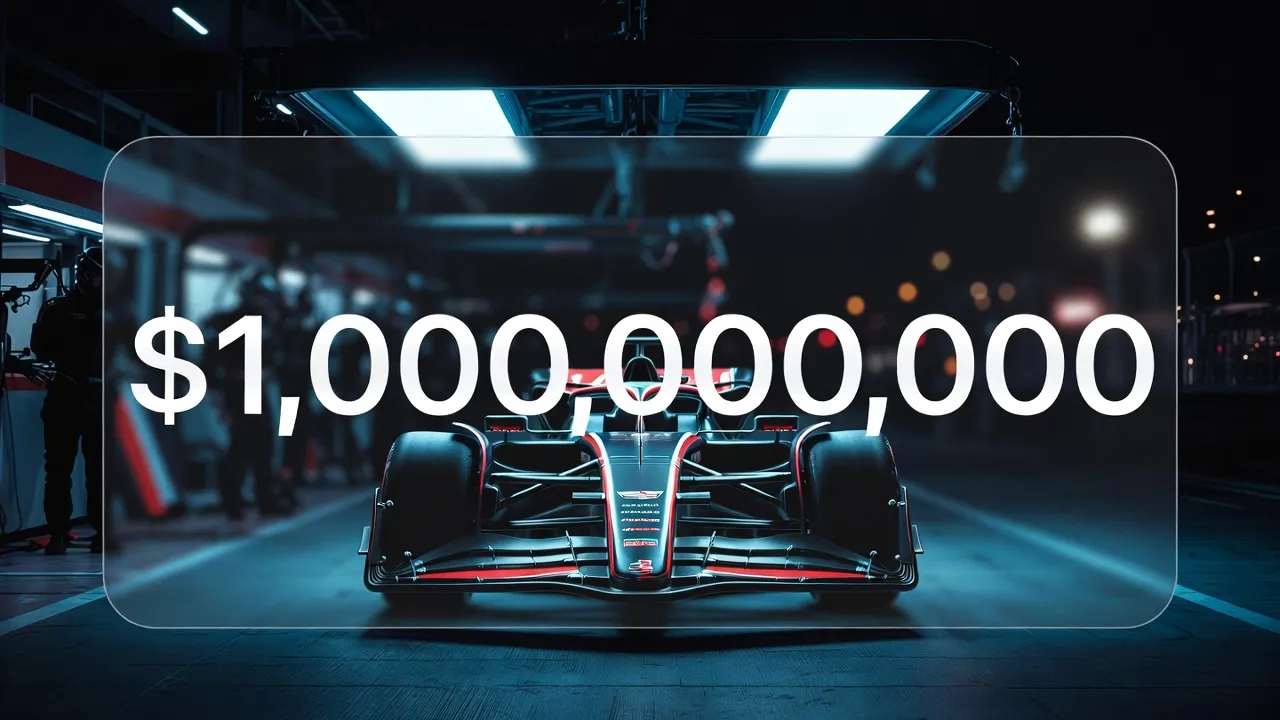
The headline figure circulating in high-level financial discussions is $1 billion. In the context of modern Formula 1 team valuations—where Alpine sold a 24% stake, valuing the team at $900 million—this figure represents the minimum viable capital required to establish a franchise from scratch.
The Anti-Dilution Fee and Beyond
To understand the barrier to entry, one must examine the mechanics of the Concorde Agreement. The initial resistance from the ten incumbent teams was predicated on the "dilution" of the prize money pot. The resolution—a $450 million anti-dilution fee—serves as an immediate capital injection distributed among the existing grid. However, Paddock Intel analysis suggests this fee is merely the ante.
Estimated Start-Up CapEx & OpEx (2025-2026):
| Cost Item | Amount (USD) | Notes |
|---|---|---|
| Anti-Dilution Fee | $450M | One-time payment to FOM/Teams |
| Operational Expenditure | ~$130M/yr | Annual, scaling to Cost Cap |
| Power Unit R&D Fund | $100M | Earmarked for 2029 GM Works unit |
| Infrastructure & Logistics | ~$150M | Charlotte, Indiana & UK bases |
| Driver & Key Personnel | ~$50M | Exempt from Cost Cap |
| TOTAL MOBILIZATION | $880M+ | Before marketing & Super Bowl spend |
- Anti-Dilution Fee: $450 Million (One-time payment to FOM/Teams).
- Operational Expenditure (Annual): ~$130 Million (Scaling to Cost Cap).
- Power Unit R&D Fund: $100 Million (Earmarked for 2029 GM Works unit).
- Infrastructure & Logistics: ~$150 Million (Charlotte, Indiana, UK bases).
- Driver & Key Personnel Retainers: ~$50 Million (Exempt from Cost Cap).
When factoring in the aggressive marketing spend—exemplified by the $8 million, 30-second Super Bowl spot and the Apple TV production partnership—the total mobilization cost easily breaches the $1 billion threshold. This is a total industrial mobilization, designed to ensure that when the lights go out in Melbourne, General Motors' brand equity is protected by a baseline level of competence.
Geopolitics: The DOJ and the "Peace Treaty"
The acceptance of Cadillac is not solely a story of financial might; it is a narrative of legal risk mitigation. The path to the grid was initially blocked by Formula One Management (FOM), leading to a high-profile rejection of the Andretti-led bid. This triggered an investigation by the US Department of Justice (DOJ) into potential anti-competitive practices by Liberty Media.
Senior sources indicate that the pivot point—the moment the red light turned green—correlated with two factors:
- The removal of Michael Andretti from the primary leadership role, replaced by Dan Towriss.
- The commitment to a Works Engine.
The agreement reached in November 2024 functions effectively as a peace treaty. By committing to become a registered Power Unit manufacturer for 2029, General Motors provided FOM with the strategic justification needed to approve the entry, simultaneously causing the DOJ investigation to "evaporate." This maneuver saved Liberty Media from federal scrutiny while securing GM a seat at the table—a masterclass in corporate leverage.
Operational Strategy: The "Enstone Diaspora"
Building a Formula 1 team from scratch carries the inherent risk of the "2010 Syndrome"—a reference to the failed entries of Caterham, Virgin, and HRT, which collapsed due to underfunding and lack of technical depth. Cadillac has mitigated this operational risk by aggressively recruiting a specific lineage of engineering talent.
We observe the formation of the "Enstone Diaspora"—a core group of senior personnel with shared DNA from Renault/Alpine. This is a calculated move; the Enstone culture has historically thrived on efficiency and punching above its weight class (notably during the 2005-2006 championship years).
Key Leadership Structure
This hiring strategy prioritizes institutional memory over innovation. By assembling a team that speaks the same engineering language, Cadillac bypasses the friction of cultural integration, allowing for faster decision-making during the critical shakedown phase.
Risk Aversion in the Cockpit
Perhaps the most telling indicator of Cadillac’s corporate strategy is the driver lineup. In a sport fueled by the "next big thing" narrative, Cadillac has opted for extreme conservatism. The decision to sign Sergio Perez and Valtteri Bottas—both turning 36 by the start of the 2026 season—is a rejection of the romantic "All-American" dream in favor of data accumulation.
- Valtteri Bottas: Brings Mercedes-era discipline and sensitive technical feedback, crucial for correlating wind-tunnel data with on-track reality.
- Sergio Perez: Offers commercial stability (vital for the North American market) and tire management data, despite recent performance volatility.
The Colton Herta Factor:
While Colton Herta remains the marketing face of the "pathway," his relegation to a test role and an F2 campaign confirms that GM is unwilling to gamble $1 billion on a rookie learning curve. The cost of a crash in the cost-cap era is not just financial—it is a loss of development time. Veterans like Perez and Bottas minimize lap-time variance and the risk of chassis write-offs.
Supply Chain: The Ferrari Bridge (2026-2028)
Technically, Cadillac enters 2026 in a compromised position. While they are a "works" team in name, they will operate as a Ferrari customer for the first three seasons. This arrangement is a necessary evil to bridge the gap until the Charlotte, NC, facility comes online with a competitive GM power unit in 2029.
- Pros: Guaranteed reliability from the Ferrari power unit; allows the team to focus 100% of resources on chassis dynamics and aero correlation.
- Cons: Packaging compromises. The chassis must be designed around a Ferrari architecture, which may differ significantly from the eventual GM architecture, requiring a total design reset in 2029.
Conclusion: The Long Game
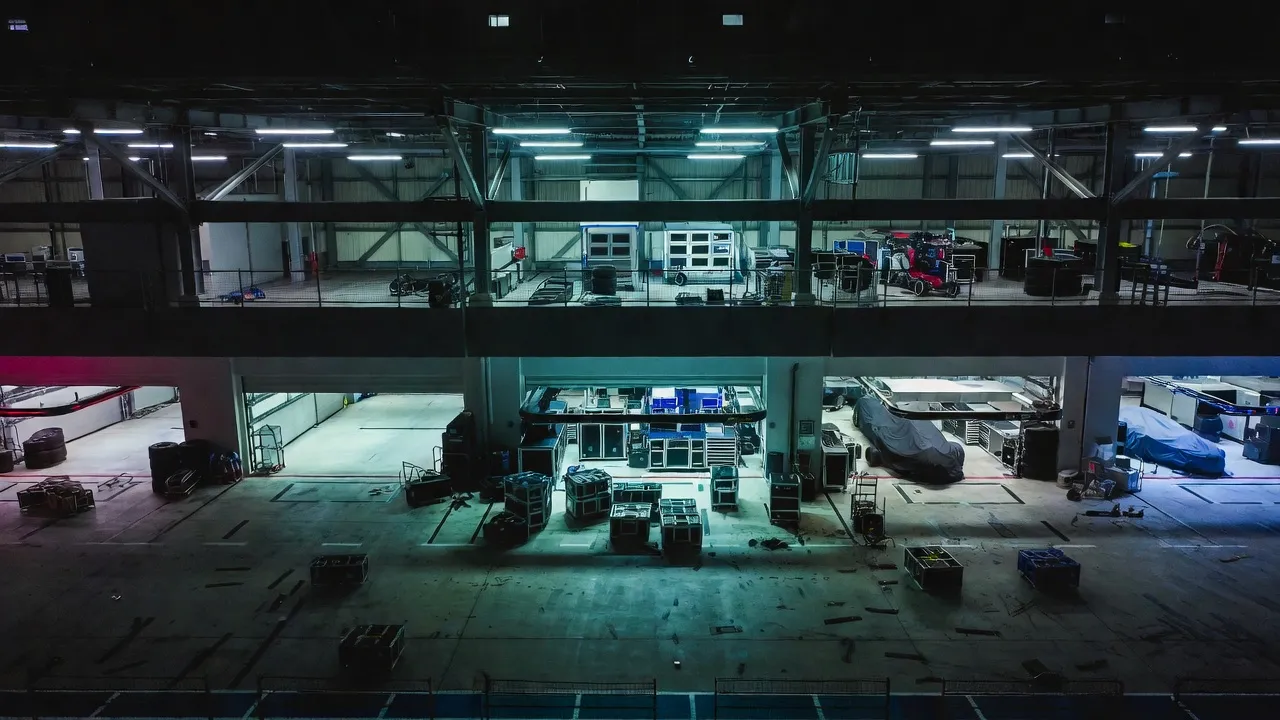
The data from the Barcelona shakedown—164 laps, slow but reliable—mirrors the Haas model of 2016 rather than the disastrous Virgin Racing debut of 2010. Cadillac is trading pace for platform stability.
For investors and stakeholders, the key metric for 2026 is not championship points, but operational compliance. Can the team execute pit stops, manage logistics, and correlate data within the 107% rule? With a billion dollars on the line and a veteran team in the garage, the infrastructure is built for survival. The brilliance—or hubris—of the project will not be truly tested until the GM engine fires up in 2029. Until then, they are the most expensive, well-funded customer team in history.