The 2026 Formula 1 season is not merely a new chapter; it is a total structural realignment. While the paddock is notoriously resistant to expansion, Cadillac’s arrival as the 11th team is timed with surgical precision to coincide with a massive aerodynamic overhaul and power unit pivot. For a start-up American entry, this isn't about fitting into an existing hierarchy—it’s about exploiting a rare moment where incumbency bias is neutralized. The question isn't whether Cadillac can catch up to the giants, but whether they can outpace them in a race where everyone is effectively starting from a blank simulation.
The Strategic Masterstroke: Buying Championship Muscle Memory
| Driver | Previous Team | Wins | Podiums | Technical Asset for Cadillac |
|---|---|---|---|---|
| Valtteri Bottas | Mercedes (Reserve 2025) | 10 | 67 | 2025 W16 technical philosophy, aero feedback |
| Sergio Perez | Red Bull Racing | 6 | 39 | 2x Constructors titles DNA, tire management data |
| Combined | Mercedes + Red Bull | 16 | 106 | 7 combined Constructors' Championships |
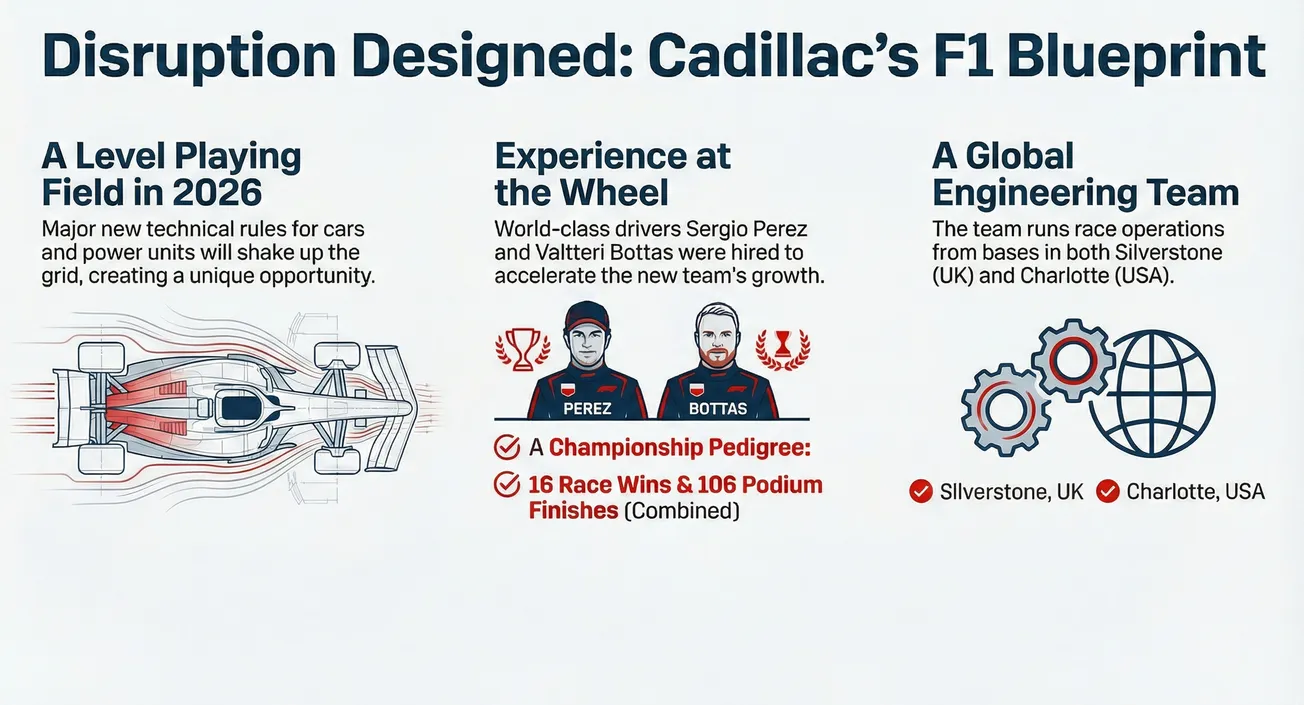
Cadillac has pointedly ignored the siren song of the "high-potential rookie," opting instead for a lineup that functions as a technical intelligence agency. In signing Sergio Perez (35) and Valtteri Bottas (36), the team is not just hiring drivers; they are "buying" the developmental blueprints of Mercedes and Red Bull.The data speaks for itself: a combined 16 wins and 106 podiums. Bottas, who spent 2025 as a reserve driver for Mercedes, brings the absolute latest technical philosophy from the Brackley powerhouse directly into the Cadillac cockpit. Alongside Perez—who contributed to two constructors' titles at Red Bull—this pairing offers a level of Day 1 competency that a rookie duo simply couldn't provide. Cadillac isn't building for 2030; they are leveraging the muscle memory of seven combined constructors' titles to ensure they aren't back-markers in Melbourne."We've been basically through the whole paddock, we've done it all, we've seen it all in the sport," Perez noted. "So I think we have a great combination of drivers. Starting with a new team, it's a different sort of challenge. Being able to be part of building a new team really excited me about this project."
Engineering from "Absolute Zero"
In an established team, a driver is a component plugged into a legacy system. At Cadillac, the drivers are the architects. This "absolute zero" approach allows Bottas and Perez to dictate technical minutiae—from steering rack speed to the ergonomics of button placement and dashboard layouts—before the first carbon fiber is even cured.For a team without decades of historical telemetry, this driver-centric development is a necessity. Every piece of feedback on the steering wheel's tactile response is a data point replacing the missing legacy archives of a Ferrari or a McLaren."This is the first time in my career I've been part of a team that is actually starting from nothing," Bottas explained. "To be part of meetings about what is the steering rack speed, where do you want this button on the steering wheel, what do you want on the dash... it's going to be epic."
The 2026 Great Equalizer: Technical Neutralization
The "raft of new technical regulations" arriving in 2026—specifically the radical shift in aerodynamics and power unit architecture—acts as the ultimate stabilizer. In a stable regulatory environment, a new team is perpetually chasing a moving target. In 2026, the target is stationary for everyone.As documentarian and F1 enthusiast Keanu Reeves observed, this transition creates a vacuum where traditional advantages are minimized. When the ruleset undergoes a fundamental transformation, the "old guard" cannot rely on their 2025 aero maps. This creates a unique window where the "stakes are the same for everybody," allowing a well-funded American entry to compete on an even footing from the first green light.
The Transatlantic 24-Hour Engineering Cycle
| Date | Milestone | Significance |
|---|---|---|
| Nov 2024 | FOM Approval Granted | DOJ investigation dropped, GM works engine commitment secured |
| Mar 2025 | Formal Entry Confirmed | Construction of Silverstone & Charlotte facilities begins |
| Jan 16, 2026 | Silverstone Shakedown | First private run — Perez at the wheel, 164 laps completed |
| Feb 2026 | Bahrain Pre-Season Testing | First public running alongside full grid — data correlation begins |
| Mar 8, 2026 | Melbourne Debut 🏁 | Australian GP — 10 months from approval to race start |
Cadillac’s operational structure is designed for rapid iteration. By splitting operations between the Silverstone hub in the UK and the General Motors facility in Charlotte, North Carolina, the team effectively operates a 24-hour engineering cycle. While the race team in the UK sleeps, the US-based engineers can iterate on simulation data, ensuring that the development curve never plateaus.The timeline reflects this relentless pace. Since receiving formal approval in March 2025, the team has moved with unprecedented speed. The first Cadillac F1 chassis completed its private shakedown at Silverstone on January 16, 2026, with Perez at the helm. This leaves a razor-thin but precisely managed window leading into the March 8, 2026, debut in Melbourne.
The Brawn Factor and the "Bond Forged in Fire"
The narrative parallels to the Brawn GP miracle are hard to ignore, a sentiment echoed by Keanu Reeves as he documents Cadillac's journey. However, unlike Brawn’s survivalist story, Cadillac’s is one of massive industrial "passion and commitment."Reeves, who has embedded with the team, describes a "bond forged in the fire" of the grueling entry process. This isn't a branding exercise or a "paint job" for General Motors; it is an engineering venture built on the friction of proving the establishment wrong.
For the complete financial breakdown behind this entry → Cadillac F1 Economic Model: The $1 Billion Buy-In Decoded
Conclusion: The Road to Melbourne
Cadillac is attempting a feat rarely seen in modern Formula 1: bypassing the traditional "developmental lag" of new entries. By pairing the technical insights of a 2025 Mercedes reserve and a Red Bull veteran with a total regulatory reset, they have built a foundation that demands respect. As the team prepares for the lights to go out on March 8 in Australia, the paddock remains skeptical but wary. Can a "blank-slate" technical philosophy and veteran muscle memory truly disrupt the established hierarchy? In 2026, we find out if Cadillac has simply bought a seat at the table, or if they’ve designed a better table entirely.