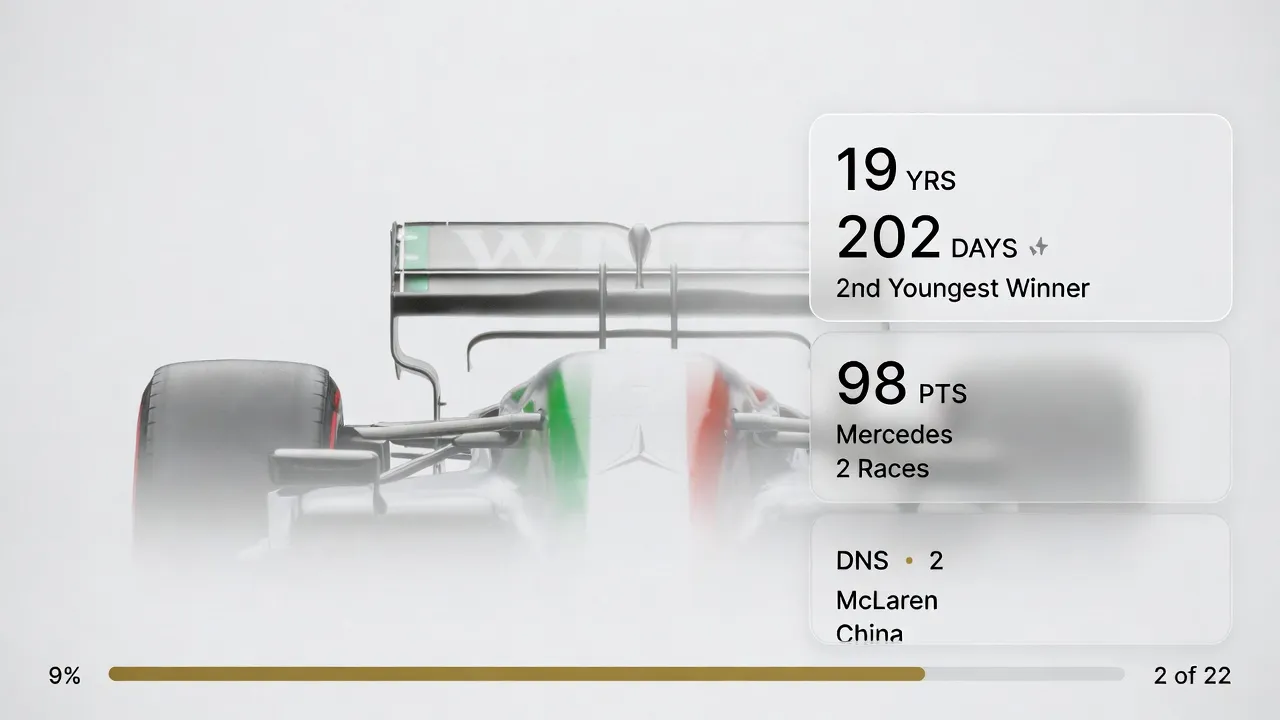
Mercedes leads the mileage war with 432 laps. Aston Martin limps out with 128. We translate every lap into dollars — and the gap is catastrophic.
Formula 1's second pre-season test in Bahrain closed on February 20 with Charles Leclerc topping the timing sheets at 1:31.992 — a qualifying simulation on low fuel that produced the headline every Italian newspaper needed. But PaddockIntel doesn't cover headlines. We cover the data underneath them, and the data from Bahrain tells a story no lap time chart can: the 2026 season's economic winners and losers were already decided in the desert, three weeks before Melbourne.
The currency of pre-season testing is laps. Every installation lap is a data point on tyre degradation. Every long run is a race simulation that informs pit stop strategy. Every qualifying sim teaches the car's limits. Fewer laps means fewer data points means more uncertainty in Australia — and in Formula 1, uncertainty costs points, and points cost money.
| Team | Fastest Driver | Best Lap | Gap to P1 | Total Laps | Test Status |
|---|---|---|---|---|---|
| Ferrari | Leclerc | 1:31.992 | — P1 | 324 | Qualy sim Day 3 |
| Mercedes | Antonelli | 1:32.803 | +0.811s | 432 | Race sim focus |
| McLaren | Piastri | 1:32.861 | +0.869s | 395 | Balanced programme |
| Red Bull | Verstappen | 1:33.109 | +1.117s | 329 | Some Day 1 issues |
| Haas | Bearman | 1:33.487 | +1.495s | 404 | Smoothest test ever |
| Alpine | Gasly | 1:33.421 | +1.429s | 359 | Positive surprise |
| Audi | Bortoleto | 1:33.755 | +1.763s | 357 | Steady progress |
| Racing Bulls | Lindblad | 1:34.149 | +2.157s | 407 | 165 laps Day 3 record |
| Williams | Sainz | 1:34.342 | +2.350s | 368 | Overweight chassis |
| Cadillac | Bottas | 1:35.290 | +3.298s | 266 | Expected for year 1 |
| Aston Martin | Stroll | 1:35.974 | +3.982s | 128 | Honda battery crisis |
| 📊 PaddockIntel.com | Economic Analysis · paddockintel.com | ||||
Ferrari's time requires an asterisk that most media glossed over: Leclerc set his benchmark during a qualifying simulation on low fuel in the final hours of Day 3, under cooler desert night conditions. This is not comparable to Red Bull's 1:33.109 — Verstappen was running a balanced programme across fuel loads. The raw time gap is not the competitive gap.
The more honest performance indicator is Mercedes' race simulation pace, which multiple senior paddock sources confirmed ran several tenths faster per lap than Ferrari's equivalent long-run data. In Formula 1, race pace wins constructors' championships. Qualifying lap times win Saturday headlines.
The Strategic Divergence Behind the Numbers
Mercedes' 432-lap total is the product of a deliberate reliability-first programme. After suffering through four years of ground-effect regulations that exposed their aerodynamic philosophy's weaknesses, Toto Wolff's team entered 2026 with clear priorities: understand the W17's behaviour across every fuel load, tyre compound, and temperature window. The occasional mechanical gremlins — including a pneumatic failure that stopped Antonelli on track — didn't derail the programme. They completed more laps than any team in the field.
Racing Bulls' 407 laps, headlined by Arvid Lindblad's record-breaking 165-lap single-day run, represents a different philosophy: the junior Red Bull team maximising data collection as a squad transitions into a new driver lineup. Lindblad's mileage record is operationally significant — it demonstrates the team's logistical capacity to sustain maximum running rates, which matters for long-haul flyaway circuits where operational efficiency determines points finish as much as car pace.
Aston Martin's 128 laps are the number that defines their 2026 season before it starts. Honda's battery integration failures — confirmed in an official statement on Friday — weren't minor reliability niggles. They were symptomatic of a fundamental integration challenge between the AMR26's chassis architecture and the Japanese power unit's energy deployment system. Lance Stroll completing six non-timed laps on Day 3 while the team ran out of spare components is not a pre-season story. It's a Melbourne warning.
Ferrari's decision to halt 2026 car development in April 2025 — a move that cost them approximately $20 million in 2025 competitiveness — appears vindicated. The SF-26's rotating rear wing and beam wing vane represent genuine aerodynamic innovation within the active-geometry space permitted by the 2026 regulations. Fred Vasseur's gamble paid off: a clean, innovative car with sufficient mileage to understand its behaviour before the season opener.
Translating Laps Into Melbourne Prize Money
Formula 1's 2026 prize fund distributes approximately $750 million to teams based on the constructor championship position. The gap between finishing first and second in the WCC is roughly $50 million. Between first and fifth: over $120 million. Every testing lap that didn't happen in Bahrain represents uncertainty in Australia — and uncertainty in F1 costs positions, and positions cost money.
PaddockIntel's economic model applies a simple framework: testing mileage correlates with setup optimisation depth, which in turn correlates with performance consistency across a race weekend. A team with 432 laps of data arrives in Melbourne knowing their tyre window, fuel load behaviour, and power unit deployment characteristics. A team with 128 laps arrives, guessing.
| Team | Total Laps | Data Deficit vs MER | Setup Risk | Est. Points R1-3 | Prize Money Risk |
|---|---|---|---|---|---|
| Mercedes | 432 | — | Minimal | +15 to +25 pts | None |
| Racing Bulls | 407 | -25 | Low | +8 to +15 pts | Minimal |
| Haas | 404 | -28 | Low | +6 to +12 pts | Minimal |
| McLaren | 395 | -37 | Low | +18 to +30 pts | None |
| Williams | 368 | -64 | Medium (overweight) | +3 to +8 pts | $5-10M season risk |
| Alpine | 359 | -73 | Medium (new PU) | +4 to +10 pts | Minimal-Medium |
| Audi | 357 | -75 | Medium | +3 to +8 pts | $5M season risk |
| Red Bull | 329 | -103 | Medium | +15 to +28 pts | Low (Verstappen) |
| Ferrari | 324 | -108 | Medium (qualy focus) | +18 to +32 pts | Low (strong pace) |
| Cadillac | 266 | -166 | High (year 1) | 0 to +4 pts | Expected — year 1 |
| Aston Martin | 128 | -304 | CRITICAL | -10 to -20 vs potential | $15-25M season risk |
| 📊 PaddockIntel.com | Economic model · paddockintel.com | ||||
The Williams situation deserves specific attention. An overweight car in Formula 1 is a quantifiable problem: every kilogram above the minimum weight costs approximately 0.03 seconds per lap at a circuit like Melbourne's Albert Park. If the FW48 is 5-7kg over minimum — consistent with James Vowles' public comments — that's 0.15-0.21 seconds of permanent deficit until upgrades arrive. At a circuit where the points gap between 8th and 10th is worth $8 million annually in WCC prize fund differential, that weight penalty has a direct dollar value.
The Aston Martin calculus is starker. Lawrence Stroll has invested over $300 million in the Silverstone facility — wind tunnels, simulator complex, and manufacturing infrastructure. That investment assumes competitive performance that generates prize money, sponsor revenue, and driver and partner attraction. A Honda battery crisis that limits pre-season testing to 128 laps doesn't just threaten Melbourne — it threatens the ROI model for the entire infrastructure investment.
"In Formula 1's economic ecosystem, the team that arrives in Melbourne with the most data doesn't just have a performance advantage — they have a risk management advantage worth millions in prize money over the course of a season."
| Publication | Testing Coverage | Lap Time Analysis | Economic Translation | Prize Money Model | Sponsor Impact |
|---|---|---|---|---|---|
| Formula1.com | ✓ Comprehensive | ✓ All teams | ✗ None | ✗ None | ✗ None |
| Motorsport.com | ✓ Comprehensive | ✓ Technical | ✗ None | ✗ None | ✗ None |
| RacingNews365 | ~ Partial | ~ Basic | ✗ None | ✗ None | ✗ None |
| The Race | ✓ Good | ✓ Technical | ✗ None | ✗ None | ✗ None |
| Sky Sports F1 | ✓ Broadcast focus | ~ Commentary | ✗ None | ✗ None | ✗ None |
| BBC Sport | ~ Limited | ~ Basic | ✗ None | ✗ None | ✗ None |
| ESPN F1 | ~ US focus | ~ Basic | ✗ None | ✗ None | ✗ None |
| 🏁 PaddockIntel.com | ✓ All teams | ✓ Full context | ✓ UNIQUE | ✓ UNIQUE | ✓ UNIQUE |
PaddockIntel Verdict
Mercedes arrives in Melbourne with the most complete dataset in the field — 432 laps of W17 behaviour across every fuel load and tyre compound. Their race simulation pace, confirmed by multiple paddock sources to run faster than Ferrari's equivalent long runs, positions them as the team best equipped to manage a 58-lap race in variable Australian conditions. Ferrari's qualifying ceiling may be higher on Saturday. Mercedes' race management floor is higher on Sunday — and constructors' championships are built on Sundays.
Aston Martin is the economic story of this pre-season. Lawrence Stroll's $300M+ Silverstone investment requires competitive performance to generate returns. Honda's battery integration failure — 128 laps against a field average of 350 — doesn't just threaten points in Melbourne. It threatens the sponsor's confidence and the driver attraction model that justifies the infrastructure spend. The Japanese manufacturer has three weeks to solve what three days in Bahrain couldn't. The prize money clock is already running.