Vibrations that risk permanent nerve damage to drivers. Four batteries consumed before the season opener. A budget cap that punishes every emergency fix. Melbourne 2026 didn't just expose a broken power unit — it exposed the financial architecture of a crisis that will follow Aston Martin for the rest of the season.
program 2023–26
Round 1
before nerve risk
Tax, 2026 season
Melbourne Was a Test Session, Not a Race
Aston Martin arrived at Albert Park carrying a power unit that Adrian Newey, their own team principal, publicly described as potentially causing "permanent nerve damage" to his drivers' hands. That statement alone is extraordinary — teams don't voluntarily broadcast the severity of their problems. When they do, it means the situation has moved beyond competitive embarrassment into regulatory territory.
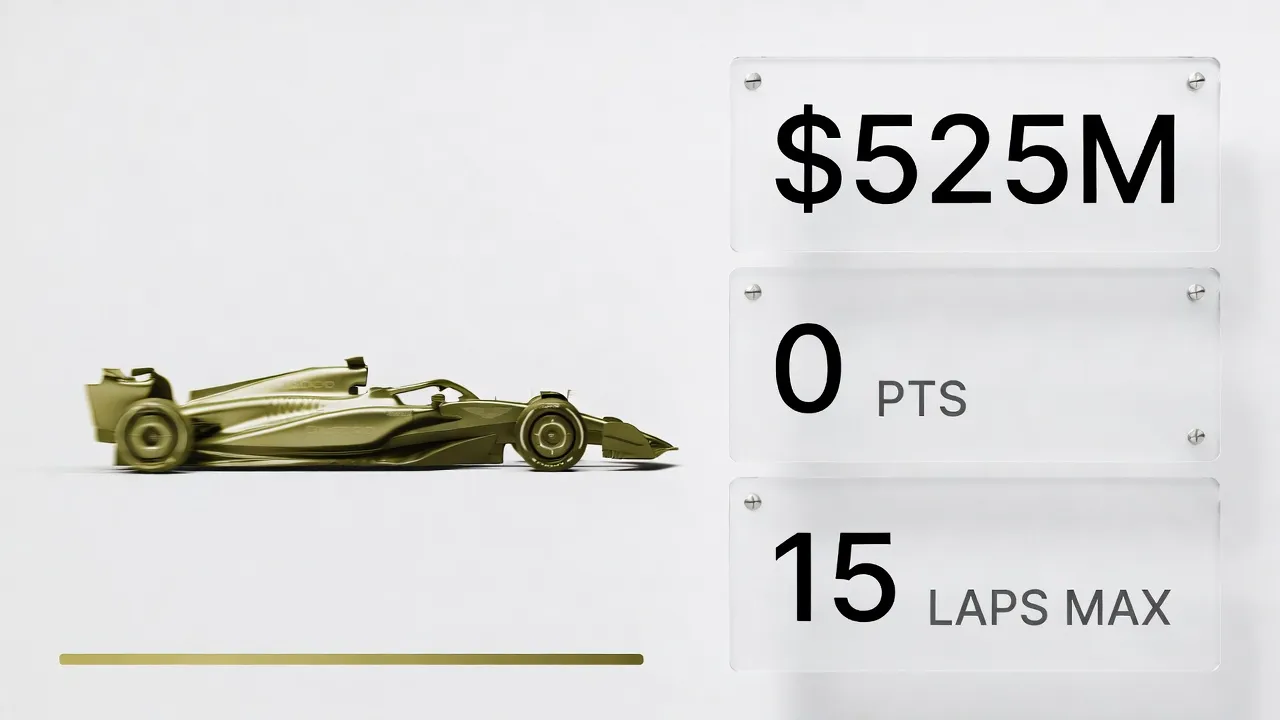
The Honda power unit generates vibrations so extreme that Lance Stroll — who underwent wrist surgery in 2025 following prior fractures — can sustain no more than 15 consecutive laps before crossing the threshold for permanent nerve injury. Fernando Alonso, at 45, manages 25 laps maximum. The Australian GP runs to 58. Neither driver could complete a race distance under normal conditions.
"Fernando is of the feeling that he can't do more than 25 laps consecutively before he will risk permanent nerve damage to his hands. Lance is of the opinion that he can't do more than 15 laps."
— Adrian Newey, Team Principal, Aston Martin F1 · Formula1.com, March 6, 2026Alonso launched from 17th to 10th in the opening laps — proof the chassis has real pace — but a data error triggered an early pit stop and the team ultimately retired both cars to preserve components. The race weekend was a data collection exercise dressed as a competitive entry.
A One-Year Gap That Cost Everything
The root cause of Honda's crisis is well-documented: when Honda announced its 2021 withdrawal from F1, the engineering team that had built the championship-winning Red Bull power unit largely disbanded. Key personnel moved to solar energy projects and other divisions. When Honda reversed course in late 2022 to partner with Aston Martin for 2026, the institutional knowledge was gone.
As Newey explained, the group that reformed to build the 2026 PU is "actually fresh to Formula 1 — they didn't bring the experience that they had had previously." That matters enormously in a regulation cycle demanding a simultaneous 50/50 ICE/electric split, a tripled MGU-K output (350kW, up from 120kW), and entirely new battery architecture — all under a new $130M power unit cost cap.
The Budget Cap Trap
This is where the story moves from sport to finance. The 2026 budget cap sits at $215M for team operational expenditure and $130M for power unit manufacturers. Emergency engine development of the kind Honda now needs isn't cheap, and the regulations are not designed for failure at this scale.
Where the $50M+ Honda Tax Accumulates
| Cost Category | Mechanism | Est. Impact |
|---|---|---|
| Emergency PU development | Honda R&D acceleration under $130M PU cap | $15–20M+ |
| Component overconsumption | Grid penalties → lost championship positions | ~$10M / position |
| Prize money loss (constructors) | P10 vs. P6 delta = est. 4 positions × $10M | ~$40M |
| Sponsor recalibration risk | Performance clauses, visibility reduction | Variable |
| Conservative floor estimate | $50M+ |
Championship position vs. prize money exposure
Why Newey Went Public
A motorsport.com analysis asked the right question: why did Newey and Honda Racing Corporation president Koji Watanabe go public with the severity of the crisis? Teams deny even obvious problems. Newey chose transparency. The answer is financial and regulatory, not sporting.
By publicly disclosing the vibration severity and driver safety implications before the race, Aston Martin creates the legal and regulatory documentation trail needed to petition the FIA for exceptional component allowances. "Nothing happens by chance." The medical dimension — nerve damage risk — is precisely the kind of force majeure language that FIA stewards respond to.
David Coulthard invoked the McLaren-Honda 1988–1992 relationship as the template: Honda's failures with McLaren preceded their most successful era. The institution can recover. But that recovery is measured in years, not months. For Aston Martin, operating within a budget cap with two aging drivers on expiring contracts, time is the one resource money cannot buy.
Aston Martin's 2026 crisis is structurally unlike any other team's difficulties this season. It is not a development miss or an aero philosophy gamble — it is a power unit that produces vibrations dangerous enough to injure drivers, consuming allocated components at rates the regulations were not designed to accommodate.
Lawrence Stroll's $525M infrastructure program represents genuine long-term asset value. Honda will solve the vibration problem. But 2026 is a write-off season whose financial cost extends beyond the race calendar: every championship position lost to reliability translates to approximately $10M less in prize money, compounding against a budget cap that limits Honda's ability to accelerate the fix.
The Honda Tax is real. It will cost Aston Martin $50M+ in direct and indirect losses across 2026 alone. Whether Lawrence Stroll can absorb that within the total program budget — and still emerge competitive in 2027 — is the most consequential financial question in the paddock right now.
Key Questions
- Formula1.com — Newey confirms driver nerve damage risk and lap limits
- Motorsport.com — Coulthard: "massive penalties" via budget cap
- ESPN — Honda's disbanded team and the origins of the 2026 crisis
- Motorsport.com — Why Newey and Honda went public with the crisis
- Motorsport.com — Stroll: vibrations like "electrocuting yourself on a chair"
- Wikipedia — 2026 F1 Championship: budget cap and PU regulations
- Karmactive — Battery allocation: 4 units consumed pre-Melbourne