What Happened
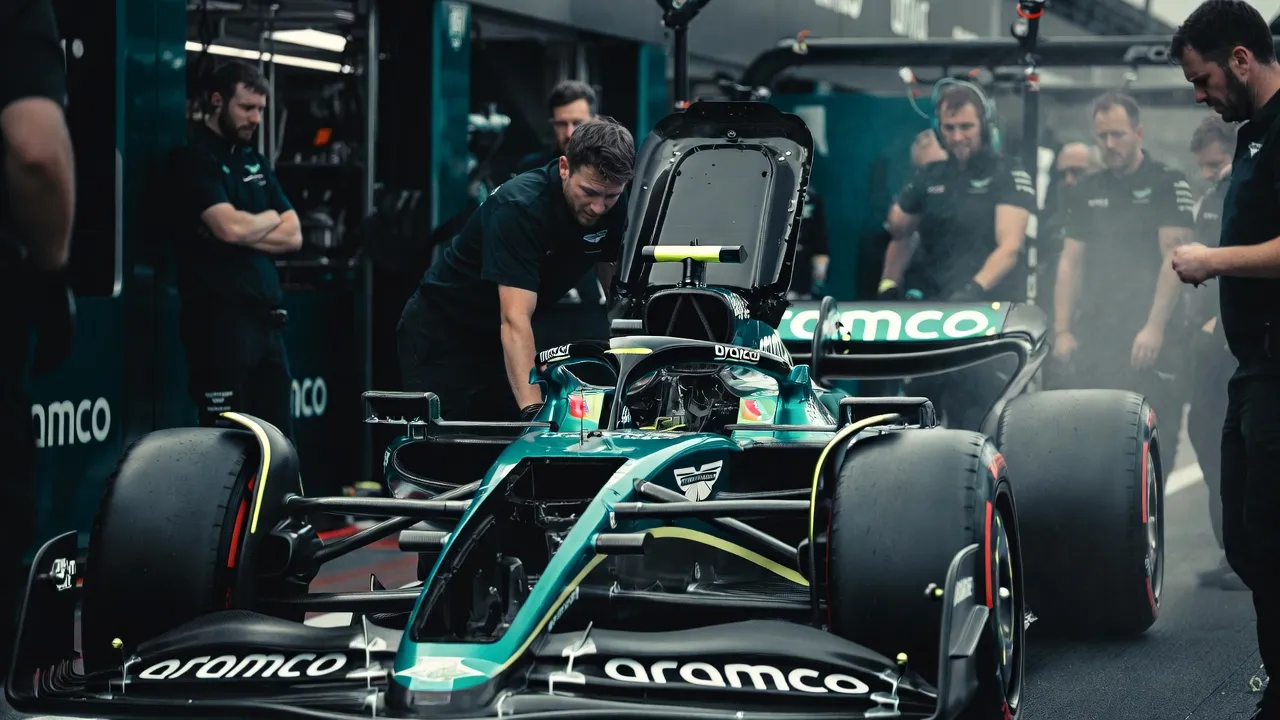
On Thursday morning at Albert Park, Adrian Newey and Honda Racing Corporation president Koji Watanabe held what amounted to a financial damage-control press conference disguised as a technical briefing. The message, stripped of diplomatic language, was this: Honda's 2026 power unit produces vibrations so severe that the car cannot complete the 58 laps of the Australian Grand Prix without the drivers risking permanent neurological damage to their hands.
Fernando Alonso has set a personal limit of 25 consecutive laps. Lance Stroll, who has suffered wrist injuries in recent years, stops at 15. Neither threshold gets them to the chequered flag. The root cause of the vibration has not been identified. Honda brought a countermeasure to Melbourne — developed over intensive dyno sessions at Sakura following testing — but Watanabe himself would not guarantee its effectiveness under real track conditions. The team logged the least mileage of all 11 teams across two weeks of Bahrain testing. They were slower than Cadillac, a brand-new operation with no prior F1 infrastructure.
Race Distance Analysis
Melbourne Race: 58 Laps. Aston Martin's Hard Limits.
Source: Adrian Newey press conference, Melbourne · March 5, 2026
Why It Happened
The structural cause is a correlation failure between Honda's dyno environment and real-world track conditions. Honda conducts its virtual track testing — integrating engine, chassis, and gearbox — at its Sakura facility in Japan, rather than co-locating that process with the chassis manufacturer as most top teams do. The problem did not appear on the bench. It appeared on track in Bahrain, where abnormal vibrations immediately began damaging the battery pack and transmitting through the carbon monocoque into the steering column and drivers' hands.
Carbon fibre is inherently stiff with minimal damping. A vibration source inside the power unit doesn't dissipate through the chassis — it amplifies. Newey described the ICE and potentially the MGU-K as "the source of the vibration" and "the amplifier," with the chassis acting as the passive receiver. Stroll, who compared the sensation to "electrocuting yourself in a chair," was not being theatrical. The neurological risk is real enough that the team discussed not taking the start in Melbourne at all.
There is also a timeline problem. Honda submitted its power unit homologation to the FIA on March 1 — the final legal deadline. What ran in Bahrain is, in regulatory terms, the specification Honda is committed to for the 2026 season. Mid-season changes are permitted only for reliability-related reasons, and even those require FIA approval and must be accounted for within the power unit cost cap, which rises to $130 million in 2026. Honda is not building a new engine. It is managing a known problem it cannot yet fully explain.
Constructors' Prize Money 2025
What Aston Martin Earned Last Year — and What's at Risk in 2026
Aston Martin finished 7th in 2025 Constructors'. In 2026, a slippage to 9th–10th costs $25–35M in prize money. Source: Liberty Media FY2025 filings / PlanetF1 estimates.
The Prize Money Hemorrhage
The financial architecture of Formula 1 punishes unreliability twice. The first time is immediate: you don't score points, so you don't improve your constructors' standing. The second time is deferred, but larger: your prize money allocation in the following season is calculated on your current-year performance, meaning a bad 2026 compounds into a financially worse 2027.
Aston Martin collected $109.3 million in prize money based on its seventh-place finish in the 2025 Constructors' Championship. That figure covers roughly half of the team's operational budget at the current $215 million cost cap. In 2026, with an 11-team grid including Cadillac diluting the prize pool, that number was already expected to decline. A season in which both cars regularly fail to complete race distances pushes Aston Martin toward the lower half of the pay scale. The difference between finishing seventh and finishing ninth or tenth in the 2026 Constructors' Championship is estimated at $25–35 million in annual prize money — a figure large enough to meaningfully constrain their development budget for 2027 before the season even ends.
The Concorde Agreement's prize money structure has a feature that makes this worse: historical performance bonuses are calculated over the preceding decade. Aston Martin has no legacy of dominance to draw from. Their payments are almost entirely performance-contingent. There is no Ferrari-style structural floor protecting them from a poor season. Every position lost costs them directly.
Sponsorship Exposure: What Aramco Paid For
In December 2023, Saudi Aramco signed a five-year exclusive title sponsorship deal with Aston Martin, running through 2028. The precise commercial value is not public, but title sponsorships at mid-tier teams in the modern F1 era are typically structured in the range of $30–50 million annually, with performance escalators that increase value as results improve. Aramco's logo occupies the most prominent real estate on the AMR26 — the nose, sidepod center, and engine cover. That visibility is the product being sold.
What Aramco purchased was not just a logo placement. It was a guaranteed association with a functioning, competitive Formula 1 team during a new technical era that Aramco itself is technically integrated into — supplying the 100% sustainable fuel that the 2026 power unit regulations mandate. The partnership narrative was built around innovation, high performance, and energy transition. A car that is physically incapable of finishing a race is not that product. It is the inverse of it.
Sponsorship contracts in F1 do not typically include race-completion guarantees as binary performance triggers — that would make them uninsurable. But they do include brand protection clauses and material adverse performance provisions. A team that consistently fails to finish races, or qualifies in last position, erodes the sponsor's earned media value. Aramco's marketing team in Dhahran is watching the same timing screens as everyone else in Melbourne. The relationship survives one bad weekend. It doesn't survive a season of them.
Season Projection Scenarios
What Honda's Fix Timeline Means for Aston Martin's 2026 Finances
✅ Best Case
Fixed by R3
Japan / Bahrain — Honda identifies root cause, hardware fix deployed
Team recovers to 7th–8th in constructors'. Prize money ~$95–105M. Sponsorship intact. Development trajectory preserved.
⚠️ Mid Case
Fixed by R8
Miami / Canada — Countermeasures buy laps, but performance is compromised
Constructors' drops to 8th–9th. Prize money hits ~$80–90M. Sponsor conversations initiated. Newey credibility under pressure.
🔴 Worst Case
H1 lost
No race completions until Europe — structural hardware change required
Constructors' finishes 10th–11th. Prize money falls to ~$63–70M. $35–45M annual gap vs 2025 payout. Aramco escalators trigger review.
Projections based on Liberty Media FY2025 prize pool structure. Figures are estimates.
The Dependency Framework
The strategic decision that defines Aston Martin's current vulnerability was made in 2022, when Lawrence Stroll committed the team to a Honda works partnership beginning in 2026. The logic was sound: works engine status is considered a prerequisite for championship-level competitiveness. Customer teams receive whatever the manufacturer deems appropriate to supply; works teams co-develop. The partnership with Honda was framed as Aston Martin's path from midfield novelty to title contender, accelerated by the arrival of Adrian Newey from Red Bull.
The problem with a works partnership — as Ferrari, Renault, and Honda's own previous customers have discovered — is that when the works package fails, there is no fallback. A customer Mercedes or customer Ferrari engine comes with decades of validated performance data and a supplier relationship structured around reliability guarantees. Honda's 2026 power unit is a new architecture, co-developed with Aston Martin's specific packaging requirements, running rules that nobody has fully proven in competition. When Newey laid out his chassis' dimensional constraints to Honda — including pressure for a shorter, more compact engine — he was limiting Honda's engineering options at the same time he was creating dependency on Honda's execution.
This is the trap that works partnerships set. You gain maximum integration. You also absorb maximum risk. Newey has already stated, with unusual directness, that the chassis is "fifth-best" on the grid. The gap between a top-five chassis and a bottom-of-the-grid result is Honda's engine problem. That single variable — unresolved, root-cause-unknown as of this morning — is worth $30–40 million in prize money, multiple sponsorship escalator thresholds, and two drivers' careers if the vibration compounds into long-term injuries.
For more context on how the force majeure framework applies to Aston Martin's accumulated pre-season costs, see our earlier analysis at Aston Martin / Honda: Force Majeure and the Melbourne Cost. The financial exposure modeled there has only widened since.