The image of Stefano Domenicali standing shoulder-to-shoulder with Eddy Cue, Apple’s Senior VP of Services, signals more than a mere partnership announcement. It represents a definitive changing of the commercial guard. For decades, Formula 1’s broadcast model relied on a linear equation: rights fees plus advertising slots equals revenue. The deal unveiled for the 2026 season—a five-year, $750 million exclusive agreement for US rights—dismantles that calculus entirely.
We are witnessing the sport pivot from ESPN’s traditional linear distribution toward a "total ecosystem" strategy. Apple’s intent is not merely to televise the race but to integrate the world’s most expensive logistical circus into a seamless loop of high-margin services, retail activations, and hardware dependency. This is a seismic shift in the operational mechanics of the sport, moving the point of sale from the living room television to every digital touchpoint in a consumer's life.
The Deal Structure: A Valuation of Ubiquity
Starting in 2026, the American broadcast landscape for Formula 1 will operate under a new paradigm. The five-year exclusive deal effectively ends the ESPN era, placing every session under the Apple umbrella. While the headline figure is $750 million, the granular economics reveal a strategy focused on Average Revenue Per User (ARPU) expansion rather than pure viewership volume.
Core Commercial Terms
| Contract Component | Specification |
|---|---|
| Total Valuation | $750 Million (Estimated) |
| Duration | 5 Years (2026–2030) |
| Annual Value | $150 Million/Year |
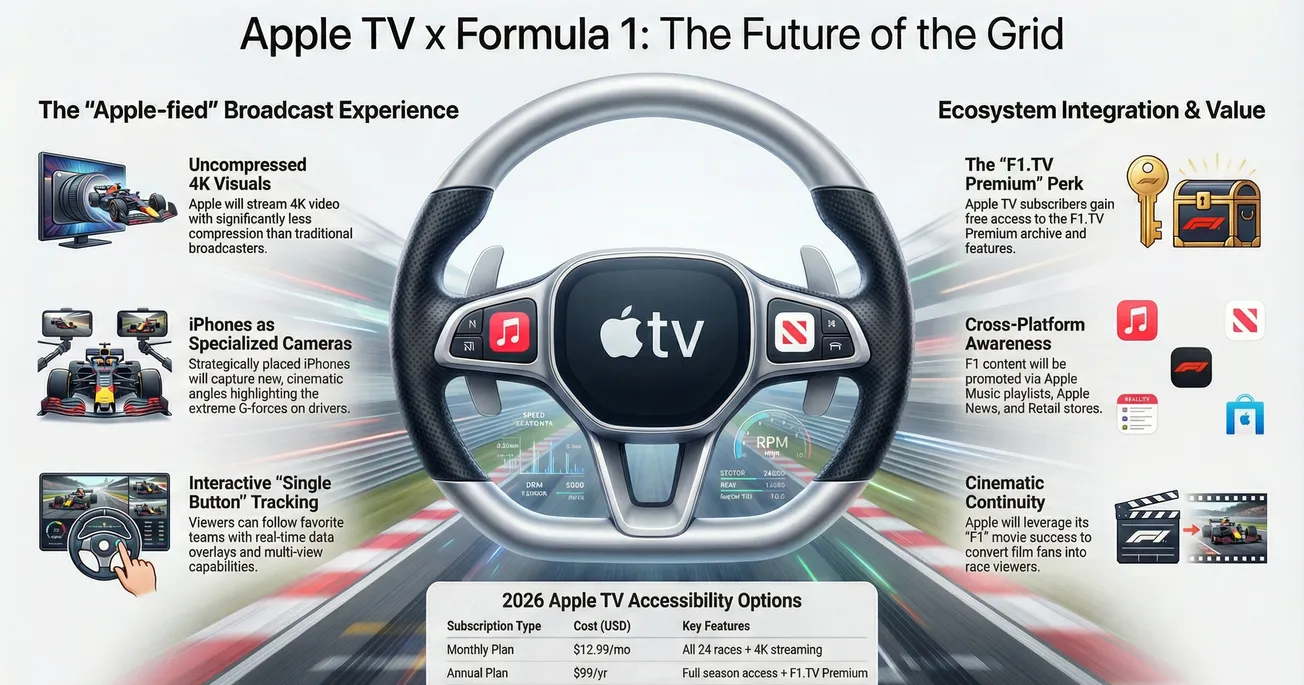
| Pricing Model | $12.99/mo or $99/yr (Standalone) |
| Bundle Integration | Included in Apple One Premier ($19.95/mo+) |
| Acquisition Strategy | Practice Sessions Free (No Paywall) |
The strategic genius lies in the "Taster" Strategy. By making all practice sessions available for free, Apple creates a zero-friction funnel for casual viewers—perhaps those converted by Drive to Survive—to sample the product without an immediate credit card commitment. This lowers the Customer Acquisition Cost (CAC) significantly compared to traditional cable packages.
Operational Intelligence: The Bitrate as a Competitive Moat
For the paddock’s technical directors, "performance" is measured in lap time; for Apple, it is measured in bitrate. The prompt’s analysis of the "4K Gloss" understates the technical achievement required here. Current satellite and cable compression algorithms frequently struggle with the high-velocity motion of F1. At 300 km/h, the complex geometries of a carbon-fibre chassis often render as digital artifacts on standard broadcasts.
Eddy Cue’s pledge to deliver "uncompressed" or low-compression 4K is a direct play for the high-net-worth purist. This is not just an aesthetic upgrade; it is a value-add for sponsors. Clarity at speed ensures that sponsor logos—often costing millions for placement on a sidepod—remain legible rather than blurring into a pixelated smear.
The Hardware Integration
Furthermore, the deployment of iPhones as auxiliary trackside cameras serves a dual purpose.
- Operational Proof-of-Concept: It validates the iPhone’s camera sensor as broadcast-grade hardware in extreme environments.
- Visceral Marketing: By utilizing mobile hardware to capture the G-forces and physicality of the cockpit, Apple bridges the gap between the consumer device in the fan's pocket and the pinnacle of motorsport engineering.
The Retail Feedback Loop: Brick-and-Mortar Fan Zones
Apple’s unique advantage over ESPN or Netflix is its physical footprint. The strategy envisions Apple retail stores in major US cities functioning as de facto "Fan Zones." This integrates the digital broadcast with physical retail, creating a flywheel effect:
- Morning: Fan watches Free Practice 1 on iPhone.
- Afternoon: Fan visits Apple Store, greeted by F1-themed visual merchandising and Apple Music curated race playlists.
- Evening: Fan subscribes to Apple One to watch Qualifying.
This "always-on" loop creates a retention mechanism that purely digital broadcasters cannot replicate. It converts a weekend viewer into a year-round ecosystem subscriber.
Strategic Risks: The Notification Economy
Despite the glossy potential, the transition carries significant risk regarding consumer sentiment. The "Skeptic's" concern regarding notification fatigue is valid. Apple users pay a premium for a minimalist, ad-free experience. If the operating system begins to aggressively push F1 content—race start alerts, Apple News highlights, merchandise drops—it risks eroding the brand equity of "privacy and restraint" that Apple has cultivated.
The Migration Challenge
| Feature | Legacy Era (ESPN/F1.TV) | Apple Era (2026+) |
|---|---|---|
| Archive Access | Separate F1.TV Subscription | Free Linkable Perk |
| Onboards | Separate App | Native "Multiview" |
| Latency | High (Streaming) / Med (Cable) | Low (Optimized Infrastructure) |
| Ad Load | Commercial Breaks | Ad-Free / Ecosystem Promos |
The inclusion of F1.TV Premium features (historical archives and telemetry) as a free perk for subscribers is the critical "carrot" to mitigate the "stick" of a platform migration. It effectively subsidizes the subscription cost for die-hard fans who were previously paying F1 directly.
The 2030 Horizon: The Vision Pro Endgame
While downplayed in initial press materials, the long-term play (2028–2030) inevitably involves spatial computing. Apple’s contract extends to the Apple Vision Pro.
Translating the NBA’s immersive content strategy to the paddock offers the ultimate differentiator: a virtual pit wall. Imagine sitting in a living room with a 3D, augmented-reality map of the circuit floating on the coffee table, with live telemetry overlays and driver-tracking data. This is the only innovation that could justify the $750 million price tag over the long term. It moves the broadcast from 2D observation to 3D participation.
Conclusion: A Calculated Land Grab
Comparing this to Toyota’s ill-fated $3 billion F1 entry is tempting but inaccurate. Toyota attempted to buy competitive success; Apple is buying attention infrastructure. This is a calculated land grab for the premium sports demographic.
F1 has spent years attempting to "break America." By partnering with a company that commands the hardware, the software, and the retail environment of the target demographic, Liberty Media has found a partner capable of finishing the job. The risk is no longer whether the sport can grow in the US, but whether it can maintain its soul while being fully digested by the Silicon Valley ecosystem.