The Industrial Shift in Motorsport
When a seven-time World Champion speaks, the market listens. But when Lewis Hamilton calls new Formula 1 rules "ridiculously complex", he is identifying a structural pivot in the sport's business model, not just a grievance about drivability. The 2026 regulations represent the most aggressive alteration of the sport's technical liquidity in decades. We are moving from a formula based on aerodynamic grip to one based on algorithmic energy solvency.
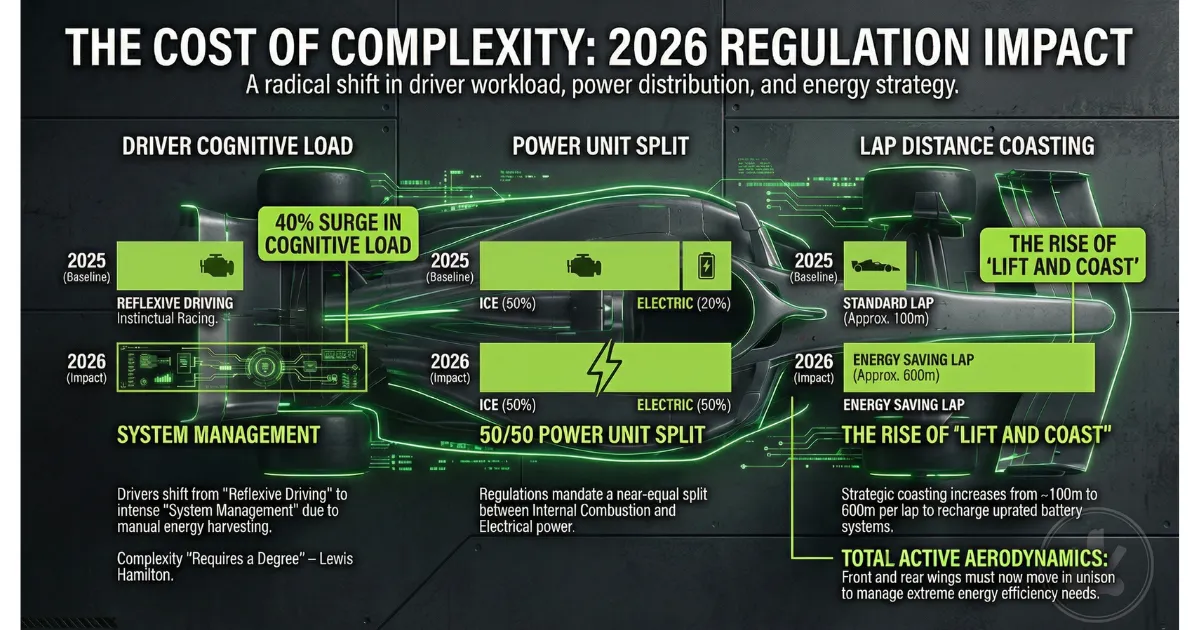
The headline data is clear: a shift to a 50/50 power split between the Internal Combustion Engine (ICE) and electrical power. However, the underlying economic reality is far more disruptive. The regulations mandate a vehicle that is essentially two assets in one, governed by Total Active Aerodynamics. This requires a capital expenditure (CapEx) strategy that prioritizes variable geometry and software-defined performance over static mechanical grip.
The Energy Balance Sheet
Hamilton’s critique centers on the operational load placed on the driver. In financial terms, the driver is transitioning from a trader executing high-frequency transactions (reflexive driving) to a portfolio manager balancing long-term assets (energy deployment over a lap).
The requirement to perform "lift and coast" maneuvers for up to 600 meters significantly alters the Return on Investment (ROI) of a qualifying lap. Previously, time was the only currency. In 2026, energy is the dominant currency. A driver who expends too much electrical capital in Sector 1 will face a liquidity crisis in Sector 3, leaving them vulnerable on the straights regardless of their cornering speed. The "complex energy equation" Hamilton refers to is a literal balance sheet that must be reconciled every 90 seconds.
Technical Insolvency: The Risk of Over-Regulation
The complexity Hamilton flags introduces a risk of technical insolvency. The rules require drivers to downshift to unusually low gears in high-speed sections to spike engine revs for battery regeneration. This counterintuitive behavior is an efficiency hack—a way to manipulate the system to maintain energy solvency.
From an engineering perspective, this increases the number of components that learn the driver's style in real time, including OpEx gearboxes and MGU-K units. Teams like Mercedes, Ferrari, and Red Bull Ford Powertrains must now account for higher failure rates in their reliability projections.
Furthermore, the software dependency creates a new layer of volatility. If the car's performance is dictated by an algorithm that learns the driver's style in OpEx, a single driving error (a "market fluctuation") can corrupt the data set, causing the algorithm to miscalculate energy deployment for the remainder of the lap. The driver is no longer just driving; they are feeding data to a machine learning model. If the input quality drops, the output (lap time) crashes.
Macroeconomic Implications for Teams
Why does it matter that Lewis Hamilton calls new Formula 1 rules "ridiculously complex"? Because complexity costs money.
- Human Capital Inflation: The demand for simulation engineers and control systems specialists will skyrocket. The "degree" Hamilton suggests one needs to understand the car represents a literal barrier to entry for talent.
- The Active Aero Gamble: Developing wings that move in unison (low drag on straights, high downforce in corners) without physical testing creates a high-risk R&D environment. The correlation between CFD (Computational Fluid Dynamics) and track reality becomes the single most valuable asset a team possesses.
- Commercial Viability: If the cars are too complex to race wheel-to-wheel because drivers are managing energy deltas, the entertainment product suffers. F1 management is betting that this "Industrial-Fintech" approach to racing—where efficiency is king—will resonate with automotive manufacturers looking to justify their R&D spend on hybrid technologies.
Conclusion: The Driver as Systems Administrator
The 2026 regulations are an exercise in scarcity economics. Fuel flow is limited; electrical energy is capped; aerodynamic drag is variable. By calling the rules "ridiculously complex," Hamilton is highlighting the friction between human athletic endeavor and strict resource management.
For investors and stakeholders in PaddockIntel, the takeaway is clear: 2026 will not be won by the team with the most horsepower. It will be won by the team that builds the most efficient energy clearinghouse on four wheels. The car is no longer a vehicle; it is a high-speed energy grid, and the driver is its chief operator.