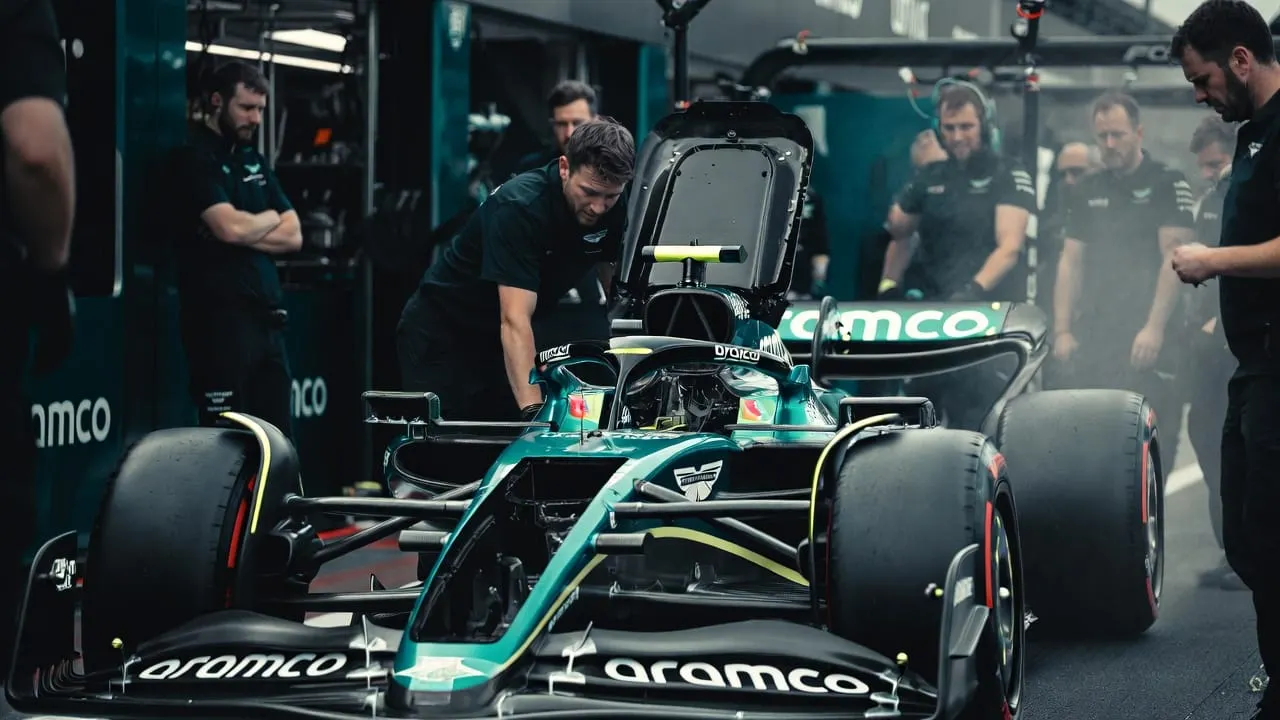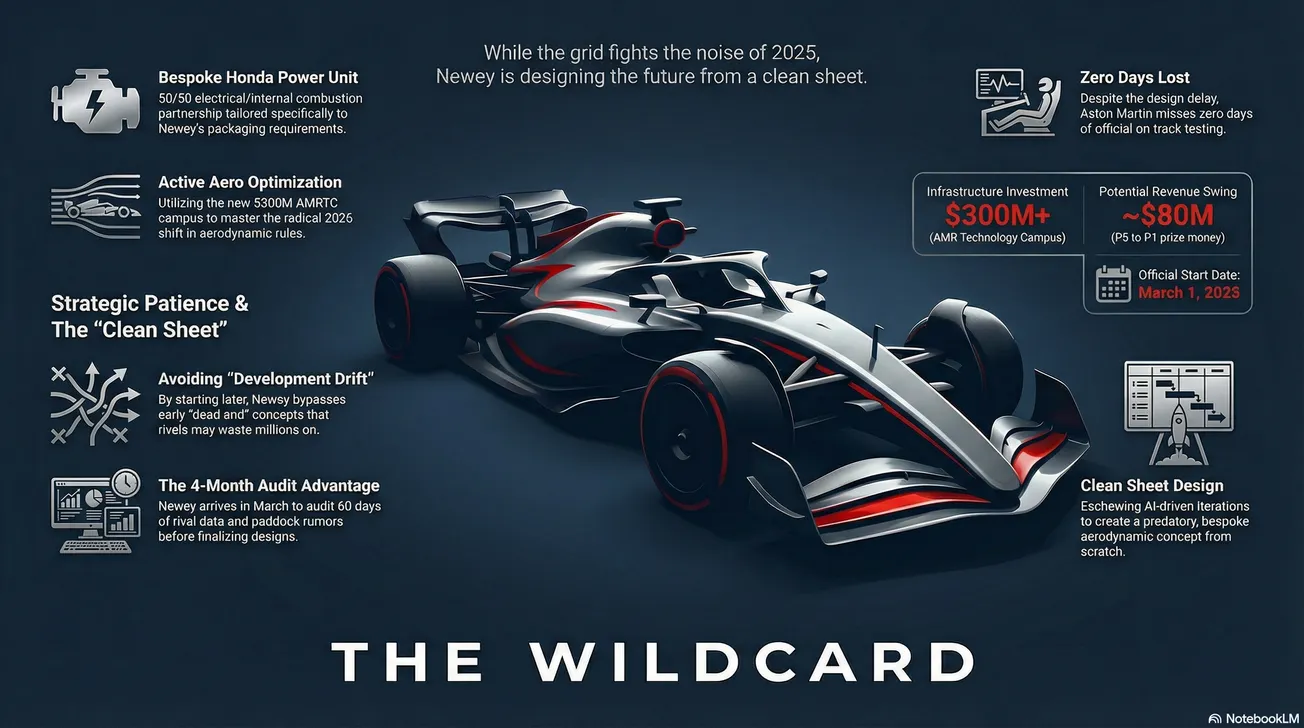
While rivals burn wind tunnel hours on 2026 guesswork, Newey's March 1 start date creates strategic patience—letting competitors make expensive mistakes first, then optimizing second.
Formula 1's paddock loves a crisis narrative. Adrian Newey cannot officially begin work at Aston Martin's Silverstone facility until March 1, 2025—four months after Ferrari, Mercedes, and McLaren started their 2026 aerodynamic development programs. The immediate framing: Aston Martin is "behind schedule," Newey faces an "impossible timeline," Lawrence Stroll's $300 million investment arrives "too late."
The operational reality tells a different story.
In Formula 1 regulation resets—particularly the seismic 2026 overhaul mandating 50/50 hybrid power split and active aerodynamics—being first often means being first to a dead end. Early movers commit wind tunnel hours, CFD allocations, and manufacturing resources to concepts that prove fundamentally flawed. Late movers audit that data, identify the mistakes, and optimize solutions before carbon fiber ever enters an autoclave.
Adrian Newey has built a Hall of Fame career on this exact pattern: strategic patience, late-stage intervention, and exploiting what rivals discover the hard way. His four-month delay isn't a disadvantage. It's a calculated feature of Aston Martin's $300M bet on 2026 dominance.
Here's the economic calculation, operational advantage, and historical precedent behind Formula 1's most expensive game of strategic patience.
The Economic Reality: Deferring Costs, Not Losing Money
Under Formula 1's $215 million cost cap (2026 baseline), the most expensive mistake teams make is "development drift"—spending millions on aerodynamic concepts that prove incompatible with actual car performance once track testing begins.
Aston Martin's timeline economics:
Early starters (January 2025) face immediate resource allocation:
- Wind tunnel hours: 400+ runs on initial 2026 concepts
- CFD simulations: 1,000+ computational iterations
- Manufacturing commitments: Tooling, molds, composite layup schedules
- Personnel allocation: 200+ engineers locked into development direction
Total early-phase investment: $30-40M before validating whether core concepts work.
Newey's March 1 start defers this spending until competitors have generated four months of validation data—effectively conducting $150M+ worth of collective R&D that Aston Martin can audit before committing resources.
The prize money calculus:
Aston Martin finished P5 in 2025 Constructors' Championship, earning approximately $140M in FOM prize money distribution. Moving to P1 represents an $80M revenue increase—plus exponential sponsorship value growth from championship-winning association.
The calculation: Risk a slow start to 2026 (potentially costing 1-2 positions early season, $20M) to arrive with an optimized car capable of challenging for P1-P2 long-term ($60-80M upside).
ROI if strategy succeeds: 3:1 to 4:1 return on strategic patience costs.
Lawrence Stroll's infrastructure bet:
Stroll has invested over $300M in Aston Martin's AMR Technology Campus, including:
- State-of-the-art wind tunnel (operational Q1 2025)
- Manufacturing facility expansion
- CFD computing infrastructure
- Personnel recruitment (400+ technical staff)
Newey's March arrival timing ensures this infrastructure gets used for refinement rather than experimentation. The wind tunnel opens precisely when Newey needs it—for validating optimized concepts, not exploring dead ends.
From capital allocation perspective, this is strategic sequencing: build capability first, deploy genius second, avoid wasting either on premature commitments.
The Operational Advantage: Auditing Competitors' Mistakes
The 2026 technical regulations represent Formula 1's most significant aerodynamic and power unit overhaul since 2014's hybrid introduction. Key changes include:
Active aerodynamics:
- Front and rear wings adjust dynamically during racing
- Complexity creates massive correlation risk between simulation and reality
- Teams must balance downforce generation with drag reduction
- Early concepts will struggle with actuation reliability and control algorithms
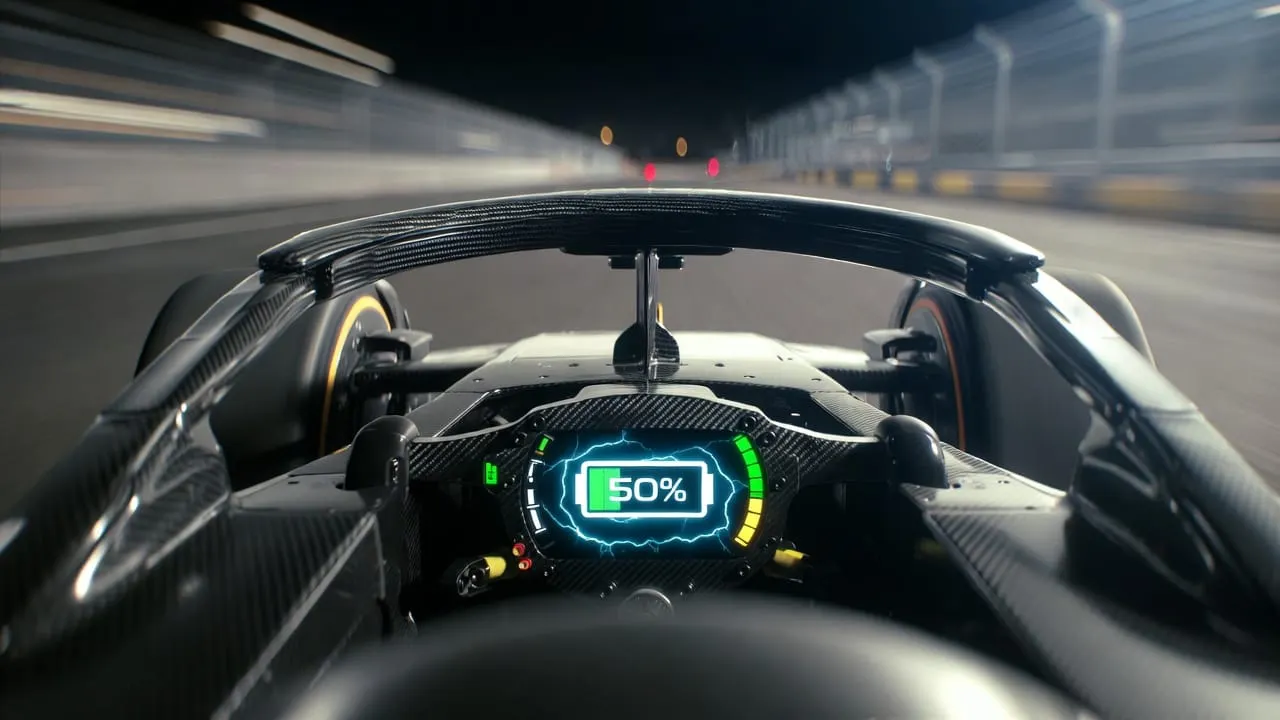
50/50 hybrid power split:
- Internal combustion and electrical output balanced equally
- Battery deployment strategy becomes critical to lap time
- Packaging constraints force aerodynamic compromises
- Power unit integration determines chassis design possibilities
Quantifying the learning window:
Between January 1 (when early starters begin) and March 1 (Newey's start date), competitors will complete:
- 400-600 wind tunnel runs exploring initial concepts
- 2,000+ CFD simulations testing variations
- Preliminary manufacturing validation (can concepts be built?)
- Internal design reviews identifying flaws
By March 1, the paddock grapevine will reveal which teams discovered fundamental problems:
- Active aero concepts that create instability
- Battery cooling solutions that don't scale
- Suspension geometries incompatible with ground effect
- Power unit packaging that constrains aerodynamic development
Newey's operational efficiency:
Unlike teams requiring 10,000 computational iterations to explore design space, Newey's approach combines intuition, first-principles physics, and human pattern recognition. His rejection of AI-driven design tools (widely reported across F1 media) stems from confidence that human creativity identifies non-obvious solutions computational models—trained on historical data—cannot discover.
The operational timeline:
- March-May 2025: Concept development (informed by competitor mistakes)
- June-August 2025: Wind tunnel validation (using new AMRTC facility)
- September-November 2025: Manufacturing preparation
- December 2025-January 2026: Assembly and systems integration
- February 2026: Pre-season testing (no disadvantage—official testing starts for everyone)
Critical insight: Newey doesn't lose testing time. Official 2026 pre-season testing begins February 2026 for all teams. The "four-month delay" affects only design phase—where learning from competitors' public mistakes provides more value than starting early in isolation.
The Supply Chain Reality: Manufacturing Flexibility as Strategic Asset
Late design finalization typically creates supply chain nightmares—compressed timelines, rushed manufacturing, quality control compromises. For Aston Martin's infrastructure scale, it creates tactical advantage.
Supplier learning curve:
Carbon fiber manufacturers, composite suppliers, and specialized component vendors serve the entire grid. By March 2025, they've spent four months learning which 2026 designs create manufacturing challenges:
- Complex geometries that increase autoclave failure rates
- Cooling solutions requiring exotic materials with long lead times
- Active aero mechanisms with tight tolerance requirements
- Electrical integration complexity affecting production yields
Aston Martin can specify solutions accounting for these discovered constraints, avoiding manufacturing bottlenecks competitors face when translating aggressive designs into buildable hardware.
Manufacturing process refinement:
The AMRTC facility's modern equipment enables rapid prototyping and iteration cycles competitors using older infrastructure cannot match. Late design finalization means:
- Suppliers already ramped production capabilities for 2026 components
- Manufacturing processes debugged through competitors' early orders
- Tooling and mold technologies proven through first-generation 2026 parts
- Quality control protocols established for new regulation components
The Honda partnership advantage:
Unlike 2014—when Newey's Red Bull designs were constrained by Renault's underperforming power unit—the 2026 Aston Martin benefits from exclusive Honda partnership allowing complete power unit/chassis integration from design inception.
Newey starting March 1 means Honda's power unit development (which began earlier) provides validated packaging constraints rather than theoretical specifications. He designs around known realities, not estimated futures.
The Contrarian Calculation: First-Mover Disadvantage in Regulation Changes
Formula 1 history demonstrates that regulatory resets favor strategic patience over aggressive early commitment.
2022 ground effect regulations:
Early launchers arrived with fundamental flaws:
- Mercedes' W13: Severe porpoising, 18 months correcting aerodynamic instability
- Aston Martin's AMR22 (original): Copied Mercedes' concept, inherited their problems
- Haas VF-22: Early launch, mid-season performance collapse
Late optimizers dominated:
- Red Bull RB18: Solved porpoising through suspension geometry before it manifested
- Ferrari F1-75: Strong early performance from refined concept
- Alpine A522: Mid-season improvements from learning competitors' mistakes
Red Bull's 2022 championship—and subsequent dominance through 2024—stemmed from Newey's suspension design preventing porpoising competitors spent billions trying to fix retroactively. He didn't rush the car; he mastered the physics before committing.
2014 hybrid power unit introduction:
Mercedes' early investment (2011 start) in hybrid technology created four-year competitive advantage, but their early mover status came from power unit development—where lead time matters exponentially.
Chassis development showed different dynamics:
- Newey's Red Bull RB10 chassis widely considered best on grid despite Renault power unit disadvantage
- Mercedes' chassis less sophisticated but power unit advantage masked it
- Late-season Newey optimizations closed chassis performance gap significantly
2009 regulation reset:
Brawn GP's championship leveraged double-diffuser loophole discovered late, but Red Bull's RB5—Newey's design—won final three races and established technical direction for four-year dominance (2010-2013).
Pattern: Newey allows field to explore regulation space, identifies winning direction, then optimizes relentlessly. He doesn't pioneer; he perfects.
The Newey Doctrine: Strategic Patience as Competitive Philosophy
Adrian Newey's career success—12 Constructors' Championships, 13 Drivers' Championships across three teams—stems from consistent operational philosophy:
"Optimization beats innovation."
In major regulation changes, teams innovate wildly seeking conceptual advantage. Most innovations fail. Newey waits, observes which innovations work, then optimizes proven concepts beyond competitors' capability.
Manufacturing philosophy:
Newey famously hand-draws initial concepts, rejecting computer-aided design's tendency toward incremental iteration. This approach enables "clean sheet" thinking—starting from first principles rather than evolving previous solutions.
For 2026 regulations mandating completely different aerodynamic and power unit philosophies, this approach provides advantage: Newey isn't constrained by 2025 design thinking competitors unconsciously carry forward.
The "silence advantage":
Between March and December 2025, Aston Martin will conduct zero public testing, reveal zero technical specifications, and generate zero competitive intelligence for rivals.
Meanwhile, competitors' wind tunnel models, CFD simulations, and design philosophies leak through:
- Supplier conversations
- Personnel movement between teams
- Mandatory FIA technical submissions
- Photographic analysis of factory equipment deliveries
By December 2025, Aston Martin will know more about competitors' AMR26 rivals than those competitors know about the AMR26. Information asymmetry as competitive advantage.
The Lawrence Stroll Calculation: $300M Infrastructure + $80M Opportunity
Lawrence Stroll's Aston Martin investment thesis depends on 2026 championship competitiveness delivering enterprise value growth exceeding infrastructure costs.
The financial model:
Infrastructure investment (2021-2025): $300M
- AMRTC facility: $200M
- Personnel recruitment: $50M
- Equipment and technology: $50M
Newey contract (estimated): $50M+ over multi-year term
Honda partnership value: Exclusive works team relationship
Revenue scenarios:
Scenario 1 - Strategy fails (P5-P7 finish):
- Prize money: $120-140M annually
- Sponsor value: Moderate
- Team valuation: $1.2-1.5B (current baseline)
- ROI: Negative on infrastructure investment
Scenario 2 - Strategy succeeds (P1-P3 finish):
- Prize money: $180-220M annually
- Sponsor value: Premium (championship association)
- Team valuation: $2.5-3.5B (championship premium)
- ROI: 300-400% on infrastructure over 5-year period
Stroll's bet: Four-month delay risk ($20M potential early-season position loss) justified by championship upside ($60-80M annual revenue increase + team valuation growth).
From private equity perspective, this is asymmetric risk/reward: capped downside, exponential upside if Newey's strategic patience delivers.
What Happens Next: The March 1 Inflection Point
Formula 1's 2026 season begins March 8, 2026, in Melbourne—exactly 372 days after Newey's March 1, 2025 Aston Martin start date.
Timeline to watch:
March 1, 2025: Newey officially begins June 2025: First wind tunnel validation data (AMRTC facility) October 2025: Design freeze and manufacturing ramp January 2026: AMR26 car reveal February 2026: Pre-season testing (Bahrain) March 8, 2026: Australian GP season opener
Performance indicators:
If Newey's strategic patience works:
- Pre-season testing reveals fundamentally different AMR26 philosophy
- Aston Martin avoids active aero reliability issues plaguing rivals
- Honda power unit integration superior to customer teams
- Strong qualifying and race pace from Melbourne opener
If strategy underdelivers:
- AMR26 shows derivative concepts from competitors
- Active aero struggles with correlation between simulation and reality
- Mid-season development required to close performance gap
- Championship challenge develops 2027+, not 2026
The silence between now and January 2026 should terrify competitors more than any visible development program. Newey's four-month delay means Aston Martin's actual 2026 concept remains completely unknown while rivals' directions become increasingly transparent through testing, supplier leaks, and personnel movements.
The Bottom Line: Strategic Patience as $300M Competitive Weapon
Adrian Newey's March 1, 2025 Aston Martin start date creates four-month design phase delay versus early-starting competitors. Conventional analysis frames this as disadvantage—lost development time, compressed schedules, timeline pressure.
The operational and economic reality inverts that narrative.
What Aston Martin sacrifices:
- Four months of isolated design exploration
- Early manufacturing preparation advantages
- Potential first-mover concept breakthroughs
What Aston Martin gains:
- $150M+ worth of competitor validation data (collectively generated)
- Identification of which 2026 concepts fail before committing resources
- Manufacturing process refinement through supplier learning
- Honda power unit packaging constraints validated through testing
- Information asymmetry—rivals reveal designs while AMR26 remains secret
The calculation: Risk: Slow 2026 start costs 1-2 championship positions ($20M revenue impact) Reward: Optimized car challenges for P1-P2 ($60-80M revenue upside + team valuation growth)
Strategic patience as competitive philosophy: Let competitors make expensive mistakes first, optimize second, dominate third.
Lawrence Stroll invested $300M in infrastructure and recruited Adrian Newey specifically for 2026 regulation reset. The four-month "delay" isn't timeline failure—it's the operational manifestation of strategic patience as competitive weapon.
For Mercedes, Ferrari, and Red Bull currently burning wind tunnel hours on 2026 concepts, the real question isn't "why is Aston Martin late?"
It's "what does Newey know about our mistakes that we haven't discovered yet?"
The answer arrives March 8, 2026, in Melbourne. By then, strategic patience either delivers championship-caliber advantage or becomes $300M lesson in overestimating first-principles genius against collective grid learning.
Newey's career suggests betting against his calculated patience strategy has historically proven expensive for competitors.
Subscribe to Paddock Intel for operational strategy and economic analysis from Formula 1's 2026 regulation reset.