2026 F1 Energy Management Mapping: Thermodynamic Crisis and CapEx Restructuring
Formula 1 is approaching an event horizon in 2026. This isn't just a chassis update; it is a fundamental rewriting of the sport's physics that has triggered financial alarms across 'Top-Tier' teams. Analysis of the FIA Technical Regulations Issue 7/2026 reveals a scenario where Energy Management Mapping is not just a variable, but the sole determinant of competitive survival.
The 50/50 Equation and the Thermodynamic Wall
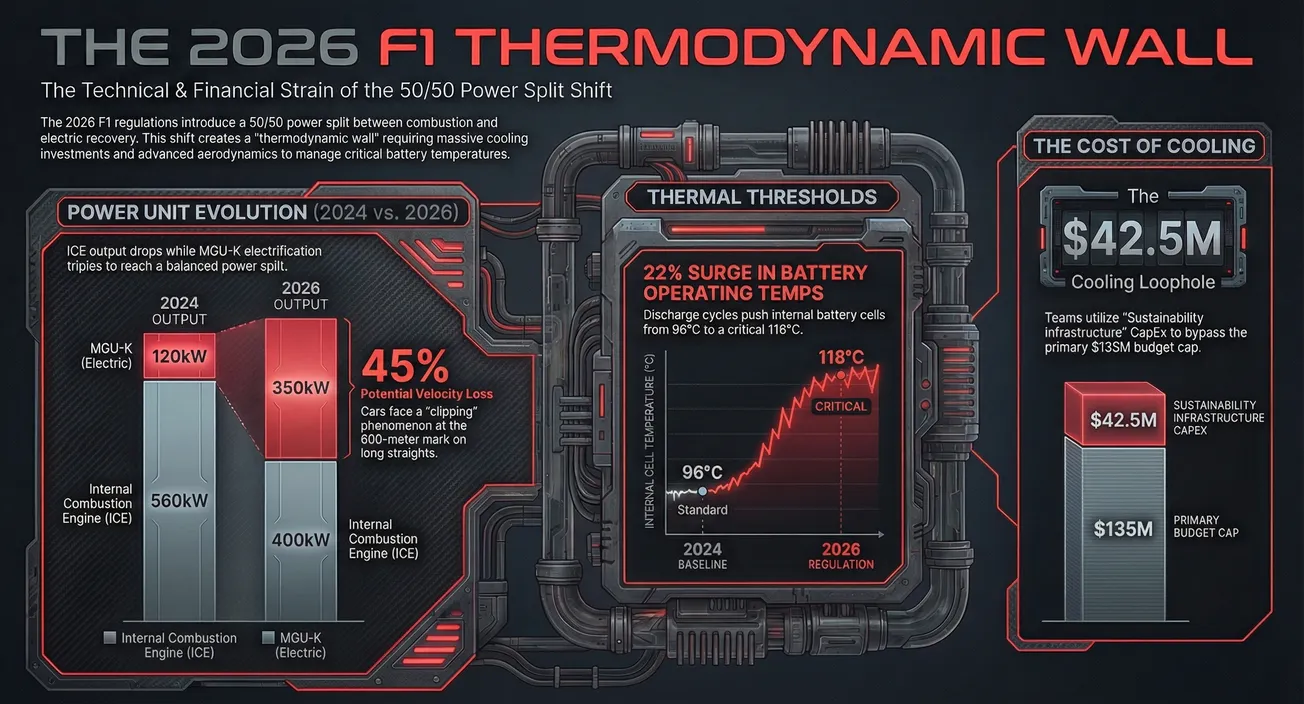
The structural shift is brutal: a 50/50 power distribution. The Internal Combustion Engine (ICE) sees its output slashed from 560 kW to 400 kW, while the electrical component (MGU-K) must triple its output to 350 kW. On paper, it looks like sustainable evolution. In the simulator, it is a thermodynamic nightmare.
Our projections indicate severe "Clipping." Without surgical deployment management, cars will lose 45% of their speed potential beyond the 600-meter mark on straights. The driver ceases to be a torque operator and becomes a 'State of Charge' (SoC) crisis manager. If recovery does not match deployment, the car simply stops pushing.
The Hidden Cost of 118°C
Physics comes with a price tag. The aggressive discharge cycles required to feed that 350 kW MGU-K are pushing battery cells to critical temperatures of 118°C, a 22% increase over 2024 standards. This isn't solved with air; it's solved with CapEx.
Teams are diverting approximately $42.5 million into advanced immersion cooling systems, exploiting the "Sustainability Infrastructure" loophole to bypass the $135 million budget cap. The irony is palpable: the radiator surface area needed to cool the electrical system threatens to negate the aerodynamic gains of the new chassis, unless "Z-Mode" (active aero) works perfectly to reduce drag by 30%.
R&D Inflation: The Barrier to Entry
The development cost per electrical kW has risen by 115% compared to 2014. This doesn't just affect Red Bull Powertrains or Ferrari; it is a containment wall for new entrants like Cadillac. F1 in 2026 won't be won by whoever has the most powerful engine; it will be won by whoever keeps their battery from melting before the checkered flag without ruining their balance sheet.
Critical Comparison: 2024 vs 2026
| Technical Metric | 2024 Standard (Ref) | 2026 Projection | Delta % |
| ICE Output | ~560 kW | ~400 kW | -28.5% |
| MGU-K Output | 120 kW | 350 kW | +191% |
| Battery Critical Temp | 96°C | 118°C | +22.9% |
| Cooling CapEx | Operating Base | $42.5M (Est.) | N/A |
| R&D Cost per kW (Elec.) | 2014 Base | +115% vs 2014 | +115% |
The conclusion is stark: thermal management is the new competitive advantage, and it is an advantage paid for in millions of dollars outside the Cap Cost.